Rindge

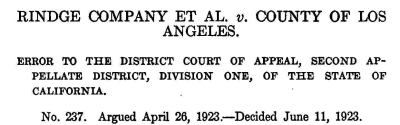
Continuing in our line of posts noting milestones in dirt law, we bring you Rindge Co. v. County of Los Angeles, 262 U.S. 700 (1923), decided 100 years ago today.

For any of you who have driven the Pacific Coast Highway through Malibu, you will know the site of this eminent domain case. As described by the Supreme Court in its opinion:

The plaintiffs in error are the owners of a large tract of land lying on the shore of the Pacific Ocean, known as the Malibu Ranch, extending in an easterly and westerly direction about twenty-two miles and varying in width from one-half mile to one and one-half miles. It lies at the base of a high and rugged mountain range which parallels the shore at a distance of from three to four miles, its northern line extending along the slope and foothills of this mountain
Continue Reading Has Not Aged Well – SCOTUS, June 11, 1923: “The necessity for appropriating private property for public use is not a judicial question.”

PXL_20230414_184043420
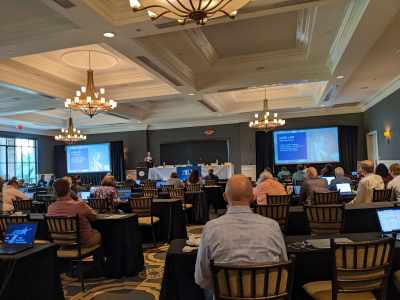
Good crowd.

Here are the cases and other materials we spoke about on Friday at the 22d Annual Texas Eminent Domain Conference, in Austin. A big thank you to the Planning Chairs and to our friends at CLE International for the speaking invite.

The other cases discussed are in your materials!

PXL_20230415_011347576
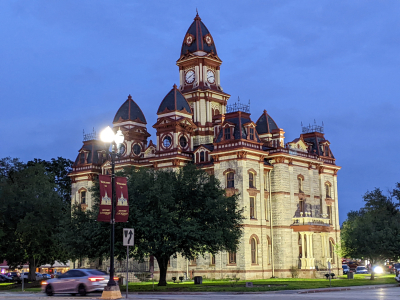
The nearby Caldwell County Courthouse. A classic.

PXL_20230414_190735641
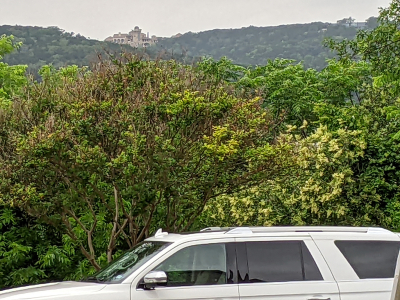
Why did no one tell me that Jabba’s Palace is in Austin?Continue Reading Links And Materials From The 22d Annual Texas Eminent Domain Conference

LUI

Here are the opinions that we spoke about this afternoon at the Land Use Institute on “The Use of Eminent Domain for Redevelopment & Economic Development Projects.”

Thanks for joining in.Continue Reading Cases And Links From Today’s Land Use Institute Session: “The Use of Eminent Domain for Redevelopment & Economic Development Projects”

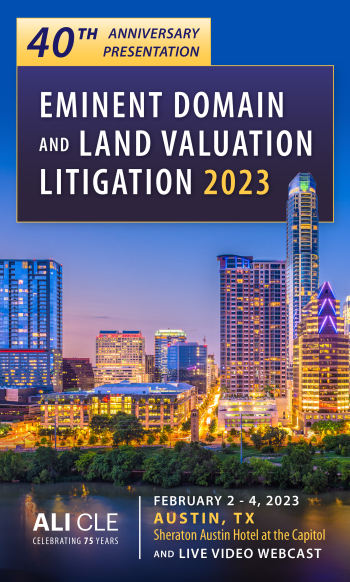
40th ALI-CLE

We were eagerly anticipating 40th American Law Institute-CLE Eminent Domain and Land Valuation Litigation Conference. The 2022 Conference in Scottsdale was one of the first meetings where everyone was back in-person (and was a smashing success), but that conference was early in the game so not everyone could or would attend. But in the past year most of us got back to some semblance of “normal,” and the turnout promised to be good.

We had record registrations: with over 300 attendees, faculty, and staff signed up, things were shaping up.

Plus, we were headed to Austin, Texas. The last time we held the Conference there in 2016, we loved it so much it has been in-demand for a return visit. And this year is the debut Conference for some new planning co-chairs for both the main tracks as well as the “Condemnation 101” tracks, so the buzz for the

Continue Reading Ice Ice Baby: A Report From The 40th ALI-CLE Eminent Domain & Land Valuation Litigation Conference, Feb 1-4, 2023, Austin

Thanks to a colleague giving us a heads-up, we’re starting 2023 with a neat case.

In Ohio Power Co. v. Burns, No. 2021-1168 (Dec. 29, 2022), the Ohio Supreme Court declined to apply a statutory presumption of necessity to the power company’s efforts to use eminent domain to expand the scope of several existing utility easements to upgrade electric transmission lines. Although the case turned on the interpretation of the term “appropriation” in the Ohio statute, it has some lessons for those of us not in the Buckeye State.

In the absence of three statutory presumptions that a taking is necessary, the general rule in Ohio is that the condemnor bears the burden of proving necessity by a preponderance of the evidence. Here, “[t]he landowners opposed the easements in general, alleging that the appropriations were overly broad and unnecessary, and they challenged the need for several of the easement

Continue Reading Ohio: Necessity Is Judged By The Property Taken, Not The Overall Project

Check this out, a decision upholding a necessity challenge to a taking.

Necessity, you say? What’s this? Aren’t necessity challenges subject to an even more deferential judicial standard of review than the rational basis test applied to declarations of public use? Didn’t the U.S. Supreme Court in Adirondack Ry. Co. v. New York, 176 U.S. 335, 349 (1900) say that “[t]he general rule is that the necessity or expediency of appropriating particular property for public use is not a matter of judicial cognizance but one for the determination of the legislative branch of the government….”? What gives?

In Lafayette City-Parish Consolidated Gov’t v. Bendel, No. 22-0432 (Dec. 23, 2022), the local government brought an expropriation action (that’s eminent domain or condemnation to you non-Louisiana chappies), seeking to take property to construct four detention pods to improve drainage. The owner objected, challenging the public use and necessity of the

Continue Reading No Necessity: Landowner Met Burden – Condemnor Did Not Consider Other Sites

Here’s the latest in a case we’ve been following.

In this cert petition, business owners on the losing end of a Co-19 shutdown order assert that the Sixth Circuit got it wrong when it concluded that the “overriding public purpose” of the shutdown orders should be given what amounts to dispositive weight under the “character of the government action” Penn Central factor.

The Sixth Circuit correctly (in our view) rejected the district court’s rationale that the takings claim could be rejected simply because “the state acts pursuant to its police powers to protect public health.” Slip op. at 15. But the Sixth Circuit didn’t stop there, and affirmed the dismissal because the “character” of responding to the Co-19 emergency was so overwhelming that it outweighed the other two factors (which the court had already concluded “weigh in favor of the Plaintiffs”).

As we explained in an article on

Continue Reading New Cert Petition: There Must Be A Real Emergency Before Commandeerings Are Exempt From Compensation

Here it is, the official agenda and program for the 40th ALI-CLE Eminent Domain & Land Valuation Litigation Conference, February 2-4, 2023 (with a special event the evening of Wednesday, February 1, 2023 to entice you to arrive early).

Screenshot 2022-11-18 at 13-35-13 ALI CLE PA NY VA TX FL Continuing Legal Education

Here’s the brochure with the complete agenda, schedule, and faculty listing. But to tempt you, here are some of the highlights of the program:

  • Everything Old is New Again: Why Today’s Practitioners Need to Understand the Original Meaning of the Takings and Just Compensation Clauses
  • Private Utility Takeovers – Lessons From a 67 Day Trial

  • Valuation Issues When Billboards and Signs are Condemned

  • Setting Client Expectations and Identifying Red Flags

  • Developing Property Right Issues in Texas – Questions and Answers from the Bench: A View From the Bench (with Texas Supreme Court Justice Jimmy Blacklock)

  • Eminent Domain and Regulatory Takings Updates: Important Decisions You Need to Know

  • Ethics:


Continue Reading Here’s The Program For The 40th ALI-CLE Eminent Domain & Land Valuation Litigation Conference, Feb 1-4, 2023, Austin

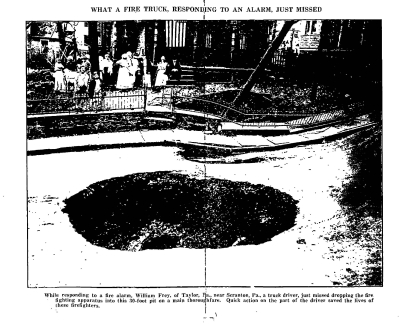
Just missed

Yes, the granddaddy of all SCOTUS regulatory takings cases, from which we got such phrases as these was argued 100 years ago this day.

  • The general rule, at least, is that, while property may be regulated to a certain extent, if regulation goes too far, it will be recognized as a taking.”
  • Government hardly could go on if, to some extent, values incident to property could not be diminished without paying for every such change in the general law.
  • “We are in danger of forgetting that a strong public desire to improve the public condition is not enough to warrant achieving the desire by a shorter cut than the constitutional way of paying for the change.”
  • “As long recognized, some values are enjoyed under an implied limitation, and must yield to the police power. But obviously the implied limitation must have its limits, or the contract and


Continue Reading It Was A Hundred Years Ago Today … Happy Argument Birthday, Pennsylvania Coal v. Mahon

Been meaning to post this one for a while.

The plaintiff in Northwest Landowners Ass’n v. North Dakota, No. 20210148 (Aug. 4, 2022), challenged North Dakota’s adoption of a statute about “pore space,” which is “a cavity or void, whether natural or artificially created, in a subsurface sedimentary stratum.” Whoa.

The problematic part of the statute “allows an oil and gas operator to use subsurface port space and denies the surface owner the right to exclude others or to demand compensation for this subsurface use.” Slip op. at 2. The statute also amended the definition of “land” to exclude pore space, and barred tort claims for injection or migration of substances into pore space. Frack!

The Association sued, asserting that the statute effected a facial taking because “it strips landowner of their right to possess and use the pore space within their lands and allows the State

Continue Reading Shades Of Mahon From North Dakota: Fracking Statute “constitutes a per se taking”