On the surface, the U.S. Court of Appeals for the Ninth Circuit’s opinion in Stavrianoudakis v. U.S. Fish & Wildlife Svc., No. 22-16788 (July 25, 2024) is about Article III standing (a highly technical gateway issue that is very federal courts wonky).

But taking a deeper look offers an insight into ways other than the usual Fifth Amendment arguments for protecting property rights. [Before we go on, a disclosure: this is one of our cases, argued and won by PLF colleague Daniel Woislaw].

This is a case involving the sport of falconry. Can’t say that we knew too much about that — until maybe the occasional movie — until this case. First (and this may not come as a surprise to you who have been observing what things the government finds worthy of regulations and licensing), did you know that every state government except Hawaii has
Continue Reading CA9: Unannounced Inspections As Condition Of Falconry License Are Subject To Nollan/Dolan Challenge

We suggest those of you interested in takings ripeness — here, the so-called “final decision” requirement — take a quick gander at the Texas Court of Appeals’ opinion in City of Buda v. N.M. Edificios, LLC, No. 07-23-00427-CV (July 2, 2024).

We won’t go into the details, except to say that a property owner developing its land entered into an agreement with the city, under which the owner would grant a drainage easement to the city to alleviate citywide flooding, while the city was obligated to construct drainage improvements. When the owner submitted a plan, the city instructed it to “provide additional drainage improvements on the property.” Slip op. at 2. Not so fast, said the owner: the city, not me, is on the hook for these additional improvements. If you condition approval of my development plans on me providing more drainage stuff, that’s a taking (what the

Continue Reading Final Decision Takings Ripeness Is Based On All Circumstances, Not Hard-And-Fast Requirements (Read That Again: A Factual Question)

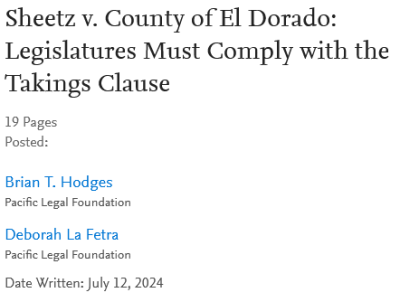
Screenshot 2024-07-14 at 09-00-18 Sheetz v. County of El Dorado Legislatures Must Comply with the Takings Clause by Brian T. Hodges Deborah La Fetra SSRN

Check this out: our Pacific Legal Foundation colleagues (Brian Hodges and Deborah La Fetra we on our Sheetz SCOTUS team), have posted a new scholarly piece on SSRN, “Sheetz v. County of El Dorado: Legislatures Must Comply with the Takings Clause.”

Here’s the Abstract:

For more than 30 years, the Supreme Court has recognized that building permit conditions requiring a dedication of property to the public implicate the Fifth Amendment’s Takings Clause and are therefore subject to the unconstitutional conditions doctrine as set out by Nollan v. California Coastal Commission, 483 U.S. 825 (1987), and Dolan v. City of Tigard, 512 U.S. 374 (1994). But for nearly as long as the Nollan/Dolan doctrine has been in place, state and lower federal courts have divided on the foundational question of whether the doctrine applies equally to all branches of government, or if it applies only to administrative

Continue Reading New Article – “Sheetz v. County of El Dorado: Legislatures Must Comply with the Takings Clause” (Brian Hodges & Deb La Fetra)

A short one (for us takings types) from the Hawaii Supreme Court.

In In re Surface Water Use Permit Applications, No. SCOT-21-0000581 (June 20, 2024), the court considered a challenge to the State of Hawaii Commission on Water Resource Management’s authority to impose conditions on a water permit. The applicant asserted that the nexus and proportionality requirements of Nollan and Dolan must have been complied with.

No, the court concluded, those standards only apply where there’s a takings claim present. And there’s no takings claims here:

WWC relies on Nollan v. California Coastal Commission, 483 U.S. 825 (1987), and Dolan v. City of Tigard, 512 U.S. 374 (1994), to argue that any conditions the Commission attaches to its SWUP for system losses must relate to those losses. WWC attempts to frame Nollan and Dolan as providing a “clear statement of the unconstitutional conditions doctrine,” but fails to

Continue Reading Hawaii: Permit Conditions Not Subject To Nollan/Dolan When There’s No Taking Claim

DJK was adding a bedroom to an existing residence and needed a wastewater permit from Vermont’s environmental agency. The agency has a “presumptive isolation zone” around potable water supplies and septic systems in which a property owner is presumed to be barred from doing anything sewage related. In this case, the isolation zone for DJK’s property crossed over onto the property of their neighbors, the Crowleys.

The agency granted DJK the permit, which contained a provision that not only no sewage-related construction could take place in the isolation zone, but that “[n]o buildings” could be construction which “might interfere with the operation of a wastewater system or potable water supply[.]” Remember, the isolation zone was located partially on the Crowley property.

The Crowleys were not very appreciative, so appealed (to a Vermont trial court sitting as the Environmental court). They argued that the permit was invalid because it worked a

Continue Reading Vermont: Environmental Court Doesn’t Have Jurisdiction To Determine Property Rights, But We’re Going To Find No Cedar Point Taking Anyway

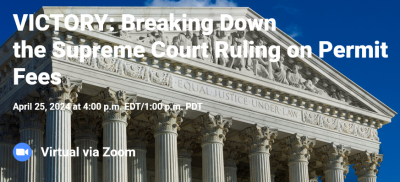
Screenshot 2024-04-24 at 10-12-17 VICTORY Breaking Down the Supreme Court Ruling on Permit Fees

Be sure to join our Pacific Legal Foundation colleagues Brian Hodges and Larry Salzman, and Paul Beard (arguing counsel) and Chance Weldon (Texas Public Policy Foundation) tomorrow, Thursday, April 25, 2024, at 4pm ET for a free webinar on Sheetz v. El Dorado County, the Supreme Court’s recent decision holding that all permit conditions are subject to the nexus and proportionality tests of Nollan and Dolan.

Here’s the description:

Pacific Legal Foundation just won its 18th Supreme Court victory! Join us for a virtual discussion to learn more about the case, Sheetz v. County of El Dorado, and how it helps secure property rights (and lower housing costs) for everyone. 

When George Sheetz wanted to build a modest manufactured home on the property he bought in El Dorado Country, California, the government told him he was going to have to pay a “traffic impact fee” of more than


Continue Reading “Breaking Down the Supreme Court Ruling on Permit Fees” (Thursday, Apr. 25, 2024, 4pm ET/1pm PT)

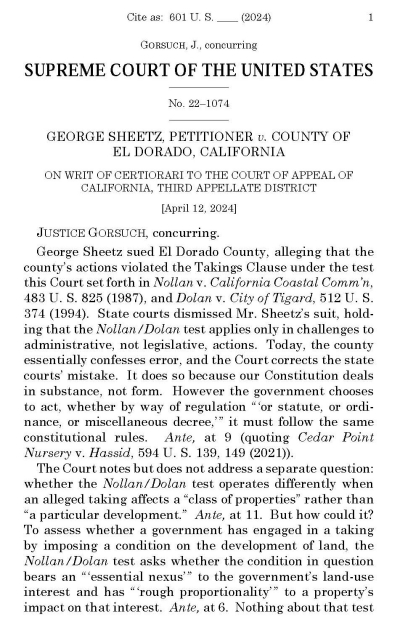
Gorsuch concurring

Note: this is the second of our posts on the recent Supreme Court opinions in Sheetz v. County of El Dorado, the case in which the unanimous Court held that exactions imposed by legislation are not exempt from the essential nexus (Nollan) and rough proportionality (Dolan) standards. Here’s our first post, which covers the case and the main opinion (“Sheetz pt. I – ‘Radical Agreement’ At SCOTUS: ‘Your Money Or Your Rights’ Isn’t OK Just Because A Legislature Does It“).

[Disclosure: this case is one of ours.]

In this post, we cover the three very short concurring opinions.

* * * *

The Court took no position on whether the County’s traffic impact fee has an essential nexus to the Sheetz development, or whether $23 grand is roughly proportional to any traffic his proposal might be responsible for. For this and more

Continue Reading Sheetz pt. II: The Concurrences – Does Nollan/Dolan Operate Differently When Exaction Affects A Class?

PXL_20231101_125417762.PORTRAIT (Small)
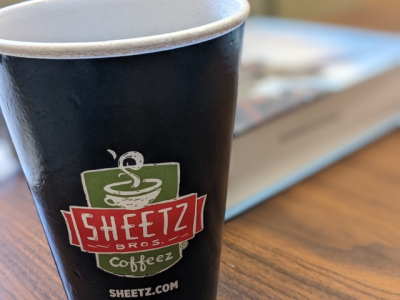
Guess where we stopped for coffee this morning?
(A reminder: this case has nothing to do
with the convenience store.)

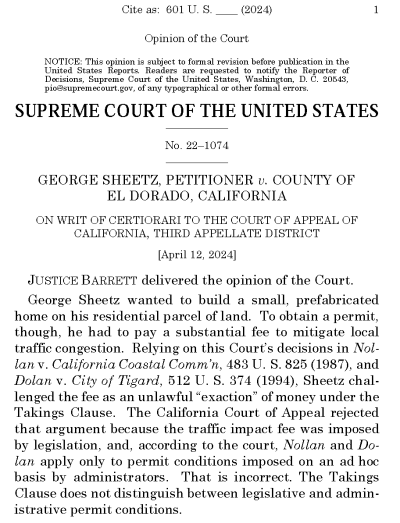
Note: this is the first of two posts on the recent Supreme Court opinions in Sheetz v. County of El Dorado, the case in which the unanimous Court held that exactions imposed by legislation are not exempt from the essential nexus (Nollan) and rough proportionality (Dolan) standards. Here’s the second post, which covers the concurring opinions.

[Disclosure: this case is one of ours.]

In this post, we cover the background, and the Court’s unanimous opinion.

* * * *

Does the government have the unfettered ability to demand “the goodies” (as one municipality’s chief land use planner famously called them in the 1980s), simply because a property owner needs the government’s approval to make use if his or her land?

That’s the

Continue Reading Sheetz pt. I – “Radical Agreement” At SCOTUS: “Your Money Or Your Rights” Isn’t OK Just Because A Legislature Does It

Here’s what folks are saying about yesterday’s unanimous U.S. Supreme Court decision in Sheetz v. County of El Dorado, where the Court held that impact fees and exactions imposed by legislative action are not categorically immune from the close nexus and rough proportionality requirements already applicable to ad hoc/administratively-imposed exactions under Nollan, Dolan, and Koontz.


Continue Reading Sheetz Round-Up

Sheetz

This just in: the U.S. Supreme Court has issued a unanimous opinion in Sheetz v. County of El Dorado, a case we’ve been following (not only because it is one of ours).

The Court, as predicted, held that an exaction (in this case a traffic impact fee) isn’t immune from the Nollan/Dolan nexus and rough proportionality requirements merely because the exaction is imposed by legislation.

At heart, this is a very pro-YIMBY decision because it gives property owners and housing builders a path to object to barriers to creating housing and the government’s use of the land use approval process as a way of exacting “goodies” that increase housing costs.

While we digest the opinion and the multiple concurring opinions — we shall post more once we do so — you can either read the opinions themselves, or see what we thought after the oral arguments. Or

Continue Reading Unanimous SCOTUS Delivers A YIMBY Blow: “The Takings Clause does not distinguish between legislative and administrative permit conditions.”