Here’s what we’re reading today:


Continue Reading Thursday Round Up: Pretextual Takings, Squatting, Unconstitutional Conditions
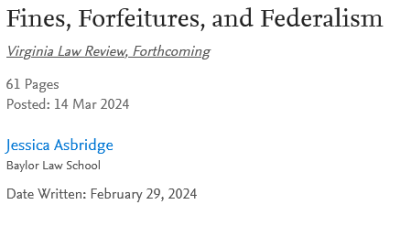
Screenshot 2024-03-14 at 19-30-43 Fines Forfeitures and Federalism

When it comes to property rights, we’re most often focused on takings, compensation, and due process. But as you all know, the concept of property rights encompasses a whole lot more.

Our colleague, lawprof Jessica Asbridge, has posted on SSRN an article that is forthcoming in the Virginia Law Review, “Fines, Forfeitures, and Federalism,” in which she delves into the question of how the Excessive Fines Clause applies to state and local forfeitures and fines. To resolve the federalism concerns she identifies, the article argues that courts “should look to the exactions doctrine under the Takings Clause.”

Count us as intrigued.

Here’s the Abstract:

Fines are ubiquitous in modern society, and they are imposed for both serious crimes and minor civil wrongs. The U.S. Supreme Court recently recognized that the Constitution’s Excessive Fines Clause applies to the states, but that decision raises previously unexplored questions as to how to enforce the Clause’s protections in the states. A key question is what role, if any, federalism should play in crafting doctrinal rules that apply the Clause’s protections to state and local fines and related property forfeitures. This Article is the first to accord in-depth treatment to that important question.

The extent to which federalism principles should apply does not have an immediate and obvious answer. On the one hand, federalism plays a significant role in the Court’s jurisprudence on the Cruel and Unusual Punishment Clause. The Court therefore generally takes a highly deferential approach in reviewing sentences of imprisonment. Lower courts have applied that same deferential review in the context of the Excessive Fines Clause. On the other hand, fines and forfeitures are unlike other forms of punishment—such as prison—because they are often used as a revenue source for state and local governments, creating a conflict of interest for state and local decision-making bodies.

To address this conundrum, this Article makes the novel argument that the Court should look to the exactions doctrine under the Takings Clause, which often implicates similar concerns of government self-interest and overreaching. Exactions and excessive fines are conceptually similar, but scholars thus far have overlooked the close relationship between them. The exactions doctrine gives minimal weight to federalism concerns, and it applies a heightened-scrutiny standard that is well suited to the excessive fines context. Indeed, differences between federal practice and state and local practices as to fines suggest that discretionary state and local fines should be subject to closer constitutional scrutiny than federal fines. As a recent example illustrates, such heightened scrutiny would ensure that the Excessive Fines Clause is not merely a parchment barrier, while still accounting for variations between states and localities in terms of their communities’ values and needs.

Check it out. Download your copy on SSRN here.
Continue Reading New Article: “Fines, Forfeitures, and Federalism” (Jessica Asbridge)

In Rhone v. City of Texas City, No. 22-40551 (Feb. 14, 2024), the U.S. Court of Appeals for the Fifth Circuit held that a municipality’s conclusion that Rhone’s apartment building had not been properly maintained, and a subsequent municipal court demolition order, might be a taking … or it might not be.

We won’t get too far into the facts, except to say that Rhone argued that the city had it out for him, and that the municipal court judge who issued the demolition order was in a contractual relationship with the city by which the judge had to submit for approval all of the court’s decisions to the city attorney (the very party pressing the nuisance claims against Rhone). Weird, but apparently a product of Texas law. Short story, according tot the court: “[a]ll of this, facially at least, is a declaration of a lack of independence of

Continue Reading Too Soon For CA5 To Figure Out Whether City Demolishing Property For Code Violations Is A Taking

ALI-CLE brochure cover page

When it comes to the longstanding ALI-CLE American Law Institute-CLE Eminent Domain and Land Valuation Litigation Conferences, we’re always ready to go. You know that. But this year’s version — the 41st — was buzzing like no other in recent memory.

Maybe it was the New Orleans venue with its atmo, food, and music for our after-class activities, or even the timing (the second-to-last week on the Mardi Gras parade season, and our conference hotel was right on the routes). It might have been the nice weather (oh, it rained buckets one evening, but there wasn’t an ice storm like we experienced in Austin in 2023). Or maybe it was the capacity crowd, and new topics and speakers on the agenda. Or maybe it was just the prospect of seeing our friends and colleagues again after a year.

Here’s a photo essay of some of the Conference highlights.

And

Continue Reading Pass A Good Time: Our Report From The 41st ALI-CLE Eminent Domain & Land Valuation Litigation Conference, Feb 1-3, 2024, New Orleans

Screenshot 2024-02-13 at 06-58-13 Professors' Corner - Legislative Exactions & Sheetz v. Co. of El Dorado

Join us at 12:30pm ET today, Tuesday, February 13, 2024, for the ABA’s Section of Real Property, Trust and Estates’ monthly Professor’s Corner, where we will join exactions experts Prof Tim Mulvaney, Andrew Gowder, and Prof Elizabeth Elia to discuss the Supreme Court arguments, the issues in the case, and what may be down the road.

Here’s the description:

Can legislative action constitute an exaction subject to the Nollan/Dolan/Koontz test? In his concurrence to the Supreme Court’s 2016 denial of certiorari in California BIA v. City of San Jose, Justice Thomas made clear that he was eager to examine this issue. Justice Thomas’s wait is over; the Supreme Court granted certiorari to address this very question during the 2024 session in the case Sheetz v. Co. of El Dorado. Our expert panel will discuss all sides of this extremely interesting case and its implication for takings jurisprudence.Continue Reading Today, 12:30pm ET: Professor’s Corner – Legislative Exactions & Sheetz v. County of El Dorado (ABA RPTE)

DSCF3357

If you dream such dreams as this photo, read on.

My law firm, Pacific Legal Foundation, is on the hunt for lawyer to join our Property Rights group (yours truly is the Director of Property Rights Litigation, so you will be working with me and the other takings and con law mavens in our practice). Here’s the full description of the spot:

You: An entrepreneurial freedom fighter with a passion for property rights litigation. You work with more senior-level attorneys to find and win cutting-edge property rights cases in trial and appellate across the country. You work as a part of a collaborative team, but are also self-motivated and able to work independently with minimal supervision. You are eager to learn, relentless, and a focused lawyer.

Them: Bureaucrats, city councils, mayors, governors, and federal agencies stripping Americans of their rights every day. There’s a lot of government overreach out there

Continue Reading Dig Property Rights? Join Our Firm As A Courtroom Property Rights Lawyer

Don’t miss out!

We promise: this is the last time we’re going to try to entice you to the upcoming ALI-CLE Eminent Domain & Land Valuation Litigation Conference in New Orleans. We are getting close to capacity, but there is still room. In recent years, we have standing room only in the Conference halls, and have sold out the hotel block. After all, this is a pretty niche area of law. So what gives?

When we were in Austin last year, we thought it might be nice to try and answer that question. We asked Conference participants why they come, year-after-year (and in Austin, despite massive travel disruptions). Yes, it is the various venues (Nashville, Austin, Scottsdale, Palm Springs, to name a few recent locations), and yes, it is the excellent and useful programming.

But as we suspected it is more than that.

Continue Reading No FOMO: There’s Still Room For You To Join Us In New Orleans Feb 1-3, 2024 For The 41st ALI-CLE Eminent Domain & Land Valuation Litigation Conference

Here is a collection of commentary on the oral arguments in Sheetz v. El Dorado County, heard by the Supreme Court earlier this week. (Our own thoughts here.)


Continue Reading Sheetz Argument Round-Up

DSCF3357

If you were looking for deep clarity from the Justices about land use law and whether a legislature imposing monetary conditions on property development always gets the free judicial pass of rational basis review in this morning’s oral arguments in Sheetz v. County of El Dorado, you may not discover a lot of predictive insight when you listen to the argument recording or read the transcript.

But it is definitely worth your time to listen or read. Yes, there were some head-scratching moments as several of the Justices struggled with how to differentiate between monetary land use exactions that are subject to the nexus and rough proportionality standards, and other government requirements to pay money such as user fees, tolls, and property taxes that presumably are exempt. But there were also moments of clarity. Important moments.

In other words, there’s gold in them thar transcript hills if you

Continue Reading Today’s Arguments In Sheetz v. El Dorado County: “[R]adical [A]greement” On The Key Issue