


Sheetz

Get ready for Sheetz v. El Dorado County, No. 22-1074, the “legislative exactions” case at the Supreme Court. [Disclosure: this is one of our firm’s cases, so we won’t be doing an analysis here. Besides, you already know where we stand on the issue.]

With the final merits brief filed last week (Petitioner’s Reply), the case is now teed up for argument next week. Wow, that seemed to come at us very quickly.

Screenshot 2024-01-01 at 15-41-45 Search - Supreme Court of the United States

Here’s the Question Presented:

George Sheetz applied, to the County of El Dorado, California, for a permit to build a modest manufactured house on his property. Pursuant to legislation enacted by the County, and as the condition of obtaining the permit, Mr. Sheetz was required to pay a monetary exaction of $23,420 to help finance unrelated road improvements. The County demanded payment in spite of the fact that it made no individualized determination

Continue Reading Sheetz v. El Dorado County Argument Preview: Do Blanket Exactions Present The Same Risk As Ad Hoc Exactions?

Here are the cases that Michael Berger and I discussed in today’s presentation to the ABA State and Local Government Law Section’s Land Use group. It was good seeing everyone, even virtually:


Continue Reading Cases And Links From Today’s ABA State & Local Govt Law Land Use Presentation

Here’s the merits brief in a case we’ve been following (naturally, because it is one of ours). This is Sheetz v. El Dorado County, the case which asks whether a condition on development (aka an “exaction”) is exempt from the close nexus and rough proportionality standards of Nollan/Dolan/Koontz simply because the exaction is imposed on every owner who asks for permission to use its property, and not via an ad hoc administrative permit procedure.

Because this is one of ours, we’re not going to go into in further, but leave to you to read our brief:

In this Court’s key exactions precedents—Nollan, Dolan, and Koontz—it held that when government exacts money or real property as a condition on the right to use or develop land, it must establish that the exaction bears an “essential nexus” and “rough proportionality” to an adverse public impact caused by the owner’s proposed

Continue Reading Legislative Exactions Merits Brief (Ours): “the text and history of the Takings Clause admit no exception for legislative takings”

ALI-CLE brochure cover page

Here’s the brochure and the full agenda and registration information for the upcoming ALI-CLE Eminent Domain and Land Valuation Litigation Conference at the JW Marriott in New Orleans, February 1-3, 2024.

This is the long-running nationally-focused conference on all things eminent domain, takings, valuation, and related. We have three tracks, from which you can choose a la carte – Practice, Substantive, and Condemnation 101:

For over 40 years, we’ve been bringing eminent domain practitioners together to examine the latest issues, engage in healthy debate, and get the information they need to stay current in their practice. This year – our 41st – is THE perfect time to reunite with your eminent domain colleagues. There will be plentiful opportunities to meet and mingle with the faculty and other registrants – throughout the conference and at evening social events. Attendees come back year after year to make new friendships and renew

Continue Reading Here’s The Program For The 41st ALI-CLE Eminent Domain And Land Valuation Litigation Conference, Feb 1-3, 2024, New Orleans

Here’s what we’re reading about the Supreme Court’s property rights docket — some good, some disappointing — this day.

  • Niina Farah, “Supreme Court flooding case could ripple across the energy sector (E & E News / Energywire) – About the Devillier case (which we summarized here), in which we were quoted: “The Supreme Court decision to hear the Devillier case comes after a concerted effort in recent years to convince the court to address procedural maneuvers that have made it challenging for property owners to bring their claims to court, said Robert Thomas, director of property rights litigation at the Pacific Legal Foundation. The nonprofit is among the groups that has asked the court to address takings cases and has lent its support for the property owners in Devillier in a ‘friend of the court‘ brief. ‘There’s a lot of gamesmanship going on


Continue Reading Supreme Court Property Rights Round-Up

092923zr_q8l1_Page_1
I’ll take ‘Words I Like to See’ for $800, Alex.

In this Order, the U.S. Supreme Court agreed to hear two important property rights cases (are there any other kind?). Both are cases we’ve been following — and indeed are now playing a part in.

The first is detailed in this post.

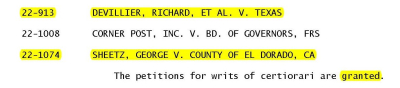
In the second, Sheetz v. El Dorado County, the Court is finally getting to the long-unresolved question of whether an exaction or permit condition is exempt from the usual requirements of “logical nexus” and “rough proportionality” simply because the condition is imposed uniformly by legislation, and not ad hoc via an administrative or other permit decision.

We commented on the Sheetz case in this post (“Whether $23K Traffic Fee Is Proportional To One Single-Family Home Is Beyond The Ken Of Judges“) and won’t repeat the facts or comments here.

But here’s

Continue Reading Cert Grant #2 – SCOTUS (Finally!) To Resolve Whether Legislative Exactions Are Subject To Nollan-Dolan-Koontz Nexus And Rough Proportionality

Why is it, you ask, that the ALI-CLE Eminent Domain & Land Valuation Litigation Conference (scheduled next February 1-3, 2024, in New Orleans) is an event that seems to be growing in popularity and attendance. In recent years, we have standing room only in the Conference halls, and have sold out the hotel block. After all, this is a pretty niche area of law. So what gives?

When we were in Austin earlier this year, we thought it might be nice to try and answer that question. We asked Conference participants why they come, year-after-year (and in Austin, despite massive travel disruptions). Yes, it is the various venues (Nashville, Austin, Scottsdale, Palm Springs, to name a few recent locations), and yes, it is the excellent and useful programming.

But as we suspected it is more than that. As the above video notes

Continue Reading ALI-CLE’s Eminent Domain & Land Valuation Litigation Conference (Feb 1-3, 2024, New Orleans): Why Attend? Here’s Why.

The buried lede in the U.S. Court of Appeals for the D.C. Circuit’s opinion in Valancourt Books, LLC v. Garland, No. 21-5205 (Aug. 29, 2023) is that the government doesn’t have that big of a role in copyrights, at least in the bare minimum of copyright protections.

We’re no copyright experts (that’s an understatement), but we knew the basics here: in order to have a copyright and all the rights that entails, the owner need do nothing more than fix the work in a tangible medium. No formalities are necessary, including publication. As the court put it, “[c]opyright thus accrues automatically upon creation of an original work in a tangible medium, and creators need not take any further action such as publication or registration to gain the protection.” Slip op. at 4.

You may register your copyright to obtain certain other benefits — for example, registration is prima facie

Continue Reading DC Circuit: US Copyright Office’s Requirement To Turn Over Copies Is A Taking

The city told an owner whose three parcels were outside of the city’s jurisdiction that if it wanted the city’s permission to replat into 74 parcels, it would need city water and sewer service to each of the proposed lots.

So the owner asked to connect to the city’s water and sewer system (deliberately overbuilt to account for future users, apparently), and in response, the city told the developer that it would have to do two things. First, it would have to contribute to the cost of building the system by purchasing water/sewer chits (our term). When the system was built, the city anticipated future connections and created a chit system by which future connections would help pay for the cost of construction. Second, in order to purchase these chits, the buyer’s property must be included within the city’s jurisdiction. And that meant a voluntary annexation. Annexation does not come

Continue Reading Tex App: Nollan/Dolan Challenge To Annexation Fees Not Ripe: You Have To Apply For Annexation To Find Out What The Fee Will Be

We’re not going to dwell all that much on the California Court of Appeal’s recent opinion in Discovery Builders, Inc. v. City of Oakland, No. A164315 (June 22, 2023), mostly because it seems entirely predictable.

The developer thought it had an agreement with the city to pay certain fees (dare we say “exactions”) the city required in order to approve and provide what the court calls “project oversight.” The contract “provided that the fees set forth in the agreement satisfied ‘all of the Developer’s obligations for fees due to the City for the Project.'” Slip op. at 1. You know where this is headed, don’t you?

That’s right, eleven years later while the project was still underway, the city adopted new ordinances imposing new impact fees. When the developer sought additional building permits … no permit without paying the additional exactions. The trial court thought the contract took care

Continue Reading Chump Alert! Developer’s Claim That City Can Be Held To Its Contract Limiting Exactions Goes About As Well As You’d Expect