Check out this recently-filed cert petition, which asks the Court to review a California Court of Appeal decision about exactions.

It’s a somewhat odd situation: the county issued a building permit, but conditioned it (yes, the county tried to put a condition in a ministerial building permit!) on the property owners recording a deed restriction that they will forever preserve the natural vegetation on a portion of the lot. “Visually important ridgelines” and all that.

Land use types will immediately understand our puzzlement. Building permits are the classic ministerial (“shall issue”) development permits. Meaning that the issuing official has no discretion to deny a permit if the applicant meets the straightforward requirements of the building code, and certainly doesn’t have the authority to grant a permit with conditions. That’s way outside the building department’s authority, and the applicant should be able to get a court to issue a

Continue Reading New Cert Petition: Building Permit That Comes With Requirement To Preserve Plants Is An “Exaction”

All the topics you want to know about, presented by top-notch faculty from across the nation. Sessions include:

  • Property Rights as Civil Rights
  • Eminent Domain National Update
  • Just Relocation: Understanding the Law and Regulations to Ensure Fairness
  • Challenging Public Use: Lessons From a 67-Day Trial
  • COVID Takings
  • Federal Court and the Daubert Challenge: How to Prepare
  • Did the Supreme Court Signal a New Direction in Property Rights in Cedar Point Nursery?
  • How to Position Your Client for the Fallout When Projects Don’t Get Built
  • Rural Broadband and the Emerging Constitutional Challenges
  • Are Precondemnation Entry Statutes Still Valid After Cedar Point Nursery?
  • How Condemnor and Property Owners’ Counsel Prepare the Battlefield
  • How Will the Trillion Dollar Infrastructure Bill Impact Your Practice?
  • Ethics
  • …and more, including a full slate of networking and social events!

We’ve sold out the last few years, so don’t miss out. Room block now taking reservations. Continue Reading Join Us For The 39th Annual ALI-CLE Eminent Domain & Land Valuation Litigation Conference, Jan 26-29, 2022 (Scottsdale, AZ)

In this post — the fifth and penultimate post in a series of deeper dives that we’re posting about June’s U.S. Supreme Court opinion in Cedar Point Nursery v. Hassid, No. 20-107 (June 23, 2021) — we’ll be trying to take some educated guesses about what the decision means for the future.

Here are all of the posts in our Cedar Point series:

And in case you missed the live webcast on Friday, July 16, 2021 that featured expert analysis of the case, please don’t miss listening to the recording of ALI-CLE’s “Takings and Eminent Domain After Cedar Point: What

Continue Reading Cedar Point Part V: Help Us Help You

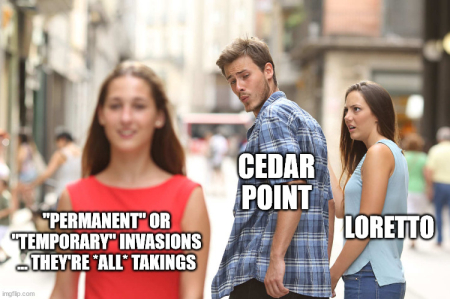
Permanentortemporary

In this post — the fourth in a series of deeper dives that we’re posting about June’s U.S. Supreme Court opinion in Cedar Point Nursery v. Hassid, No. 20-107 (June 23, 2021) — we’ll be discussing the two separate opinions, Justice Kavanaugh’s concurrence, and the Justice Breyer-authored dissent.

Here are all of the posts in our Cedar Point series:

And in case you missed the live webcast on Friday, July 16, 2021 that featured expert analysis of the case, please don’t miss listening to the recording of ALI-CLE’s “Takings and Eminent Domain After Cedar Point: What Practitioners Need to Know

Continue Reading Cedar Point Part IV: The Other Opinions

Our thanks to our friends and colleagues at the ABA Section of Real Property, Probate & Trust Section’s Land Use and Environmental Group for inviting us to a discussion of the latest and greatest decisions of interest.

We only had an hour together, so naturally could not cover everything of interest (indeed, we reserved a big discussion of the biggest item, the Supreme Court’s decision in Cedar Point, assuming that the Group will schedule a full session on that decision alone). So here is our curated list of what we think are the most interesting recent decisions in areas of interest to the Group:


Continue Reading Links From Today’s ABA RPTE Session

In this post — the third in a series of deeper dives that we’ll be posting about last week’s U.S. Supreme Court opinion in Cedar Point Nursery v. Hassid, No. 20-107 (June 23, 2021) — we’ll be discussing whether the “right to exclude” is absolute, what exceptions the Court laid out, and how it responded to the arguments that the ruling will bring the system crashing down.

Here are all of the posts in our Cedar Point series:

And in case you missed the live webcast on Friday, July 16, 2021 that featured expert analysis of the case, please don’t miss

Continue Reading Cedar Point Part III: No, Chicken Little, The Sky Isn’t Falling

License_20131009164108_63618

Another day, another property rights decision from SCOTUS. This time, the unanimous per curiam opinion in a case we’ve been following, Pakdel v. City & County of San Francisco, No. 20-1212 (June 28, 2021).

[Disclosure: our PLF colleague Jeff McCoy is lead counsel on this case, and we pitched in with help on the petition and related.]

Because we’re directly involved in this one, we’re not going to take a deep dive analysis. But the opinion is short, and the result clear: grant, vacate, remand, with instructions:

On remand, the Ninth Circuit may give further consideration to these claims in light of our recent decision in Cedar Point Nursery v. Hassid, ante, p. ___.

Slip op. at 3, n.*.

The Pakdels sued San Francisco for a regulatory taking because of the city’s requirement that as a condition of converting a tenancy-in-common to a condominium, the owners must

Continue Reading Another SCOTUS Property Rights Win, This Time On Williamson County’s “Final Decision” Requirement

We’ve been meaning to post up the California Court of Appeal’s (now published) opinion in Alliance for Responsible Planning v. Taylor, No. C085712 (May 4, 2021) for a bit, and while we were distracted by lawyer work last week, our friend and colleague Bryan Wenter beat us to it with “County’s Initiative-Enacted General Plan Traffic Mitigation Policies Are Unconstitutional Exactions.”

So rather than do our own summary, we’re just going to recommend you read his analysis. Some high points of that and the opinion:

  • The court called the Nollan/Dolan/Koontz doctrine the “unconstitutional conditions doctrine.” Slip op. at 6. We like that. In our view, N/D/K really isn’t a takings doctrine so much as it is one that says the government can’t force you to choose among your rights (in these cases, one of those rights being your right to just compensation).
  • The N/D/K


Continue Reading Ordinance Requiring Developer Pay For “All Necessary Road Capacity Improvements” Violates Nollan/Dolan

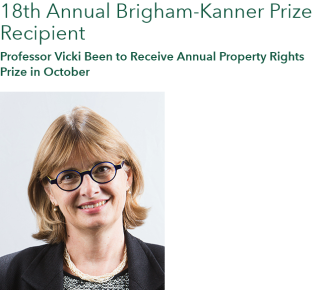
Screenshot_2021-05-15 18th Annual Brigham-Kanner Prize Recipient

Mark your calendars for September 30 – October 1, 2021, and join us at the William and Mary Law School in Williamsburg, Virginia for the 18th Annual Brigham-Kanner Property Rights Conference. It’s planned to be in-person, so when we mean “join us” we really mean join us.

This year the Conference will recognize the lifetime work of Professor Vicki Been (NYU Law) with the Brigham–Kanner Property Rights Prize. As noted in the Law School’s press release:

The Brigham-Kanner Property Rights Prize is named in honor of the lifetime contributions to property rights of Toby Prince Brigham, founding partner of Brigham Moore, LLP, and Gideon Kanner, professor of law emeritus at Loyola Law School in Los Angeles. Brigham died earlier this month in Miami. A true legend in the law, he was esteemed by colleagues for the invaluable counsel, knowledge and skills he possessed and shared so generously. The prize

Continue Reading Mark Your Calendars: 2021 Brigham-Kanner Property Rights Conference, Williamsburg, Virginia, Sept 30-Oct 1 (in-person)

You listened live. Or you missed that, and listened to the recording. Or, you preferred to review what others thought of the arguments. Now you can read it yourself.

Here’s the transcript of Monday’s oral arguments in Cedar Point Nursery v. Hassid, No. 20-107, the case in which the Supreme Court is considering whether California’s forbidding of agricultural property owners from keeping union organizers off their land is a taking.

Some highlights, in our opinion:

  • Several of the Justices wanted to know whether it was important that the property owners called the access required by the regulation an “easement,” even though it is not formally an easement (you know, the thing where the dominant and servient estate owners agree that one can use the land of another, that is recorded, that runs with the land, and the like. Lawprof Josh Blackman writes about that here (“


Continue Reading Read And Listen To The Oral Arguments In SCOTUS’ Latest Takings Case