In City of Baytown v. Schrock, No. 20-0309 (May 13, 2022), the Texas Supreme Court held that it isn’t a taking when a city, in violation of state law, cuts off utility services to property.

The issue, as the court restated it, was “whether a claim of economic harm to property resulting from the improper enforcement of a municipal collection ordinance alleges a regulatory taking.” Slip op. at 6. Schrock owned property in Baytown on which he had a mobile home he planned to rent. The water bill wasn’t paid, and Baytown has an ordinance that requires property owners to guarantee utility payments, or file a statement that the owner would not guarantee these payments. Schrock didn’t file a disavowal statement until after had already assessed him nearly two grand for unpaid water bills. Slip op. at 3. 

He didn’t pay, so when one one of Schrock’s prospective tenants
Continue Reading Texas: City Illegally Cutting Off Utilities Isn’t A Taking – It Needs To Be Regulating “Land Use”

Screenshot 2022-05-02 at 11-51-57 Display event - 2022 Hawaii Land Use Law Conference (LIVE)

It’s back! After a hiatus on the in-person program, the bi-annual Hawaii Land Use Conference is back in-person (see here for a sample of one of our prior presentations at this conference).

May 25 and 26, 2022, downtown Honolulu.

The full agenda and speaker list has not yet been published, but here’s a summary of the program:

Sponsored by the Hawaii State Bar Association and the Real Property and Financial Services Section. Coordinated by David Callies and Benjamin Kudo, his 2-day conference is a must attend for any attorney or professional whose practice involves land use and development. Distinguished land-use practitioners, scholars, planners, and regulators from Hawaii and the Mainland will discuss timely and relevant issues, including:

• Takings 

• Transit Oriented Development (TOD) 

• Seawalls and Shoreline Access 

• Climate Change 

• Affordable/Workforce Housing 

• Ethical Considerations for Real Property Practitioners and Other Professionals

We’ll be speaking during

Continue Reading Hawaii Land Use Law Conference, May 25-26, 2022, Honolulu – Join Us!

PXL_20220422_171653637

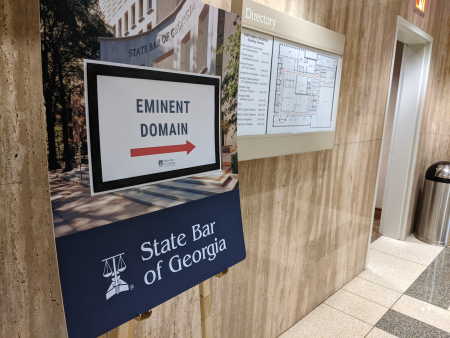
Here are the links to the cases and other materials that we talked about last Friday at the Georgia Bar Association’s annual Eminent Domain Conference. Our talk was entitled “It’s the Chief Justice’s Property World, We Just Live In It: National Trends in Takings, Property, & Eminent Domain,” and was part of the Eminent Domain Section’s (yes, the Georgia Bar has a Section entirely devoted to eminent domain!) annual conference on the topic. I was honored to have been asked to chat with this august and expert group of lawyers.


Continue Reading Links From Last Week’s Georgia Bar Association Eminent Domain Conference

Another takings challenge to a Co-19 shutdown, another “no taking” result.

This time, it is from the Florida District Court of Appeal (Fifth District). In Orlando Bar Group, LLC v. Desantis, No.5D21-1248 (Apr. 8, 2022), the court affirmed dismissal of takings challenges to the governor’s emergency order that barred certain alcohol sales, and limited the service in bars. Orlando-area bar owners sued for inverse condemnation.

The Fifth District concluded that this did not result in a taking. First, the court held that it would not apply a categorical physical rule, because Cedar Point Nursery is not applicable. In that case, the owners were asserting their right to exclude the public, but here the bar owners claimed that the restrictions abrogated their right to include patrons and others. Slip op. at 7 (“The COVID orders at issue here did not permit third parties to access Appellants’ property; they did

Continue Reading Fla App: No Taking, Because COVID Is A Really Good Reason To Shut Bars Down

Here’s the latest case challenging a pandemic-related eviction moratorium, this one from Minnesota and the U.S. Court of Appeals for the Eighth Circuit.

In Heights Apts, LLC v. Walz, No. 21-1278 (Apr. 5, 2022), the court reversed the district court’s dismissal of a property owner’s takings claims. The owner challenged the Minnesota governor’s residential eviction moratorium and later extensions. Like a lot of these things, the Minnesota version was not a rent “holiday” (tenants were still, technically speaking, on the hook for the rent, and there were several limited exceptions under which the property owner could evict). But for the most part, the Minnesota measure, like a lot of these things, effectively left property owners holding the economic bag (good luck collecting thousands in back rent), and turned their units into public pandemic housing. 

The owner’s complaint raised Contract Clause, Petition Clause, and Takings claims.

Before we get to

Continue Reading CA8: Yee v. Escondido Doesn’t Save Eviction Moratorium From Takings Review

Check out the U.S. Court of Appeals for the Eighth Circuit’s opinion in 301, 712, 2103 and 3141 LLC v. City of Minneapolis, No. 20-3493 (Mar. 14, 2022), in which the court held that a Minneapolis ordinance prohibiting property owners from rejecting a prospective tenant because of the applicant’s criminal, credit, or rental history isn’t a taking.

The challenged ordinance “requires landlords to evaluate applicants for rental housing by either (1) ‘inclusive screening criteria’ or (2) ‘individualized assessment.'” Slip op. at 2. That’s a roundabout way of saying that a property owner cannot reject an applicant for their criminal or credit background, unless the owner first considers other “supplemental evidence” to justify why the applicant should become a tenant in spite of these problems, and notifies the tenant why this evidence isn’t enough to outweigh the problems. 

The court first rejected the owners’ claim that the ordinance allows third

Continue Reading CA8: Ordinance Making It Really Really Hard To Reject Tenants Isn’t A Physical Taking

PXL_20220127_144224442

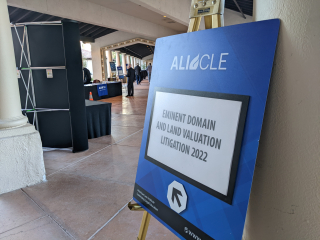
After a two-year absence in which we went remote, in the last week of last month (our usual spot on the calendar, between the playoffs and Super Bowl), we once again met in-person for the American Law Institute-CLE Eminent Domain and Land Valuation Litigation Conference.

Approximately 200 lawyers, judges, legal scholars, appraisers, law students, right-of-way agents, relocation experts, property owners, and other related professionals gathered in-person–yes, in-person–at the Scottsdale (Arizona) Resort at McCormick Ranch, to get reacquainted, learn stuff, and renew ties last made in-person in Nashville in 2020. In addition to the live attendance, we also welcomed about 50 remote colleagues, who joined the live webstream.

This was the 39th edition of the Conference, one of the most-established and successful conferences in the ALI-CLE stable of programs.

To those who joined us – thank you. This conference reminded us of why this program is so

Continue Reading 2022 ALI-CLE Eminent Domain And Land Valuation Litigation Conference, Scottsdale: You Should Have Been There!

If you ever get the opportunity to teach in a law school — either as a full-time legal scholar, or part-time as an expert adjunct practitioner — take it if you can. You might think you know a lot about a particular subject, but there’s nothing like spending time at the lectern in a law classroom in front of sharp and eager lawyers-in-training to sharpen your thoughts, and get you to truly understand a subject.

And folks calling you “professor” can evoke a smile.

Sensei

But if there’s one downside to the law school experience from the teacher’s side of the lectern, it’s grading. Especially at a law school like William and Mary that has a pretty strict mandatory curve. In upper-division courses that we handle like Eminent Domain and Property Rights Law and Land Use — where we’re dealing with some very high-level stuff and the quality of the

Continue Reading The Circle Is Now Complete: A Sampling Of Final Paper Topics From William and Mary Law’s Eminent Domain & Property Rights, And Land Use Courses

Here’s a must-read from the Texas Court of Appeals (Second District).

In City of Grapevine v. Muns, No. 02-19-00257 (Dec. 23, 2021), 

Before 2018, the city’s 1982 zoning ordinance authorized “single-family detached dwellings” and didn’t say anything about short-term renting (short-term being defined as less than 30 days). The ordinance didn’t expressly authorize it, but it didn’t prohibit it either. The ordinance was one of those that say anything not expressly authorized is prohibited. Bed and breakfast operations were recognized in a 2000 amendment, but these operations require, among other things, that the owner live on-site.

But after the introduction of platforms such as AirBnB and VRBO, the short-term market “exploded” and the usual complaints from neighborhood residents followed. Slip op. at 6 (“criminal mischief, domestic disputes, parking violations, alarm calls, and noise disturbances”). Next came studies, public hearings, and the city’s assertion that it didn’t really need to

Continue Reading Tex App: “Property” Includes Right To Rent It Out – City’s Short-Term Ban May Be A Taking

It takes a bit of work to work your way through the Arizona statute being challenged in the U.S. Court of Appeals’ opinion in CDK Globall LLC v. Brnovich, No. 20-16469 (Oct. 25, 2021). But we recommend you read the opinion and do the work nonetheless, because it tells us something about the way the Ninth Circuit views the right to exclude.

The statute, known as the “Dealer Law,” deals with the way car dealers treat the data they obtain from their customers. Data like the cars themselves, parts, services and the like, but also things like credit history and social security numbers. Like pretty much every other thing these days, that data is managed by proprietary software. Not surprisingly, there are specialized vendors who license the industry-specific, proprietary software. According to the opinion, those vendors in the past allowed dealers to extract the data from the proprietary platform

Continue Reading CA9: Once You Open The Door For One, You’ve Opened It For Everyone