Here’s the cert petition that we’ve been waiting to drop in a case we’ve been following. Last we checked in, the Ninth Circuit (with concurral) had denied en banc review, over a dissental.

In Cedar Point Nursery v. Shiroma, 923 F.3d 524 (May 8, 2019), a 2-1 panel of the Ninth Circuit affirmed the dismissal of a complaint for failure to plausibly state a takings claim under Twombly/Iqbal.  At issue was a regulation adopted by California’s Agricultural Labor Relations Board which requires agricultural employees to open their land to labor union organizers. The regulation is framed as protecting the rights of ag employees to “access by union organizers to the premises of an agricultural employer for the purpose of meeting and talking with employees and soliciting their support.”

The panel majority viewed the complaint as alleging a Loretto physical invasion taking, and held the

Continue Reading New Cert Petition: Does A Physical Invasion Taking Require 24/7 Occupation?
Here’s a cert petition that we’ve been waiting to drop in a case we’ve been following. This one asks whether a state legislature’s virtual elimination of a cause of action is a taking.

The harsh reality is that farms and ranches can stink. But in Right to Farm Acts, many state legislatures, Indiana’s included, have concluded that farming and ranching are so important that the consequences (“negative externalities“) that naturally occur have to be accepted. One Indiana court summed up Right to Farm Acts as well as anyone when it noted, “so long as the human race consumes pork, someone must tolerate the smell.” Shatto v. McNulty, 509 N.E.2d 897, 900 (Ind. App. 1987). Let’s call it a “stink easement.”

Indiana’s version stands somewhat apart from others, however. Like many other states, it bars lawsuits which assert that a long-standing agricultural operation is a

Continue Reading New Stinky Cert Petition: By Wiping Out Nuisance Claims, Right-To-Farm Act Is A Taking

20160114_125445

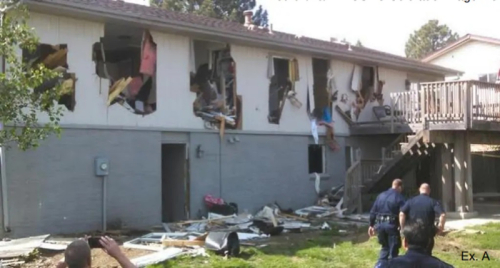
Here’s the latest in a case we’ve been following for what seems like forever. This is also a fact situation that has resulted in litigation in a variety of different fora, and at times has seemed like the final exam question in a Federal Courts law school class. We wrote about this latest phase — the issues raised by the Ninth Circuit’s opinion — in this article, even.

We won’t go into the background of the case, but if you are interested, you can find out more at this post (“What Constitutes a Loss“). The property owner has also summarized the situation thusly:

The State of Hawaii zoned for agricultural use land that it knew was not viable or appropriate for such use. At the property owner’s request, it rezoned it for urban use but, after Plaintiff Bridge Aina Le‘a began developing it, the State

Continue Reading New (Mike Berger) Cert Petition: “This case is the proverbial ‘Exhibit A’ of much that is wrong [with takings law].”

Parslow article

I must say that am pretty chuffed that one of my (now former) William and Mary Law students published a law review article, and he wrote about…takings. And Blackstone, and history.

Read it: Andrew Parslow, A Defense of the Regulatory Takings Doctrine: A Historical Analysis of This Conflict Between Property Rights and Public Good and A Prediction for Its Future, 44 Wm & Mary Environ. L. & Pol’y Rev. 799 (2020).

Well done! Continue Reading New Article: “A Defense of the Regulatory Takings Doctrine: A Historical Analysis of This Conflict Between Property Rights and Public Good and A Prediction for Its Future”

We joined friend and colleague Clint Schumacher for the milestone 50th episode of his essential Eminent Domain Podcast

If you are not already a subscriber and regular listener, you should be. Clint features interesting guests (present company excepted) and listening in is a good way to keep our community together, especially when many of us may be feeling isolated and shut off from our friends and fellow property law travelers.

The 50th Episode is indeed a milestone. Anyone who has tried it knows that putting together a podcast is nowhere near as simple as you might think. Scheduling guests. Getting the sound right. Mixing boards. Editing it so the guest doesn’t sound completely illiterate (thanks for removing the “you knows” and “uhhhhhs,” Clint). Bumper music. So thank you Clint, for providing this service for the rest of us. (If you have any suggestions for guests or topics, be sure

Continue Reading We Join Clint Schumacher For The 50th Episode Of The Eminent Domain Podcast To Talk COVID Takings

As we noted here, property owners sued the New York governor asserting that one of his emergency measures to respond to the coronavirus crisis (a suspension of eviction proceedings) is a taking.

Yesterday, the District Court denied the plaintiffs’ motion for summary judgment, and entered summary judgment in favor of the governor. Order Denying Plaintiffs’ Motion for Summary Judgment and Granting Defendant’s Motion for Summary Judgment, Elmsford Apt. Assocs., LLC v. Cuomo, No. 20-cv-4062 (CM) (June 29, 2020).

No physical take (see Yee: you invited the tenants in, owners). And no regulatory taking either because — you guessed correctly — this is “temporary” and Tahoe-Sierra. When this is all done, no-harm, no-foul. And not a Lucas taking because the restrictions left the owners with some use and value, so this is a Penn Central analysis. And you can guess where the Penn Central analysis leads, no?

Continue Reading SDNY: No Taking For NY’s Eviction Moratorium (It’s Temporary, And You Invited Them In Landlords)

Lech

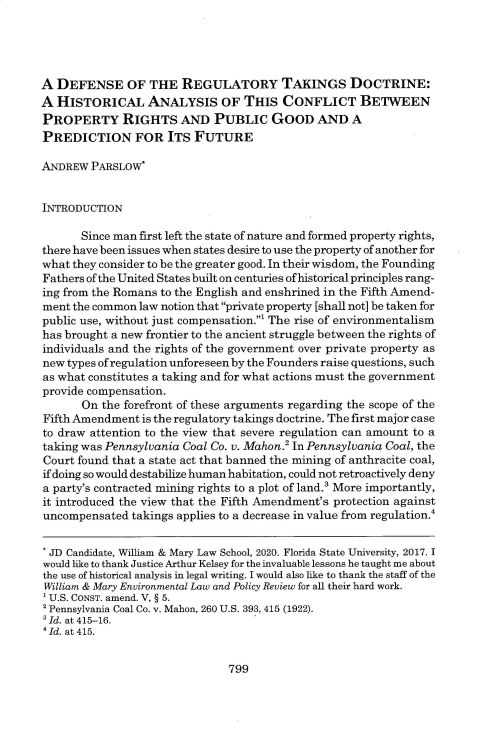
The Supreme Court today declined to review a Tenth Circuit decision that held a municipality could not be liable for a taking when its police officers pretty much destroyed a house in the course of dislodging a suspect who had holed up there. 

Along with our colleague Bill DeVinney, we filed an amicus brief in support of the homeowner, arguing that an invocation of “police power” isn’t the only question in these kind of cases, and the government’s assertion that it destroyed property for a police power purpose is but one of the factors a court considers when an owner asserts the destruction resulted in a taking. Police power may be a compelling factor militating against compensation. But it should never be the sole factor, as the Tenth Circuit concluded.

We had hoped that the Court would take notice of this case because after after the petition was filed, the

Continue Reading Cert Denied In Police Power Takings Case (Lech v. Greenwood Village)

We’ve posted a lot of complaints lately (the lawsuit kind, not the “can I see the manager” kind), mostly coronavirus-related. All involving in one way or another a takings claim. See here, here, here, here, here, here, here, here, here, here, here, here and here, for a sampling.

This latest complaint does not challenge a government’s response to COVID, but instead might be even more “ripped from the headlines.” Read on!

As you may be aware, a neighborhood in Seattle, Washington has been blocked off and declared a no-go zone for certain folks. Most recently labeled “CHOP” (Capitol Hill Occupying Protest) after the first naming action went badly and someone realized that the acronym for “Capitol Hill Autonomous Zone” was CHAZ, “[p]eople can now freely walk in the area, which has been covered

Continue Reading Complaint: City’s Abandonment Of CHOP/CHAZ Neighborhood Is A Taking

Congratulations – if you understood this post’s headline, you are officially a rails-to-trails nerd. A super-nerd.

But even if not, you shouldn’t need a rails-to-trails nerd’s level of knowledge to understand and appreciate the Federal Circuit’s ruling in Caquelin v. United States, No. 19-1385 (May 29, 2020). It’s a case worth reading for all of us — nonnerds included — because it nicely gets into the weeds of takings doctrine. 

One observation before we begin. There are takings of a fee simple interest. Takings of less-than-a-fee interest, such as the taking of an easement. Partial takings where less than all of the owner’s property is taken, and there’s a remainder property. Temporal takings where the seizure is not forever (temporary takings vs permanent takings). Regulatory takings, inverse condemnations, per se (categorical) takings, physical takings and ad hoc (Penn Central) takings. And myriad combinations fo the

Continue Reading Federal Circuit: Arkansas Game Did Not Overrule Ladd (NITUs Are Categorical Takings)

Another complaint asserting that a business that had to shut down is entitled to compensation for a taking (among other claims). The business in this case is a law firm, and the complaint is a class action. This joins a long (and growing) list of similar complaints. See here, here, here, here, here, here, here, here, here and here, for example. 

This complaint alleges both a Lucas total wipeout taking, as well as an ad hoc Penn Central type taking.

Read more analysis from Allan Zhang (“Law Firm Cites Founding Fathers in Suit Against Governor Cuomo and Attorney General“) from McKirdy Riskin Olson DellaPelle, our friends and colleagues in New Jersey.

Complaint, Hoganwillig, PLLC v. James, No. 1:20-cv-00577 (W.D.N.Y. May 13, 2020)

Continue Reading New Coronavirus Complaint: Shut Down Order Took Our Law Firm (NY)