DSCF3117
If you know, you know.

Sad birthday wishes to what just might be our most un-favorite decision ever, Penn Central Transp. Co. v. New York City, 438 U.S. 104 (1978), which turns 46 today. This in addition to the unhappy Kelo-versary earlier this week. A takings and regulatory takings one-two punch! 

Time has not treated the opinion well. Practitioners, judges, and legal scholars across the spectrum have called the three-factor Penn Central test for an ad hoc regulatory taking “demanding,” “fuzzy,” a four-part test, “neither defensible as a matter of theory nor mandated as a matter of precedent,” and “problematic” and “mysterious.”

No one but the Supreme Court professes to understand what that case means. Courts mess up the basic meaning of the factors, treat what is supposed to be a fact-centric “ad hoc

Continue Reading Not A Great Week For Property Rights Anniversaries: Penn Central Turns 46 Today
In this order, the U.S. District Court for the Northern District of Illinois temporarily enjoined enforcement of Chicago suburb Glen Ellyn‘s prohibition on renting property for less than 30 days.

Blakelick owns a five-bedroom single family home that when purchased was not located in Glen Ellyn. Since 2022, it has been offering the home for short-term rental on platforms like Airbnb. But in 2024, the property was annexed by the Village of Glen Ellyn. Blakelick continued to rent the property for less than 30 days. 

The dispute apparently began six months earlier when a neighbor began complaining about noise, culminating in the threat to “do everything in [his] capability to see to it that such use of property is banned in this area.” Slip op. at 2. Apparently he was successful, because in 2025, the Village, now having jurisdiction over the property, adopted an ordinance prohibiting owners from

Continue Reading Property Owner Likely To Succeed On Claim That Prohibition Of Short-Term Rentals Is A Penn Central Taking

In Brady v. City of Myrtle Beach, No. 23-1847 (May 16, 2025), the U.S. Court of Appeals for the Fourth Circuit made short work of the takings claims brought by several business owners who claimed the city directly or indirectly shut them down because their businesses contributed to a rise in crime in the area.

Myrtle Beach’s “Superblock,” was one of those problem areas. As the Fourth Circuit put it:

In 2015 and 2016 alone, eleven people were shot in the Superblock. Dozens more were sexually assaulted, battered, or robbed. Because most of these crimes occurred in or around a small cluster of bars, the City increased its police presence in the area and began closely investigating the establishments for compliance with state and local safety regulations. Despite these measures, crime continued unabated.

Slip op. at 2.

Some of the details of those incidents:

The crime in

Continue Reading CA4: No Property Right To Conduct A Business, So No Taking For Police Response To Area Crime Surge

Daunting

You know the claim: even after the federal courts opened back up to regulatory takings claims, winning a case is still pretty difficult. 

Yes, that may be by design: maybe it’s not supposed to be easy to get in the way of the regulatory state and prevail on a claim that a government action has “gone too far” by having similar effects on the owner’s property rights as an exercise of eminent domain. Or maybe it is. But either way, those of you who have been at this long enough can sense that something isn’t quite right. That our property owners are not getting a fair shake from the courts. That there’s an imbalance in The Force. 

Whether it is surviving a motion to dismiss where the court applies stricter pleadings standards than in other civil cases, or getting to the merits by escaping summary judgment, or even having

Continue Reading New Article: “Daunting Odds: Regulatory Takings Claims in The United States Circuit Courts of Appeals,” 94 Miss. L. J. 637 (2025)

The question in today’s case is an old one: can you own wild animals?

In Texas Parks & Wildlife Dep’t v. RW Trophy Ranch, Ltd., No. 15-24-00112-CV (Apr. 10, 2025), the Texas Court of Appeals said no. At least not when that wild animal is a white-tailed deer.

Here are the facts. Generally, you can’t possess a white tailed deer in Texas. (We bet you can hunt ’em. But you can’t, like, domesticate them.) But there are exceptions to that general rule. One of these exceptions allows you to obtain a breeder permit, by which you can keep breeder deer in captivity for propagation purposes. The Ranch is such a deer breeding facility.

But white-tailed deer in Texas — and elsewhere — are susceptible to a disease that sounds truly horrible: Chronic Wasting Disease, “a type of transmissible spongiform encephalopathy[.]” Slip op. at 2. One of

Continue Reading Deer Me! No Property Interest In Deer, Even If You Possess Them

These days, when we have cases where there’s tinkering with the terms of rental agreements, we most often see local governments using their police power to force property owners to rent their properties on a long-term (more than 30 days) basis.

But in Bigelow Arizona TX-344, LP v. Town of Addison, No. 05-23-00642-CV (Apr. 4, 2025), the Texas Court of Appeals was dealing with a town ordinance that went the other way: it redefined the definition of “hotel,” which had the effect of prohibiting an extended-stay hotel from continuing to rent 95% of its rooms on a long-term basis under a nearly 30-year old special use permit, and forced what had been long term stays to become short-term stays.

Why? The town’s “desire for motels and hotels to operate so that rooms are available for the Town’s tourists[.]” Slip op. at 3. Really? Read a bit further and you

Continue Reading Tex App Dismisses Penn Central Claim – But What’s It Doing Weighing The Facts?

Here’s the latest in a case we’ve been following closely (and disclosure: our firm filed an amicus brief in the Texas Supreme Court).

First, the bottom line: in The Commons at Lake Houston, Ltd. v. City of Houston, No. 23-0474 (Mar. 21, 2025), the Texas Supreme Court held that merely because a regulation is a justified exercise of police power does not insulate it from a claim that it goes too far and is also a taking requiring compensation. 

The Texas Court of Appeals held that the city could not be liable for a taking for an ordinance that limited development and use within the city’s 100-and-500-year floodplains because the ordinance was a valid exercise of police power and otherwise survived the rational basis test.

As we wrote here, that seems like utter nonsense to say that a valid police power reason categorically insulates a government action

Continue Reading Breaking: Texas Takings Law Enters The 20th Century!

Blevins

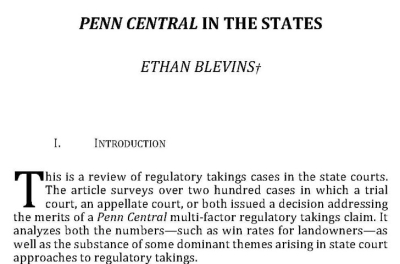
Our Pacific Legal Foundation colleague Ethan Blevins has published the lead article in the latest edition of the Wake Forest Journal of Law and Policy, and it is on a subject that makes it a must-read for you takings mavens.

The title says it all: “Penn Central in the States.” How do states treat the U.S. Supreme Court’s Penn Central test? Find out here, as Ethan surveys over 200 state court applications of that notorious test. Do they do better than federal courts? What court should you file in?

And if that doesn’t grab you enough, here’s his conclusion:

I conclude that most of these problems do not stem from unfaithful applications of the Supreme Court’s regulatory takings doctrine, but rather are a direct consequence of the Supreme Court’s failure to establish a clear, reliable test rooted in sound principles. I hope this article’s findings can assist

Continue Reading New Article: Ethan Blevins, “Penn Central in the States,” 15 Wake Forest J.L. & Policy 105 (2025)

Property_rights_and_the_roberts_court_Agenda_

Register now and plan on joining us on Thursday, February 27, 2025 at the U.C. Berkeley Law School for a one-day conference: “Property Rights and the Roberts Court: 2005-2025.”

Here’s the agenda. Here’s a description of the program:

For much of the past century, property rights were relegated to second-class status compared to the rest of the Bill of Rights. However, under the Supreme Court leadership of Chief Justice John Roberts, this trend has begun to shift.

In recognition of the 20th anniversary of the Chief Justice’s elevation to the Supreme Court, Pacific Legal Foundation is partnering with Berkeley Law’s Public Law and Policy Program to host a day-long conference exploring the major property rights developments and future of property rights law in the Roberts Court.

We’ll hear from two different panels of renowned legal scholars and accomplished litigators, as well as a keynote lunch discussion between

Continue Reading Join Us: “Property Rights and The Roberts Court: 2005-2025” (Feb. 27, 2025, UC Berkeley Law School)

Two — count ’em two! — cert petitions from our shop, filed today. Both call for “clarifying or overruling” Penn Central.

Oh, have I got your attention now?

Both arise out of the Michigan governor’s orders shuttering some, but not all, businesses during Co-19. These had devastating consequences, and owners sued for, inter alia, a taking, asserting a Penn Central theory. As we noted here, the Gym 24/7 case went up through the Michigan court system, with the Supreme Court eventually denying discretionary review over an extensive dissent. The Mount Clemens Recreational Bowl case took pretty much the same path. 

We’re not going to say much more because

Continue Reading Two New Cert Petitions (Ours) – 50 Years Of Fruitless Trying Is Enough: Overrule Or Clarify Penn Central!