At first glance, it might seem like there’s a lot there in the U.S. Court of Appeals’ opinion in Becker v. City of Hillsboro, No. 23-3367 (Jan. 7, 2025).

After all, the city’s prohibition on new private wells and another requirement that newly built homes connect to the city’s water system seems a bit arbitrary (at least the opinion doesn’t give a lot of detail why, other than “the city said so”). And the opinion evaluates a Lucas wipeout, a physical invasion, a Penn Central ad hoc taking, and a Nollan/Dolan claim. Even a Murr denominator issue. This case could have been a good vehicle to examine those questions in more detail that many courts do.

But after taking a dive in, our initial impression that this case would provide a lot of insight — or even food for deeper thought — didn’t pan out. Take a
Continue Reading CA8 Misses An Opportunity For Penn Central Clarity: No Taking When City Bans New Private Wells, Requires City Water

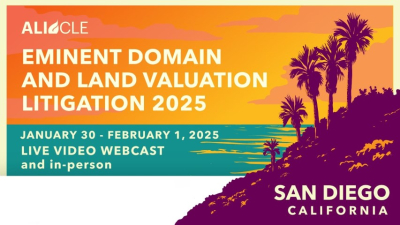
With our tongues firmly planted in cheeks, the Planning Chairs for the upcoming 42d edition of this popular and venerable Conference bring you this “breaking news” report from San Diego!

As you know, in addition to being the best nationally-focused conference on the subjects that we love and a venue that is nearly certain to have some of the warmest winter weather in the continental United States, and we went on-location from some of the local highlights: the beaches, Torrey Pines, the Zoo, Balboa Park, the Gaslamp Quarter, and Coronado to name but a few.

More about the Conference here, including registration information.

Here are some of the highlights:

  • Property Rights at the Supreme Court: DeVillier and Sheetz and What’s Next
  • Slow Take: Possession, Rent, Relocation, and Offset
  • The Jury’s View: How Jurors See Your Case
  • From Penn Coal to Penn Central: How to


Continue Reading Breaking News: Come Join Us For The 42d ALI-CLE Eminent Domain & Land Valuation Litigation Conference, San Diego, Jan 30-Feb 1

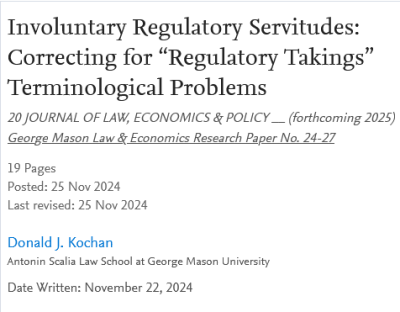
Screenshot 2024-12-09 at 16-13-02 Involuntary Regulatory Servitudes Correcting for “Regulatory Takings” Terminological Problems by Donald J. Kochan SSRN

Check this out, a new SSRN posting by lawprof Donald Kochan (George Mason/Scalia Law).

If this one is not a direct sequel to his earlier work on re-branding the “takings clause” (a piece we think is excellent and is part of the materials we teach in our Eminent Domain course at William and Mary Law), it does at least seem like a spiritual successor.

Here, Professor Kochan suggests that we’re being unclear when we use the term “regulatory takings” to describe those instances where an exercise of some governmental power other than eminent domain results in what feels like an eminent domain taking from the property owner’s viewpoint.

Instead, he argues, we should focus on the burdens the regulations place on an owner’s use (what the common law described as a servitude). To us, that seems very consistent with the Supreme Court’s approach, and proposals from other commentators. And it does focus the inquiry on the right question, namely what effect has a regulation put on an owner’s property rights. As that suggests, this should be a property-centric inquiry, and not on such unknowables such as the “character of the government action,” or whether an owner has “distinct investment-backed expectations.”

Here’s the Abstract:

This essay challenges the use of the term “regulatory takings” in our takings jurisprudence and scholarly discussion. The words we choose when developing doctrine matter. They can, even subconsciously, affect—by reducing, enlarging, distorting, limiting, or accurately shaping—the perceived and functional quality and character of the things they describe.

The better way to frame the inquiry underlying what is often called regulatory takings law should be to determine not whether there is a “regulatory taking” – some special kind of taking – but instead whether there is a regulation that amounts to a taking. Segmenting the judicial treatment of regulatory effects into a specialized analysis that takes it farther and farther away from an enterprise focused on equivalency between the private law of voluntary servitudes and the public law of what we should be calling involuntary regulatory servitudes. Regulations that restrict some but not all sticks in the property rights bundle should be characterized as the involuntary equivalent of the voluntary instrument, mechanism, or transfer that would have been necessary to achieve a parallel result. The essay proposes an alternative test for determining whether a regulation should be deemed a taking based on a comparison between the effect on the bundle from the regulation and determining whether the same effect in the private marketplace would have required a consensual, mutually beneficial exchange with appropriate compensation. This would better serve the meaning and purposes of the so-called Takings Clause.

The essay also documents the usage history of the regulatory takings label. To be sure, “regulatory takings” was not a dominate part of the takings lexicon before 1981. The first law review publication available in Westlaw to use the term “regulatory takings” is from 1965. The first court opinion to use the term came in a footnote in 1977. Briefing in advance of the 1980 U.S. Supreme Court decision in Agins v. Tiburon involved significant invocations of “regulatory takings” language across nearly a dozen briefs. But, the U.S. Supreme Court in its Agins opinion never uses the phrase “regulatory takings.” The first major court opinion to use “regulatory takings” language is the dissenting opinion by Justice William Brennan—joined by Justices Stewart, Marshall, and Powell—in the 1981 case of San Diego Gas & Elec. Co. v. City of San Diego. And, the Brennan dissent may have entrenched the term in the takings lexicon and is likely the impetus for widespread adoption of the term after 1981.

A must-read for all you takings…uh, dirt law…mavens.
Continue Reading New Article (Donald Kochan): “Involuntary Regulatory Servitudes: Correcting for ‘Regulatory Takings’ Terminological Problems”

2025 San Diego

Get ready to join your colleagues and friends in San Diego for the 42d ALI-CLE Eminent Domain & Land Valuation Litigation Conference.

The 41st Conference was in New Orleans. Here’s a report of that event, and here are our reports from prior conferences in Austin and Scottsdale.

Here are some of the highlights of the upcoming Conference:

  • Property Rights at the Supreme Court: DeVillier and Sheetz and What’s Next
  • Slow Take: Possession, Rent, Relocation, and Offset
  • The Jury’s View: How Jurors See Your Case
  • From Penn Coal to Penn Central: How to Prove “Too Far”
  • Leveraging Expertise in Eminent Domain Litigation: Working with Land Planners, Engineers, and Other Predicate Experts
  • Kelo at Twenty: What Changed, What Didn’t, and What’s on the Horizon
  • Viva Las Vegas: How the Nevada Judiciary Upheld Property Rights in 180 Land’s Inverse Condemnation Taking
  • Ethics: Guiding the Trolley: Perspectives on Professional Ethics in


Continue Reading Registration For The 42d ALI-CLE Eminent Domain & Land Valuation Litigation Conference Is Underway (Don’t Miss Out!)

Here are the cases and other materials we discussed in today’s Section of State & Local Government Law Land Use group meeting on takings:


Continue Reading Links From Today’s ABA Land Use Session

Untitled Extract Pages

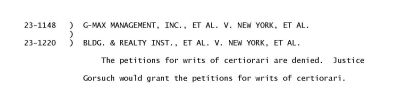
Here’s the latest in a case we’ve been following. This morning, in this Order, the Supreme Court denied cert in two cases which seemed to have a good chance at a grant, on two pressing issues which have divided lower courts, the physical occupation in tenancies (aka Yee), and the nature of the Penn Central takings test. Only Justice Gorsuch would have granted.

Here are the Questions Presented:

New York’s Housing Stability and Tenant Protection Act of 2019 transforms a temporary rent- regulation system into a permanent expropriation of vast swaths of private real estate, without just compensation, in the name of “affordable housing.” Among other things, the Act prohibits owners—even of small and midsized apartment buildings like Petitioners—from reclaiming rental units for their own personal use, and grants tenants a collective veto right over condo/co-op conversions. As Justice Thomas has observed, the constitutionality of regimes like New York’s

Continue Reading SCOTUS Declines To Review NYC Rent Control Challenge

PXL_20241111_181016079.MP

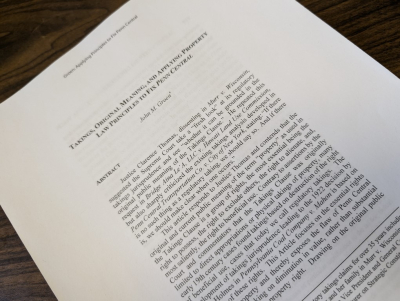
Today’s must-read, a (very) recent article by our Pacific Legal Foundation colleague John Groen, published in the Touro Law Review, “Takings, Original Meaning, and Applying Property Law Principles to Fix Penn Central.”

Get the pdf here.

With a title like that, who could resist? Here’s the Abstract:

Justice Clarence Thomas, dissenting in Murr v. Wisconsin, suggested the Supreme Court take a “fresh look” at its regulatory takings jurisprudence and see “whether it can be grounded in the original public meaning of the Takings Clause.” He repeated this request in Bridge Aina Le’A, LLC v. Hawaii Land Use Commission, but also sharply criticized the existing takings analysis developed in Penn Central Transportation Co. v. City of New York, stating: “If there is no such thing as a regulatory taking, we should say so. And if there is, we should make clear when one occurs.”

Continue Reading New Law Review Article: John Groen, “Takings, Original Meaning, and Applying Property Law Principles to Fix Penn Central,” 39 Touro L. Rev. 973 (2024)

Screenshot 2024-11-08 at 07-19-21 Track Appeals NJ Courts

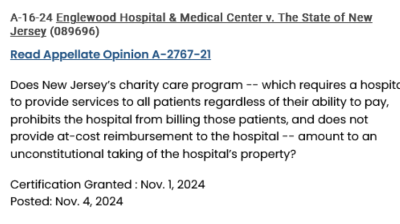
Here’s the latest in a case we’ve been following. The New Jersey Supreme Court has agreed to review the Appellate Division’s decision in Englewood Hospital & Medical Center v. New Jersey

That’s the case where several hospitals challenged a New Jersey statute which requires hospitals to take all patients regardless of their ability to pay, but does not fully reimburse under Medicaid the hospitals for the costs of treating these patients even where it results in the hospitals losing money.

The Appellate Division held this was not a categorical (Cedar Point/Loretto) or an ad hoc (Penn Central) taking.

The hospitals asserted that the statute required them to suffer a physical invasion, because the statute prohibited hospitals from excluding nonpaying patients. The court rejected the argument, in what reminded us of the Yee rent control and PruneYard commercial benefit approach, where the essential reasoning

Continue Reading NJ Supreme Court Grants Review: Is Forcing Hospitals To Operate At A Loss A Taking?

Here’s the latest takings cert petition, in a case involving a California county’s refusal to rezone property back to its former zoning to allow residential development. The only uses permitted on the property presently are “scientific research facilities uses” and hiking trails. Or, at the petition puts it, “only public, park-like uses.” Pet. at 5. 

The District Court and the Ninth Circuit both held no taking.

Here are the Questions Presented:

Does a taking analyzed under Lucas v. S.C. Coastal Council require that the affected property be left with no value even if the regulation in question deprives the property of all economically beneficial uses?

Does Palazzolo v. Rhode Island leave any room for consideration of the landowners’ expectations in a Penn Central takings analysis?

Do the decisions in Loper Bright Enters. v. Raimondo, Cedar Point Nursery v. Hassid, Sheetz v. Cnty. of El Dorado and Lingle

Continue Reading New Cert Petition: Use vs Value, And Applying Penn Central

You understand that there are just some cases where a certain analysis and outcome  appeal to your intellect, but your gut goes “ick,” and you’d bet that a judge’s (or judges’) reaction would be similar. Thus, intellectual analysis takes a backseat to the gut. (What one of our mentors referred to as “the widow plaintiff” scenario.)

The Kentucky Court of Appeals’ opinion in Doe v. Dean, No. 2023-CA-0844-MR (Sep. 20, 2024) is just one of those.

Kentucky law prohibits registered sex offenders from residing, working, loitering, or otherwise being within 1,000 feet of certain child-related operations such as daycare facilities, schools, or playgrounds. The plaintiff Doe is a registered sex offender, having “pled guilty to one felony count of possession of matter portraying a sexual performance by a minor[.]” Slip op. at 2.

Apparently, he’s been toeing the line since then, and “Doe has not been subject to active

Continue Reading Ky App: No Taking To Force Sex Offender To Move When Daycare Opens Near His Home