20170918_185734_Richtone(HDR)

Here’s the latest in a case we’ve been following for a while, Smyth v. Conservation Comm’n of Falmouth, No. 19-223 (cert. petition filed Aug. 16, 2019). 

The petition seeks review of a Massachusetts decision which held that a judge, not a jury, determines Penn Central takings questions, and also that the owner lost anyhow because, you know, Penn Central. The petition asks the Supreme Court to review these Questions Presented:

  1. Whether the loss of all developmental use of property and a 91.5% decline in its value is a sufficient “economic impact” to support a regulatory takings claim under Penn Central.
  2. Whether a person who acquires land in a developed area, prior to regulation, has a legitimate “expectation” of building and, if so, whether that interest can be defeated by a lack of investment in construction?
  3. Whether the Court should excise the “character” factor from Penn Central regulatory


Continue Reading Latest In SCOTUS Penn Central Cert Petition
Untitled Diagram-Page-1(1)

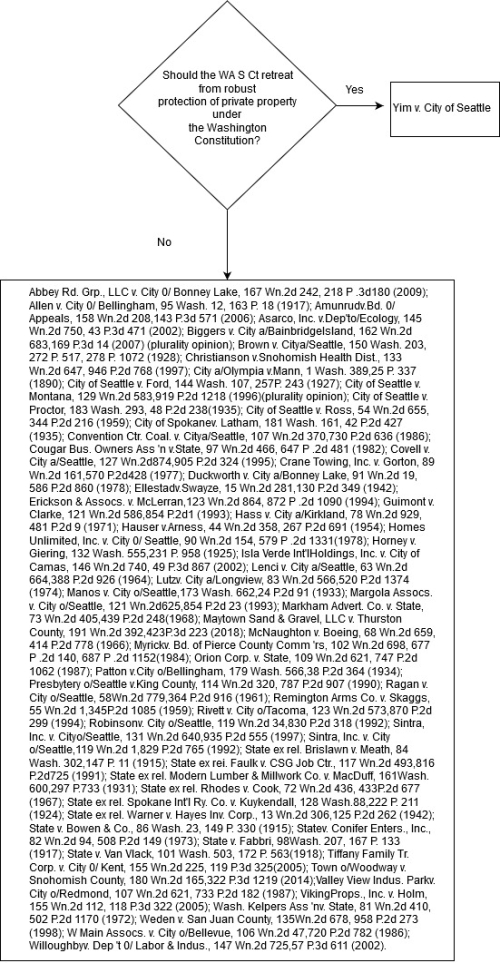
We add a flowchart to this post because the Washington Supreme Court on page 15 of its opinion in Yim v. City of Seattle, No. 95813 (Wash. Nov. 14, 2019) (em banc) (Yim I), includes a flowchart that purports to solve the regulatory takings puzzle once and for all.

Really.

You should check it out. We use “purports” because (surprise, surprise) the court gets it wrong. Flowcharts — also known as decision trees (if A, then B) — are supposed to help, not confuse. And this one doesn’t help if you are trying to figure out if a regulation effects a taking under the Fifth Amendment (and, as a result of the Yim I opinion, under the Washington Constitution). 

If that were not bad enough, in a companion opinion in the same matter (on certified questions from the federal court), Yim v. City of Seattle, No.

Continue Reading Washington (State) Supreme Court: All Those Opinions In Which We Held That Our Property Owners Have Greater Protections Under The State Constitution Were Just “Confused”

Yesterday’s Supreme Court arguments in what is known as the “DACA case” would normally not be something we’d cover on this blog. Yeah, the issue of whether the executive branch has the power to unwind (or, as the cert petition puts it to “wind down”) a prior administration’s executive actions is interesting and all that, but it’s just not in our usual AO (Area of Operations). 

But after reviewing the transcript, we think that those of you who are interested in regulatory takings might find it worth skimming. The reason is that the plaintiffs’ case is for the most part built on their reliance on the DACA program and nonenforcement of immigration statutes. We conformed our behavior to the existing rules in reliance on those rules remaining in place, and therefore a subsequent executive administration can’t revoke those rules, is how we see the argument. For example,

Continue Reading Regulatory Takings Lawyers: Why You Should Pay Attention To The DACA Case

Registration underway, so come join us! Agenda full of hot topics in takings and appraisal law! The best national faculty! Renew friendships, and make new colleagues! And Nashville! 

Download the brochure and make your plans for January. (Don’t wait, we’ve sold out the past three years.)Continue Reading Register Now! ALI-CLE Eminent Domain And Land Valuation Litigation Conference (Nashville, Jan 23-25, 2020)

If you didn’t know takings, and just had to venture guess whether a court would ever conclude that the outlawing of “bump stocks” (a device which attaches to a semi-automatic rifle and makes it cycle really quickly so that it works somewhat like a fully-automatic rifle) was a taking, what would you say?

If you guessed no, you’d be right. And not because you read this blog every day and know that we’ve been down this path before with bump stocks. After all, some cases are not resolved in the mind, but in the heart and in the gut. The Court of Federal Claims’ decision in McCutchen v. United States, No. 18-1965C (Sep. 23, 2019), is one of them.

As we wrote about the earlier decision, as Justice Holmes famously noted, “‘the life of the law has not been logic; it has been experience.’ And experience

Continue Reading One From The Gut: Outlawing “Bump Stocks” Not A Taking

Last week, along with Bob Grace, I (Robert (don’t-call-me-Bob) Thomas), was a guest on Clint Schumacher’s Eminent Domain Podcast. Stream it above, or download it here.

Clint and I had a wide-ranging discussion that centered on the recent trend of limiting short-term rentals, the legal pushback, and (of course) takings. We discussed the memorably-captioned Tiki Island case from Clint’s home state of Texas. Penn Central, naturally. Vested rights. Mrs. Murphy exceptions (although those deal with discrimination in rental housing). First Amendment stuff. The upcoming ALI-CLE Eminent Domain and Land Valuation Litigation Conference in Nashville (Jan 23-25, 2020), at which both Clint and Bob are speaking. And The Castle (which might not only be our favorite eminent domain movie, but our favorite movie period). 

Check it out.

Not only is Clint presenting at our Ethics program in Nashville in January, he will — as he did

Continue Reading Latest Ep, Eminent Domain Podcast: Short-Term Rentals, Tiki Island, The Castle, Penn Central

Dragonmap

Here’s the amici brief we are filing today in support of the Petitioner in a case we’ve been following, Smyth v. Conservation Comm’n of Falmouth, No. 19-223 (cert. petition filed Aug. 20, 2019). 

The Massachusetts Court of Appeals held that a judge, not a jury, determines Penn Central takings questions, and that the owner lost anyhow because, you know, Penn Central.  Here are the Questions Presented:

  1. Whether the loss of all developmental use of property and a 91.5% decline in its value is a sufficient “economic impact” to support a regulatory takings claim under Penn Central.
  2. Whether a person who acquires land in a developed area, prior to regulation, has a legitimate “expectation” of building and, if so, whether that interest can be defeated by a lack of investment in construction?
  3. Whether the Court should excise the “character” factor from Penn Central regulatory taking analysis.

Rather

Continue Reading Here Be Dragons: New Amicus Brief Asks For A “Fresh Look” At The Penn Central Test

6a00d83451707369e2022ad3b86fce200d-800wi

You overwhelmingly asked for Nashville, and we’re bringing it to you!

Get ready, and hold your place now: here’s the list of programs and speakers for the 36th Annual ALI-CLE Eminent Domain and Land Valuation Litigation Conference, to be held at the Downtown Nashville Hilton, January 23,- 25, 2020. Two-and-a-half days with top-notch national faculty (lawyers from both sides, judges, legal scholars, appraisers, relocation experts, and others).  

Early registration and group rates are available now

Here are just some of the programs:

  • Featured Presentation: Property Rights as Civil Rights: Seeking Justice Though the Fourth and Fifth Amendments. Hon. Jonathan Apgar, Jamila Johnson, Alan Ackerman. Moderator: Leslie Fields.
  • Making Sense of the New Rules After Knick v. Township of Scott: Where Do I Go, What Do I Do? David Breemer, Smitha Chintamaneni, Professor Bethany Berger. Moderator: Professor Steven Eagle.
  • When A River Runs Thought It: Water Rights and


Continue Reading Here’s The Agenda And Faculty For The 2020 ALI-CLE Eminent Domain And Land Valuation Litigation Conference, Nashville, Jan 23-25, 2020

Today, we’re featuring a post written by our Tennessee colleague, economist William Wade. He writes about the Massachusetts Court of Appeals’ recent decision in Smyth v. Conservation Comm’n of Falmouth, and the more recent cert petition in that case. Bill writes and comments frequently on takings cases. See, e.g., William W. Wade, “Theory and Abuse of Just Compensation for Income Producing Property in Federal Courts: A View from above the Forest,” 46 Tex. Envt’l L. Rev. 140 (2016). 

* * * *

Smyth and Massachusetts’ “New” Penn Central Factor

William W. Wade, Ph.D.

The Massachusetts case, Janice Smyth v. Conservation Commission of Falmouth,[1] is current again. Pacific Legal Foundation lawyer J. David Breemer, filed a petition for writ of certiorari to the U.S. Supreme Court. Mr. Breemer’s petition is encyclopedic in its survey of regulatory takings cases, which demonstrates that Penn Central’s

Continue Reading Guest Post: An Economist Looks At Takings Law – Smyth And Massachusetts’ New Penn Central Factor

ALI Nashville 2020

The final agenda and faculty list will soon be officially published, but we wanted to give you a preview of what is in store at the ALI-CLE Eminent Domain and Land Valuation Litigation Conference, January 23-25, 2020, at the Nashville Hilton (downtown, just a few steps away from everything that Nashville has to offer). 

Don’t miss out: in recent years, we’ve been at-or-near capacity, and the conference hotel has even sold out a couple of times. Visit the ALI-CLE website to register and hold your space

Here are some of the things we’ll be discussing: 

  • Making Sense of the New Rules After Knick v. Township of Scott: Where Do I Go, What Do I Do?
  • The Missing Link in Valuing Fixtures
  • When a River Runs Through it: Water Rights and Takings
  • Responding to Project Changes: Valuation When Government Action is Ongoing
  • Property Rights as Civil Rights: Seeking Justice Through


Continue Reading Get Ready: The 2020 ALI-CLE Eminent Domain And Land Valuation Litigation Conference Agenda Coming Soon