IMG_20170810_183940
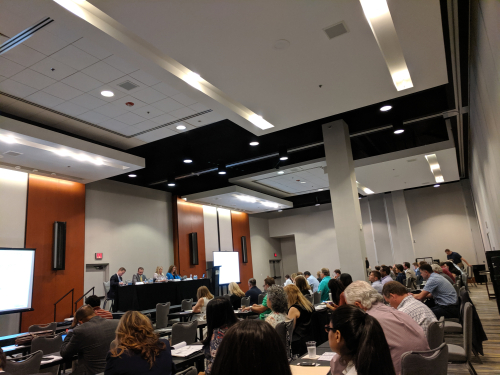
You know where this is. 

Here’s the cert petition filed recently in a case we’ve been tracking. (See also this guest post by economist Bill Wade about that case.)

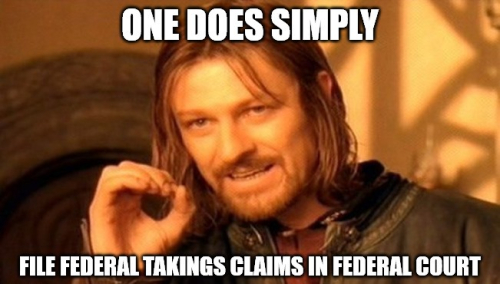
As the above photo tells you, this one is going into what may the last truly unexplored frontier of regulatory takings law, the details of the ad hoc Penn Central test, the “default” test in most situations where the regulation does not wipe out all economically beneficial use (Lucas), doesn’t physically invade the property (Loretto, Kaiser Aetna), or doesn’t render useless a fundamental attribute of property (Webb’s Fabulous Pharmacies). 

In all but those situations, the Court has told us to apply the multifactor three-part (or as Professor Steve Eagle argues, the four-part) test from Penn Central. But only in a few cases have property owners successfully navigated that minefield to
Continue Reading Hic Sunt Dracones – New Cert Petition Argues Penn Central Results In “Inconsistent,” “Unprincipled,” “Amorphous,” “Illegitimate” Decisions

20180823_102346_HDR

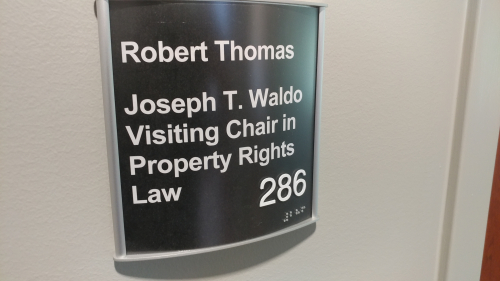
We’re about to get underway with the fall semester at William and Mary Law School, where we’re again teaching an upper-division course, Eminent Domain and Property Rights

We’ve more than doubled the size of last year’s enrollment, so it looks like the word is getting out. We cover not only eminent domain and just compensation, but takings (yes, we have a lot of new materials to cover there), civil forfeiture, a small bit of crossover with land use, local government, and related, property rights as civil rights, how property law is discussed in the public sphere, due process, and how to lawyer up these cases. And in early October, the opportunity to have some of the nation’s best property law scholars “guest lecture” during the Brigham-Kanner Property Rights Conference. Here’s the official description:

Property rights and the sovereign’s power of eminent domain have been essential components of

Continue Reading Law 608: Eminent Domain And Property Rights – Season 2

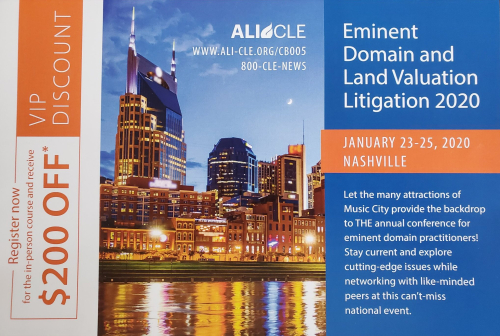
Recently, we requested crowdsourcing of this year’s “come to the ALI-CLE Eminent Domain Conference video.” Instead of doing the video ourselves, we asked folks to “please send a short clip of you and/or your colleagues telling us why you think the Eminent Domain and Land Valuation Litigation Conference is the place to be in January. Humor welcome, but not required.”

Our friend and colleague, St. Louis’ Paul Henry, has answered the call, admirably. Paul, as you may remember, is famous for his presentation a couple of years ago at the Conference about “Everything About Eminent Domain I Need To Know I Learned From Star Trek.” Which he gave in a Starfleet captain’s uniform. Brave man. Readers know that we dig Star Trek. But we are not that brave, so bravo, Paul.  

See if you don’t agree that Paul has now raised the video bar. 

Continue Reading Capt Henry Orders You To Boldly Go To The 2020 ALI-CLE Eminent Domain And Land Valuation Litigation Conference, Nashville, Jan. 23-25, 2020

Leave it to Federal Circuit Judge Timothy Dyk — who, as far as we can tell, has never once ruled against the government in a takings case — to conclude that the U.S. Supreme Court’s recent opinion in Knick v. Township of Scott, 139 S. Ct. 2162 (2019) actually works to the detriment of property owners when it comes to the statute of limitations applicable to regulatory takings claims. 

In Campbell v. United States, No. 18-2014 (Aug. 1, 2019), the plaintiffs alleged that it was a taking when their product liability tort claims against General Motors were extinguished by GM’s bankruptcy. The CFC held that the claims were barred by the six-year statute of limitations, and the Federal Circuit agreed. 

Here’s the specifics of the plaintiffs’ claim:

Relying on A & D [Auto Sales, Inc. v. United States, 748 F.3d 1142 (Fed. Cir. 2014)], on July

Continue Reading Fed Cir: File Your Regulatory Takings Claims Early (And Often?). The Statute Of Limitations Starts Running Before The Impacts Of The Regulation Are Felt

IMG_20190719_102348

I am grateful that planning chairs Justin Hodge and Jeremy Baker invited me to their conference. A room full of experts. Here are the links to the cases and other items I spoke about:


Continue Reading Cases And Links From Today’s Eminent Domain And Pipelines Conference (Houston)

If you are going to be attending the ABA Annual Meeting in San Francisco next month, here are some of the CLE and other programs of interest to property, land use, and eminent domain types, sponsored by our Section, the State and Local Govt Law Section: 

Thursday, Aug. 8

  • Knick Overrules Williamson County: What Does it Mean for Eminent Domain (in person, or webinar)

    In June 2019, the Supreme Court overruled its Williamson County precedent, which required that property owners, as a practical matter, must bring their Fifth Amendment takings claims against state or local governments in state courts. The Court’s new decision, in Knick v. Township of Scott, allows them to bring their inverse condemnation claims directly in federal court. Their insights into this important decision and its ramifications will be discussed by panelists who pled both sides of this case. Moderator: Steven J. Eagle, Professor Emeritus,


Continue Reading Dirt Lawyer CLE At ABA Annual Meeting (San Francisco)

One does knick meme

This is the fifth and last in our series of posts with thoughts on the landmark decision in Knick. In this post, we’ll be puling out our crystal balls, and doing a bit of forecasting. Here are the related posts:

 * * * *

The execrable state-litigation ripeness requirement is overruled. Ding-dong, the wicked witch is dead. No longer will our only federal review of a federal constitutional issue be limited to petitions for cert at SCOTUS. We can “simply” go to federal court. 

So now what?

Continue Reading Knick Analysis, Part V: What’s Next?

In Cranston Police Retirees Action Committee v. City of Cranston, No. 2017-36 (June 3, 2019), the Rhode Island Supreme Court concluded that a municipal ordinance “the promulgated a ten-year suspension of the cost-of-living-adjustment (COLA) benefit for retirees of the Cranston Police Department and Cranston Fire Department who were enrolled in the City of Cranston’s pension plan” was not a taking of the pension plans’ members property.

Takings mavens should skip to page 27 of the opinion for the good stuff. First, the court assumed that the plan members possessed “property.” A COLA benefit, once vested, is property, and the parties did not challenge the trial court’s conclusion on that issue. Second, the court rejected the contention that the suspension of COLA benefits was a physical invasion or a Lucas economic wipeout. Slip op. at 30-31. This was a regulatory taking, analyzed under Penn Central‘s three-part ad hoc test.

Continue Reading RI: Ten-Year Suspension Of Pension’s COLA Adjustment Not A Penn Central Taking

A must-read for takings mavens. Property rights gurus Professor Gideon Kanner and Michael Berger have published a new article, The Nasty, Brutish, and Short Life of Agins v. Tiburon, 50 Urb. Lawyer 1 (2019). It’s the lead article in the latest volume of The Urban Lawyer, the law journal of our Section of the ABA, the Section of State and Local Government Law.

Barista’s note: since TUL ended its long-time editorial relationship with UMKC Law School last year, the journal has been published in-house, and we’ve taken on the role of Editor-in-Chief, in-between our lawyering and teaching day jobs. We recognize the efforts of our ABA editor, as well as our team of volunteer Associate Editors (our fellow lawyers who took on the responsibility of tech editing the pieces) in producing the journal. 

Kanner and Berger have written an informative (and entertaining) tour-de-force of modern regulatory takings law.

Continue Reading New Must-Read Article: Kanner & Berger, “The Nasty, Brutish, and Short Life of Agins v. City of Tiburon”