Here’s the podcast of our recent talk to the American Bar Association’s Section of State and Local Government Law about the (then) upcoming decision in Horne v. Dep’t of Agriculture, No. 14-275. Transcript here, if you’d prefer to read it.

This is a preview of the decision. But since we made some predictions — several of which bore fruit in today’s opinions — we thought we’d post it while we digest the Court’s opinions. 

As you may know, the Court today issued its opinions, with eight justices concluding that the raisin marketing order is a physical taking of property, rejecting the Ninth Circuit’s holding that the physical takings rules do not apply when personal property is involved.

We’ll have more analysis shortly, including a round-up of how other commentators view the case. Stay tuned. 


Continue Reading Podcast: Leviathan Shrugged? The Supreme Court’s Raisin Takings Case
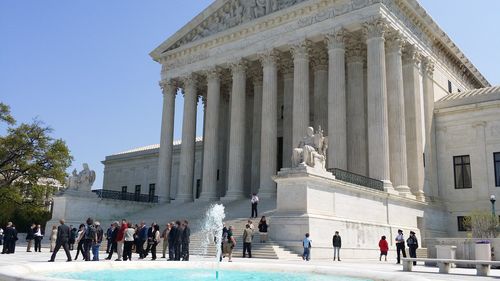
Pic_shot_1429716535697

            “It’s Frank’s world, we just live in it.”

                      – attributed to Dean Martin, about Frank Sinatra

A narrowly drawn opinion from the Supreme Court in Horne v. Dep’t of Agriculture, No. 14-275, argued in April and to be decided by the Court sometime before the Term ends this month, could attract more than the needed five Justices to form a bare majority, and the initial reports from the arguments agree that the Hornes’ takings argument appeared to gain traction with at least a couple of Justices from the Court’s left bloc. Combined with the property-friendly Justices and Justice Kennedy (who appeared to view the government’s arguments with great skepticism), they could put the Hornes well over the top. 

There may be much more at stake, however, if any part of the government’s

Continue Reading Leviathan Shrugged: Oral Arguments In Horne Reveals The Taking, But Remedy Still Open

Third time around for Lost Tree’s takings case against the federal government on this blog.

The first was the Federal Circuit’s decision concluding that a single Florida parcel owned by the plaintiff was the relevant parcel against which the impact of the Corps of Engineers’ denial of a § 404 wetlands dredge and fill permit is to be measured. The court overturned a Court of Federal Claims decision which concluded the relevant parcel was that single plot plus an additional nearby lot, plus “scattered wetlands in the vicinity” also owned by the same owner. 

Second was the Court of Federal Claims, which on remand held that there was a taking, and that, after applying either the Lucas total wipeout or the Penn Central ad hoc test (the diminution in value caused by the denial of the permit was 99.4%), the just compensation owed to Lost Tree was in the neighborhood

Continue Reading Fed Cir: “Economically Beneficial Use” Means More Than Someone Might Buy The Property

A long opinion (73 pages) from the U.S. Court of Federal Claims in St. Bernard Parish Gov’t v. United States, No. 05-1119L (May 1. 2015), and it is worth reading in its entirety (there are even photos and maps embedded). But here’s the short version:

In Arkansas Game & Fish, the United States Supreme Court held that “[f]looding cases, like other takings cases, should be assessed with reference to the ‘particular circumstances of each case,’ and not by resorting to blanket exclusionary rules.” 133 S. Ct. at 521; see also Loretto v. Teleprompter Manhattan CATV Corp., 458 U.S. 427 (1982) (“[N]o ‘set formula’ exists to determine, in all cases, whether compensation is constitutionally due for a [G]overnment restriction on property. Ordinarily, the Court must engage in ‘essentially ad hoc, factual inquiries.’” (quoting Penn Central, 438 U.S. at 124); Ridge Line, 346 F.3d at 1352 (“A

Continue Reading CFC: Katrina Flooding Is A Taking

While we put the finishing touches on our full write-up of last week’s oral arguments in Horne v. U.S.D.A., No. 14-275 (we posted our initial thoughts after attending the Court’s session here), here are other summaries of the arguments:

  • Supreme Court justices appear ready to rule against California raisin board” from the Los Angeles Times, isn’t a purely objective view of the case, and the “meta-message” (the Hornes are ingrates for challenging a program that benefits them) comes through loud and clear. The report also misunderstands the relief which the Hornes seek: “While it appeared clear a majority will side with Horne, it is not clear what this means for other farm products, or even what compensation he is due.” We hope this misconception doesn’t carry over to the Justices, since the Hornes are not seeking just compensation in this action, and only argue that


Continue Reading Horne Oral Argument Round-Up

On Wednesday, April 22, 2015, the Supreme Court will hear oral arguments in Horne v. U.S.D.A., No. 14-275, the second time this case has been to the Court. 

The first time around, the unanimous Court held that the Hornes could raise the Takings clause as a defense to the USDA’s action to enforce a regulatory scheme that Justice Kagan characterized as perhaps “the world’s most outdated law,” and which was derided by Justice Scalia as “a crazy statute.”

The Court remanded the case to the Ninth Circuit, which, to no one’s real surprise, held that the scheme was not a taking. The Court again granted cert to consider these Questions Presented:

  1. Does the government’s “categorical duty” under the Fifth Amendment to pay just compensation when it “physically takes possession of an interest in property,” Arkansas Game & Fish Comm’n v. United States, 133 S. Ct. 511, 518 (2012),


Continue Reading Raisin Takings Case Round II: Oral Argument Preview

It’s not often that we say a law review article is a “must-read.” But this one definitely is, especially for all you regulatory takings mavens: David L. Callies, Through a Glass Clearly: Predicting the Future in Land Use Takings Law, 54 Washburn L. Rev. 43 (2014). A pdf of the article is posted here

From the Introduction:

The subject of takings—the government taking of an interest in real property, either through eminent domain or through the exercise of the police power—has been the subject of continuous litigation for nearly a century. The past ten years have been particularly fruitful, as litigants struggle with the meaning and extent of the Fifth Amendment’s Public Use Clause and the extent to which the overzealous exercise of the police power can sufficiently deprive a landowner of rights in property so that the property has been “taken” by regulation, ever since Justice Holmes

Continue Reading New Law Review Article Worth Reading: “Through a Glass Clearly: Predicting the Future in Land Use Takings Law”

Thankfully, the only “Tiki Island” we have in Hawaii is a miniature golf course. Because the name “tiki” should be reserved for such things, or for kitschy bars, or Trader Vic-knockoffs.

And please, honest-to-goodness real municipalities should never be named Tiki Island. No matter how nice they appear to be. Just no.

(Martin Denny, by the way, gets a pass – rock on, Mr. Denny.)

But there it is, the Village of Tiki Island, Texaspopulation 968, “a waterfront community in Galveston County consisting of about 960 homes, with approximately 40% full-time occupants, and 60% part-time occupants.” 

Something tells us that TI, TX’s smallish population and the resident-to-part-timers ratio had something to do with the fact that in 2014, the Village adopted an ordinance prohibiting the short-term rental of residences, an activity that apparently had been ongoing for some time

Continue Reading Tiki Island’s Prohibition Of Vacation Rentals A Penn-Central Taking (For Now)

Yesterday, we were able to attend the Ninth Circuit oral arguments in a case which we posted on last month, Rancho de Calistoga v. City of Calistoga, No. 12-17749.

In that case, the U.S. District Court for the Northern District of California dismissed the complaint filed by the owner of a wine country mobile home park subject to a municipal rent control ordinance which alleged that the city’s hearing officer did not allow a fair return. The court concluded that the complaint did not adequately plead the claims for relief under a regulatory takings, private takings, due process, or equal protection theory.  

We filed an amicus brief in the case on behalf of the Western Manufactured Housing Communities Association

Much of the panel’s time was spent questioning the park owner’s counsel about whether the case was even ripe under Williamson County. Counsel responded that it

Continue Reading 9th Circuit Oral Arguments: Reg Takings, Private Takings, Due Process … And Williamson County

20150117_084032

This could be your view, winging your way to San Francisco in a couple of weeks, to join us for the 2015 ALI-CLE Eminent Domain and Land Valuation Litigation Conference (and the concurrent Condemnation 101 program), at the Hotel Nikko, February 5-7, 2015. 

There’s still a few spaces left, and time to register. We’re the co-Planning Chair of the Eminent Domain and Land Valuation Litigation program along with Joe Waldo, and we’ve assembled an exciting agenda, presented by a faculty comprised of the nation’s best-of-the-best in our field of law.

Winter in San Francisco is the one time of the year when you are likely to not be fogged in, and in addition to the 2 and a half days of programming, there are networking and social events so you can get to know your colleagues and the faculty better.

Please come and join us, if you

Continue Reading Still Time To Join Us For The 2015 ALI-CLE Eminent Domain Programs In San Francisco