The people of Margate City, New Jersey, voted to say “no thank you” to building dunes on the beach to limit damage in the event of another hurricane like Sandy were to hit.

But the State of New Jersey decided to do it anyway, and issued an administrative order “taking” an easement. Problem is, the State didn’t bother to actually go through the trouble of condemning the easement. Instead, “Bob Martin, Commissioner of the New Jersey Department of Environmental Protection,” declared:

1. The New Jersey Department of Environmental Protection Office of Floor [we assume that was meant to be “Flood”] Hazard Risk Reduction Measures hereby immediately enters upon and takes real property interest(s).

Just like that.

The City didn’t appreciate having its beach summarily taken, and filed a complaint in federal court against the Corps of Engineers and the state, and even got a TRO temporarily halting

Continue Reading Summary Takings, Eminent Domain, And Due Process At The Jersey Shore
20150115_091355-1
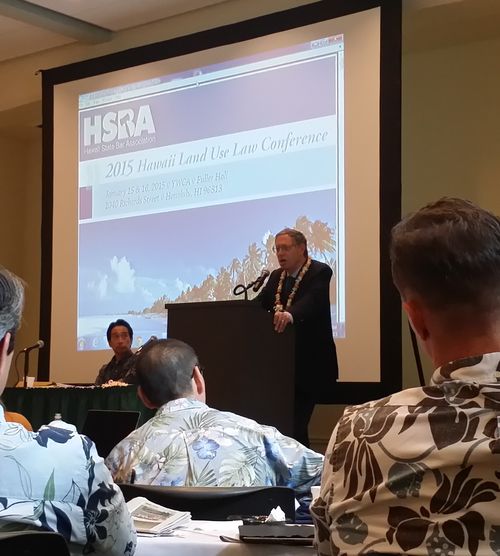
Ben Kudo and David Callies, leading off

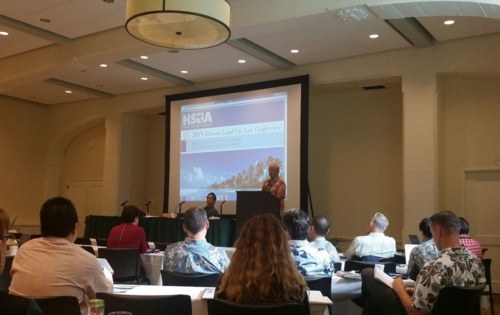
Professor Richard Epstein began the Hawaii Land Use Law Conference with the keynote presentation on “Stealth Takings: Exactions, Impact Fees, and More,” which was his usual comprehensive and non-stop takedown of takings law. 

20150115_100935

Our panel on Impact Fees and Exactions After Koontz followed, and here are the promised links and other materials which I mentioned:

Later today, I will also post up a recording of my short backgrounder on the exaction issue, to give you a flavor of the panel discussion (the Hawaii State Bar Assocation

Continue Reading 2015 Hawaii Land Use Law Conference

A short one (as usual) from the New York Supreme Court, Appellate Division.

The court’s opinion in New Creek Bluebelt, Phase 4 v. City of New York, No. D42909 (Nov. 19, 2014) is so brief, you should just read it yourself. But here are the highlights:

  • The city condemned a 19,500 square-foot vacant parcel on Staten Island.
  • The property had been designated “wetlands” before the current owners acquired it.
  • Applying a Penn Central analysis, the trial court determined, and the appellate division affirmed, that it was reasonably probable the wetlands designation was a regulatory taking. 
  • The regulations resulted in an 82% diminution of value.
  • That’s usually not enough, standing alone, but the regulations also were an “effective prohibition on development on any part of the property.”

For more, see this post (“Appellate Division Affirms 75% Increment Applicable to Wetlands Taking“) from our Owners’ Counsel colleagues at Goldstein,

Continue Reading NY: Reasonable Probability That Wetlands Designation Is A Regulatory Taking Under Penn Central

Ohio-sommers

Major interstate highway bridge construction nearby resulted in homeowners suing ODOT for inverse condemnation because “extreme noise, pounding and vibrations” caused their home (red arrow) to be uninhabitable. The Ohio Court of Claims granted ODOT summary judgment, and the property owners appealed.

The homeowners argued that the trial court applied the wrong standard, and should have analyzed the undisputed facts under the Penn Central test for a regulatory taking. Problem was, they hadn’t referred to Penn Central in the Court of Claims, arguing only that ODOT had “‘substantially and materially’ interfered with their use of their property,” and had physically trespassed. 

In Sommer v. Ohio Dep’t of Transportation, No. 13AP-848 (Dec. 23, 2014), the Ohio Court of Appeals rejected the homeowners’ argument, concluding that the Court of Claims properly analyzed the facts under the correct standard: “‘As ordinarily understood, the term, ‘taking,’ as used in the Constitution, comprehends

Continue Reading Ohio App: “Inconveniences” Caused By Highway Construction Not A Taking

You regulatory takings mavens know the “denominator” issue. It first came into our collective consciousness in the Penn Central case, where the Supreme Court concluded, among other things, that the property to be analyzed for regulatory takings purposes was not just Penn Central’s air rights, or even the parcel which it wanted to develop. Instead, the Court concluded that the property against which the development ban was to be measured was the entirety of Penn Central’s property in the area. (For more on the case, see Professor Kanner’s article, “Making Laws and Sausages: A Quarter-Century Retrospective of Penn Central Transportation Co. v. City of New York13 Wm. & Mary Bill of Rights J. 679 (2005)). 

From that inasuspicious beginning, there’s been an entire body of jurisprudence that has built up around what the “relevant parcel” is when a court is determining a regulatory taking, also known as

Continue Reading Wisconsin App: Two Parcels Can Be Treated As One For Regulatory Takings Purposes, If They Are Contiguous

Here’s one of the decisions we’ve been meaning to post for a while.

In Schmude Oil Co., Inc. v. Dep’t of Envt’l Quality, No. 313475 (July 1, 2014), the Michigan Court of Appeals held that there was no wipeout per se taking, nor was there a Penn Central taking, when the DEQ refused to permit the plaintiff to drill for shale oil on its private property.

The plaintiffs’ land was partially in a “nondevelopment region” which absolutely banned drilling, while the other portion was in a “limited development region” in which “drilling could occur, subject to certain limitations.” The plaintiffs requested the DEQ issue 8 permits for the nondevelopment region, and 3 permits for the limited region. The DEQ denied all the applications. 

The court of appeals determined that within the nondevelopment region, the DEQ was required to have rejected the drilling requests (nondevelopment means no drilling), and that

Continue Reading Mich App: Denial Of Shale Oil Drill Permits Not A Taking

2015 Hawaii Land Use Law Conference Banner - Credits

Registration is now open for the 2015 Hawaii Land Use Law Conference, to be held in downtown Honolulu on Thursday-Friday, January 15-16, 2015.

This is the bi-annual conference, co-chaired by U. Hawaii lawprof David Callies and land use lawyer Ben Kudo, that brings together the big names in our area of law. In other words, the one conference you don’t want to miss if you are a Hawaii land use or property lawyer, in-house counsel, a planner, an appraiser, a property owner or manager, or a law student interested in these topics. 

Download the full brochure here, or view it below. 

The keynote speaker this year is lawprof Richard Epstein, addressing “Stealth Takings: Exactions, Impact Fees and More.” Immediately following his talk, I will be moderating a panel on “Impact Fees and Exactions After Koontz,” with colleagues Bruce Voss and David Brittin. The rest

Continue Reading Registration Open: 2015 Hawaii Land Use Law Conference, Jan. 15-16, 2015

  DSCF2208

You can’t have rights without advocates.”

                              – Michael Berger

We’re at the William and Mary Law School in Williamsburg, Virginia today for the 11th Brigham-Kanner Property Rights Conference. As we’ve noted earlier, Michael Berger is this year’s B-K Prize honoree, for his career contributions to property law and his “scholarly work and accomplishments [which] affirm that property rights are fundamental to protecting individual and civil rights.”

The list of past recipients is an All-Star roster of property scholars and jurists, including lawprofs Frank Michelman, Richard Epstein, James Ely, Carol Rose, Thomas Merrill, and Supreme Court Justice Sandra Day O’Connor (the latter perhaps more for where she ended up in her Supreme Court career than where she started). See the plaque on the Law School’s wall for the complete list of

Continue Reading 2014 Brigham-Kanner Property Rights Conference Report: Honoring Michael Berger

On the day we celebrate Constitution Day (or should we say Khaaaaan-stitution Day?) we have to admit that pretty much nothing beats One Named Kirk’s reading of the Preamble

He might be from Iowa, but that guy who plays him is from north of the border, so our kudos to a Canadian for the best dramatic rendition of our founding document.

And in that spirit, we explain the plural parenthetical in this post’s title, which we picked up from a talk last evening by Hawaii Supreme Court Justice Simeon Acoba and U. Hawaii Law School Dean Avi Soifer at the Judiciary History Center, “Who Trumps Whom: Exploring Federalism in Hawaii.” The talk focused on the ways that state constitutional protections can extend beyond what the U.S. Constitution requires (the “floor vs ceiling” theory), and Justice Acoba suggested that today really should be called “Constitutions Day”

Continue Reading Happy Constitution(s) Day

Given the title of this blog and our usual inclinations in takings cases, you would be forgiven for assuming that we’d have a negative review of the Second Circuit’s opinion in 1256 Hurtel Avenue Associates, LLC v. Bulan, No. 12-1603-bk (Aug. 1, 2014), which held that a legislative increase in the size of the homestead exemption — which had the effect of wiping out an existing judgment lien — was not a taking. But before you jump to that conclusion, read on, since we have a couple of nice things to say about the opinion.  

In 2005, the New York legislature increased the homestead exemption — which exempts a certain amount from being used to satisfy money judgments — from $10,000 to $50,000. Five years later, the legislature raised it again to $75,000. Good for homeowners, not so good for those to whom homeowners owe money. But these

Continue Reading 2d Cir: New York’s Wipeout Of Judgment Lien Is “Legislative Tinkering,” Not A Lucas Or Penn Central Taking