PXL_20241004_152452877.MP
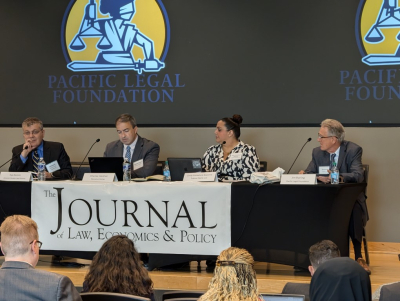
Lawprof Ilya Somin (GMU Law), Mercatus Center’s Charles Gardner,
and lawyer Emily Cruikshank Bayonne (Tubman Realty, LLC)
speaking on “
How Policy Changes Can Address Incursions on
Property Rights Where Courts Have Failed to do So.”
Jim Burling (PLF) moderating.

Recently, we attended a wonderful symposium co-sponsored by George Mason Law School’s Journal of Law, Economics & Policy (congratulations to the student editors who ran the show that day), and our outfit Pacific Legal Foundation. Of course, with the subject being “Imagining the Future of Regulatory Takings,” how could we resist attending?

If you missed it, it was not recorded unfortunately. But stay tuned for the full published symposium issue which shall include all of the articles and other pieces the speakers presented that day.
PXL_20241004_130701595.MP
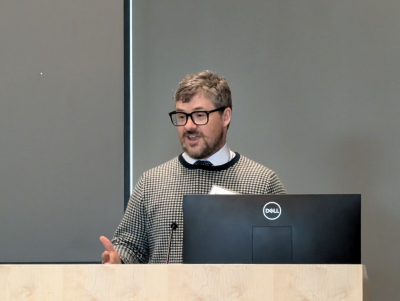
PLF’s Ethan Blevins kicked off the day by
urging the speakers and the audience to
“make property rights cool again.”
PXL_20241004_182439511.MP
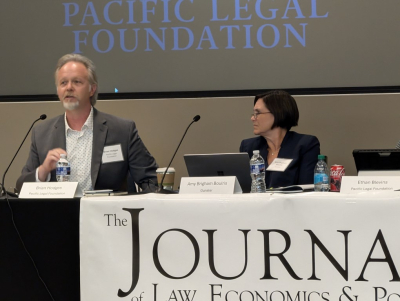
Brian Hodges

Continue Reading Imagining The Future Of Regulatory Takings: “Making Property Rights Cool Again”
This one from the Tenth Circuit didn’t even merit a published opinion, but is still worth reading, just because the situation seems so absurd.

In this Order and Judgment, the court affirmed the dismissal of property owners’ claim that the County wouldn’t issue a septic permit until after the owners actually constructed the septic system. Colorado law, they argued, requires them to get a permit before building a septic system. That’s nice, replied the County: here, we do it different; first you build, and only then do we decide whether you get a permit.

The owners alleged that without a septic permit, they could not obtain a construction permit. Which means that they couldn’t build their home as planned. Next stop, federal lawsuit alleging due process violations (both kinds) and a taking. 

The district court dismissed and the Tenth Circuit summarily affirmed:

  • Procedural due process: yes, the conflict between


Continue Reading CA10: A Municipality Is Forcing Owners To Violate State Law … No Problem!

Excerpt

In this Order, the Michigan Supreme Court declined to consider a case which challenges the Michigan governor’s Co-19 shutdown executive orders, which, in the words of the dissenting Justices, reached “nearly every aspect of life in our state.”

There have been a lot of cases asserting that Co-19 shutdowns are takings, with most (but not all) of them crashing and burning, including this one. Here, the plaintiffs — a class of owners whose businesses suffered devastating losses as a result of the shutdown orders — sought just compensation for the regulatory taking. They alleged both types of takings, categorical and ad hoc (Penn Central). They also asserted claims under the Michigan Constitution (a trend we approve!).

We recommend you take a dive into the Statement of the two Justices who dissented. They would have taken up the case because “the majority leaves unresolved

Continue Reading Michigan, Over Dissent, Declines To Hear Co-19 Shutdown Takings Case

Check out City of Kemah v. Crow, No. 01-23-00417-CV (July 25, 2024), from the Texas Court of Appeal (First District).

This is yet another takings ripeness case — here, the so-called “final decision” requirement — the second recent opinion on this issue from the Texas court. SeeFinal Decision Takings Ripeness Is Based On All Circumstances, Not Hard-And-Fast Requirements (Read That Again: A Factual Question)” for our write-up of the other case.

In this one, the owner asserted that the city issued her a building permit for her “barndominium” and and two other structures to be used as short-term rentals, but later issued a stop work order. This resulted in a Penn Central taking, she asserted.   

The city sought ripeness dismissal, asserting the owner didn’t actually have a permit issued by the city council as its ordinances require. The owner didn’t have the actual

Continue Reading Relying On Complaint’s Allegation That City Issued A Permit As Confirmed By Chief Building Officer Email, Texas App Holds Takings Claim Ripe Even Though City Said Council Must Issue Permits

We suggest those of you interested in takings ripeness — here, the so-called “final decision” requirement — take a quick gander at the Texas Court of Appeals’ opinion in City of Buda v. N.M. Edificios, LLC, No. 07-23-00427-CV (July 2, 2024).

We won’t go into the details, except to say that a property owner developing its land entered into an agreement with the city, under which the owner would grant a drainage easement to the city to alleviate citywide flooding, while the city was obligated to construct drainage improvements. When the owner submitted a plan, the city instructed it to “provide additional drainage improvements on the property.” Slip op. at 2. Not so fast, said the owner: the city, not me, is on the hook for these additional improvements. If you condition approval of my development plans on me providing more drainage stuff, that’s a taking (what the

Continue Reading Final Decision Takings Ripeness Is Based On All Circumstances, Not Hard-And-Fast Requirements (Read That Again: A Factual Question)

We were all set to write up a scintillating and detailed analysis of the New Jersey Appellate Division’s opinion in Englewood Hospital & Med. Center v. New Jersey, No. A-2767-21 (June 27, 2024), when we thought, ah, why not just ask you to read our New Jersey colleague Joe Grather’s scintillating and detailed analysis.

Short story is right there in the title of this post. As Joe puts it:

In short, the hospitals argued that requiring them to provide charity care and Medicaid care at a loss was an unconstitutional taking of private property without just compensation.  The trial court analyzed the claims as an “as-applied” challenge.  Therefore, it dismissed some of the claims because of a failure to exhaust administrative remedies.  The “slightly different reason” was that the Appellate Court found the claims were a facial challenge to the constitutionality of the statute, and therefore it analyzed the takings claims under the familiar rubric of whether there was a “direct government appropriation or physical invasion of private property,” or an “uncompensated regulatory interference with a property owner’s interest in their property.” Slip op. at 14.

No physical taking, no Penn Central taking. We recommend you read his entire post “As We Approach Our Nation’s Birthday, a New Jersey Appellate Court Rejects Hospitals’ Takings Claims.”

Joe ends it this way: “I bet the hospitals are preparing their petition for certification to the New Jersey Supreme Court now.  Happy 4th of July!”

That means to stay tuned for more.

Englewood Hospital & Med. Center v. New Jersey, No. A-2767-21 (N.J. App. Div. June 27, 2024)

Continue Reading New Jersey: Forcing Hospital To Provide Care At A Loss Isn’t A Taking

Worth reading: a student-authored piece in the latest issue of the Harvard Journal of Law & Public Policy, “Original Understanding of ‘Background Principles’ in Cedar Point Nursery v. Hassid.

From the Introduction:

But in Cedar Point, when considering a regulation that authorized union organizers to enter certain businesses, the Court held that even a temporary physical occupation was a per se taking requiring compensation.

The Court’s shift to a per se rule is significant because it means a landowner can receive “just compensation” without satisfying Penn Central’s high bar required for regulatory takings. For governments, the Cedar Point holding could pose a heavy financial burden if they must compensate landowners for temporary intrusions authorized under existing regulations. Due to this imposing financial burden, some have suggested that Cedar Point threatens existing civil rights regimes, which at first blush resemble the labor rights regulation at

Continue Reading New Article: “Original Understanding of ‘Background Principles’ in Cedar Point Nursery v. Hassid“

Check this out, a local government has filed a cert petition seeking reversal of one of those relatively rare circumstances where the property owner won below on a temporary regulatory takings claim for the County’s denial of a development permit.

We won’t go into details on this, but urge you to read the petition, especially the Questions Presented:

In First English Evangelical Lutheran Church of Glendale v. Los Angeles County, Cal., the Court held that the Fifth Amendment requires “just compensation” for temporary regulatory takings, i.e., “those regulatory takings which are ultimately invalidated by the courts.” 482 U.S. 304, 310 (1987). The appropriate compensation for a temporary regulatory taking is described as “fair value for the use of the property during this period of time.” Id. at 322. All claims for temporary regulatory takings must be analyzed using the ad-hoc, fact-based analysis set out in Penn Central Transp.

Continue Reading New Cert Petition: Gov’t Asks Whether A Penn Central Taking Is Really A Lucas Taking

DSCF3117
If you know, you know.

Sad birthday wishes to our most un-favorite decision ever, Penn Central Transp. Co. v. New York City, 438 U.S. 104 (1978), which turns 45 today.

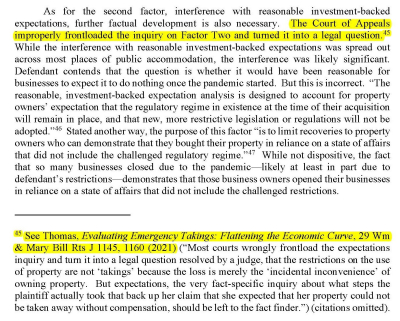
Time has not treated the opinion well. Practitioners, judges, and legal scholars across the spectrum have called the three-factor Penn Central test for an ad hoc regulatory taking “demanding,” “fuzzy,” a four-part test, “neither defensible as a matter of theory nor mandated as a matter of precedent,” and “problematic” and “mysterious.” Courts mess up the basic meaning of the factors, treat what is supposed to be a fact-centric “ad hoc” test as a legal question decided on the pleadings, and gatekeep most of these cases from juries.

The definitive deconstruction of the case was Professor Gideon Kanner’s “Making Laws and Sausages: A Quarter-Century

Continue Reading Unhappy 45th Birthday, Penn Central

As we noted here (“SCOTUS Denies Review To Remaining Rent Control Takings Petitions: “Important and pressing question” (Just Not In This Case)“), a small silver lining in the Court declining review was the statement of Justice Thomas accompanying the denial, where he noted the issue is an “important question,” and set out a rough roadmap to future challenges.

Here’s a cert petition which asserts this is the case to take up the issue. Here’s the Question Presented:

New York’s Housing Stability and Tenant Protection Act of 2019 transforms a temporary rent- regulation system into a permanent expropriation of vast swaths of private real estate, without just compensation, in the name of “affordable housing.” Among other things, the Act prohibits owners—even of small and midsized apartment buildings like Petitioners—from reclaiming rental units for their own personal use, and grants tenants a collective veto right over condo/co-op conversions. As Justice

Continue Reading We Heard You, Justice Thomas: NY Property Owners File New Takings Cert Petition Challenging Rent Control