We use “takings,” “Takings Clause” and “Fifth Amendment rights” as a convenient shorthand for the right of property owners to object or obtain compensation when a government act has so interefered with their rights that it might as well have exercised eminent domain. Every now and then, we need a reminder that the Takings Clause of the U.S. Constitution’s Fifth Amendment is not necessarily the last line of defense for property owners.

Today, in Interstate Companies, Inc v. City of Bloomington, No. A10-481 (Nov. 9, 2010), the Minnesota Court of Appeals provided the nudge. In that case, the court held that the Minnesota Constitution’s takings clause provides “broader protection to property owners than the federal constitution.” Slip op. at 6. The text of Minnesota Constitution is broader than the Fifth Amendment in that it provides that “[p]rivate property shall not be taken, destroyed or damaged for public use without

Continue Reading Min App: Minnesota Constitution’s Takings Clause Provides Greater Protection For Property Owners

Slough Remember that now-iconic scene in The Fugitive, where Harrison Ford’s character has turned the tables on Tommy Lee Jones, and while holding Jones at gunpoint proclaims, “I didn’t kill my wife!”

Jones’ response — I don’t care! — could just as easily apply to regulatory takings law, especially where a property owner alleges a regulatory action results in a per se taking (either a Lucas interference with all economically beneficial use, or a deprivation of a fundamental aspect of property such as the right to exclude).

In those cases, it generally does not matter what justifications the government may have for the regulation — the only thing relevant is the impact of the regulation on the property. In other words, even a regulatory action that might be a very good idea (from the government’s perspective) results in liability for compensation if it results in a taking

Continue Reading Wash. App: “I Don’t Care!” – Regulatory Takings Are About Impact, Not Justification

40.10914_Page_1 The first task under the Supreme Court’s three-part test for an ad hoc regulatory taking under Penn Central is to measure the “economic impact of the regulation.” Professor Steven Eagle wrote in the recent edition of his treatise Regulatory Takings that “[d]iscerning the correct measure of economic impact has been the subject of much dispute.”

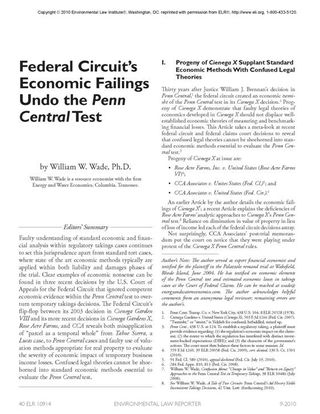
Thanks to the folks at the Environmental Law Institute, who have allowed us to reprint an article from a recent Environmental Law Reporter which brings some clarity to the subject.

In Federal Circuit’s Economic Failings Undo the Penn Central Test, William W. Wade, Ph.D., a resource economist with the firm Energy and Water Economics (Columbia, Tennessee), argues:

Faulty understanding of standard economic and financial analysis within regulatory takings cases continues to set this jurisprudence apart from standard tort cases, where state of the art economic methods typically are applied within both liability and

Continue Reading The Federal Circuit’s Economic Failings Undo The Penn Central Test

Guggenheim_enbanc

Last month, we attended the oral arguments in the rehearing en banc of Guggenheim v. City of Goleta, 582 F.3d 996 (9th Cir., Sep. 28, 2009).

The three-judge Ninth Circuit panel held 2-1 that a takings challenge was ripe under Williamson County, and ruled the City of Goleta, California’s ordinance was a facial taking by applying the three-part Penn Central test. The court remanded the case to the district court for a calculation of compensation owed to the property owners. On March 12, 2010, the court ordered en banc review.

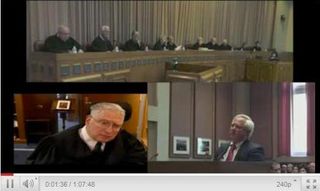
Our summary of the oral argument is posted here. Today, the court posted the video from the hearing, complete with 24-style split screen. Check it out for a rare cameras-in-the-courtroom view of a federal appeals court in action. Continue Reading Ninth Circuit Posts Video Of Guggenheim (Rent Control Takings Case) En Banc Oral Arguments

Here at inversecondemnation.com we also cover eminent domain, regulatory takings, land use, and environmental issues. We even cover election law when it strikes our fancy.

But here’s one that’s in our core competency: in Frick v. City of Salina, No. 101,355 (July 9, 2010) the Kansas Supreme Court held that property owner-plaintiffs did not meet their summary judgment burden of opposing the city’s motion, and affirmed a judgment that the city did not inversely condemn their property by denying them the ability to construct driveways to access their land.

After the city condemned their property, the Fricks moved their businesses to another nearby site. The move, according to the Fricks, “was thwarted by the ‘inappropriate regulatory’ action of the City. Slip op. at 8. The regulatory actions complained of included:

(1) denial of reasonable access to the relocation site during the Project; (2) construction activities

Continue Reading Kansas: Inverse Condemnation Case Resolved By Summary Judgment Burdens

Yesterday, we attended and posted a long summary of the en banc oral arguments in Guggenheim v. City of Goleta, the case challenging the city’s mobile home rent control ordinance as a regulatory taking, now pending in the Ninth Circuit.

Today, the court posted the sound recording of the argument.

Download it here (caution, it is a 23 MB wma file, meaning you’d best have a broadband connection and a Windows Media Player).

The argument was also broadcast from the Pasadena courthouse to the San Francisco, Portland, and Seattle courthouses, so we’re hoping that the video is eventually posted. The issues in the case aside, it was a very good example of high-level appellate advocacy.Continue Reading Oral Argument Recording In Ninth Circuit Rent Control Taking Case (Guggenheim)

Continued from Part II

The court was not much easier on the City’s attorney, even though one might think that the hard time they gave the property owners’ counsel indicated they were more sympathetic to the City’s arguments.

Right off the bat, Judge Callahan asked Schwartz whether he “conceded” [appellate advocate alarm bells going off] that there can be a facial Penn Central taking. This seemed to be a response to Judge Rymer’s questions to the property owners’ lawyers of whether “there is such an animal.” If Schwartz were to concede it, issue gone. He did concede it, but only barely. “Yes,” he answered, there can be such a thing, but it is difficult to imagine it, since the Penn Central test is “an ad hoc, factual inquiry.” Judge Callahan asked whether the Penn Central factors “bleed over to the merits” of a facial challenge, and whether the court

Continue Reading Ninth Circuit Rent Control Taking Case (Guggenheim) En Banc Oral Argument Report pt. III

Continued from Part I

Coldron seemed to sense that the court was in danger of veering off track and buying into the argument in the amicus brief filed by the League of California Cities and California State Association of Counties in support of the city about the claim being time-barred. Judge Clifton returned to his initial barrage of questions and asked whether the ordinance was the same after the City incorporated, and whether the park owners were seeking a “windfall” from that event. Recall that Goleta was originally not an incorporated city, so these parks were subject to the County’s mobile home rent control ordinance. When the City incorporated, the County ordinances continued in effect for a time, and after a gap (another issue in contention), the new City of Goleta adopted its own mobile home rent control ordinance.

Coldron responded to Judge Clifton’s question by noting that “there is

Continue Reading Ninth Circuit Rent Control Taking Case (Guggenheim) En Banc Oral Argument Report pt. II

2010-06-22 12.55.09 Even in the rarefied, academic atmosphere of an appellate court, an advocate must sometimes have a thick skin. Today’s Ninth Circuit en banc oral arguments in the rent control takings case, Guggenheim v. City of Goleta, was one where the two lawyers who argued the case certainly came away with a few callouses. 

Guggenheim is the appeal from an unsuccessful challenge to the City of Goleta’s mobile home rent control ordinance. The district court ruled against the mobile home park owners who asserted the ordinance worked a regulatory taking of their property.

In Guggenheim v. City of Goleta, 582 F.3d 996 (9th Cir., Sep. 28, 2009), a three-judge Ninth Circuit panel reversed, however, and held 2-1 that the challenge was ripe under Williamson County, and ruled the ordinance was a facial taking by applying the three-part Penn Central test. The court remanded the case to the

Continue Reading Ninth Circuit Rent Control Taking Case (Guggenheim) En Banc Oral Argument Report pt. I

The Ninth Circuit’s en banc rent control takings case, set for oral argument in Pasadena tomorrow, has generated big interest.

In Guggenheim v. City of Goleta, 582 F.3d 996 (9th Cir., Sep. 28, 2009), a three-judge panel of the U.S. Court of Appeals for the Ninth Circuit held that the city’s mobile home rent control ordinance was a regulatory taking. The court found the case ripe under Williamson County, and addressed the merits of the takings claim. On March 12, 2010, the court ordered en banc review.

Twelve amici have filed briefs (10 supporting the property owners, and 2 supporting the City; available here on our resource page), and the court will be beaming the June 22, 2010 oral arguments live to the San Francisco, Portland, and Seattle courthouses at 2:00 p.m. if you can’t make it to Pasadena.

We will be in the Pasadena courtroom tomorrow, and

Continue Reading Ninth Circuit Rent Control Takings Case (Guggenheim) Preview