The WMA Reporter, the monthly publication of the Western Manufactured Communities Housing Association has published A Regulatory Takings Glossary (or, How to Translate Property Rights Lawyerspeak), my short article that attempts to deconstruct some of the more common terms property lawyers toss about. Here’s the Introduction:

One of my law school professors once remarked (hopefully in jest) “if it ain’t Latin, it ain’t the law.” While thankfully we have moved away from the days when Latin and Norman French were the languages of the law, those of us who regularly represent property owners defending their rights sometimes toss about terms that, although they purport to be standard English, often make normal people look at us askance.

We may forget that not everyone might understand what we mean when we say, for example, “The court dismissed the regulatory takings claim on ripeness grounds under Williamson County because the

Continue Reading A Regulatory Takings Glossary (or, How to Translate Property Rights Lawyerspeak)


The_men_who_stare_at_goats According to this news release, the Ninth Circuit will offer remote viewing of the upcoming oral arguments in three en banc cases, including the rent control takings case, Guggenheim v. City of Goleta (which we’re following here). 

“Remote viewing” does not mean you have to psychically tune into the arguments, nor does it equal webcasting as many state appeals courts do. Instead, it means that if you are in San Francisco, Portland, or Seattle and you find yourself in the neighborhood of the Ninth Circuit’s courthouse in those cities at 2pm on Tuesday, June 22, 2010, you can watch a live video and audio feed.

Get thee to the courthouse: it’s “first-come-first-served” according to the news release.

Us? We’re going to be in L.A. that day, so we plan to camp out on the courthouse steps like those Star Wars and iPhone people to insure ourselves a

Continue Reading The Men Who Stare At Judges: 9th Circuit To Provide “Remote Viewing” Of En Banc Oral Arguments

On Tuesday, June 22, 2010 starting at 2:00 p.m., the U.S. Court of Appeals for the Ninth Circuit will hear oral arguments in the en banc review of a takings challenge to the City of Goleta’s mobile home rent control ordinance (RCO).

In Guggenheim v. City of Goleta, 582 F.3d 996 (9th Cir., Sep. 28, 2009), a three-judge panel held the city’s RCO was a regulatory taking. The court found the case ripe under Williamson County, and addressed the merits of the takings claim under the three-factor regulatory taking test of Penn Central Transportation Co. v. New York City, 438 U.S. 104 (1978).

On March 12, 2010, the court ordered en banc review.

The arguments will take place in Courtroom Three of the Richard H. Chambers Courthouse (125 South Grand Avenue, Pasadena, California). While we won’t be able to live blog the arguments, we are


Continue Reading June 22 Oral Arguments In Ninth Circuit Rent Control Takings Case (Guggenheim)

More on the closely-followed case rent control regulatory takings decision from the Ninth Circuit, Guggenheim v. City of Goleta, No. 06-56306 (Sep. 28, 2009), which is currently being reheard en banc by the Ninth Circuit.

Earlier, we posted a link to Professor Richard Epstein’s short article, Takings Law Made Hard, in which he opines that “[j]udged by the normal canons of judicial review, the likely outcome is that the [Supreme] Court will do to … Guggenheim what it did to Judge Kozinski [in Hall v. City of Santa Barbara, 813 F.2d 198 (1987)]: reverse and enter judgment for the defendant.” 

Responding to Professor Epstein, Pacific Legal Foundation’s RS Radford has posted Takings victories made harder, pointing out the “technical deficiencies” in Epstein’s article that undermine his conclusions. Radford writes:

Whatever Prof. Epstein’s reasons may have been for rushing into print to condemn the Guggenheim decision, his

Continue Reading Making Regulatory Takings Harder

The latest skirmish in California’s mobile home rent control wars, this time from the California Court of Appeal, Fourth District, in two cases out of San Diego county, MHC Financing Ltd. P’ship v. City of Santee, No. D053345 (Mar. 15, 2010).

The cases present a convoluted series of facts and procedural twists which we are not going to rehash, but recommend that you read yourself. It’s a long opinion (50 pages), but it’s worth delving into the details. The court held:

  • First, the property owner “sustained no legally remediable injury” from the retroactive application of a mobile home rent control ordinance which the city adopted to correct errors in an earlier-adopted mobile home rent control ordinance (the erroneous ordinance was based on the original version of a proposed initiative ordinance, and not the modified initiative ordinance which was certified by petition) (slip op. at 15-19).
  • Damages are not an


Continue Reading California Court Of Appeal: Takings Claims Brought Too Early, Too Late, And No Damages For Violations Of The Right To Petition (Inter Alia)

Aliaba We just wrapped up the annual three-day Festival of Eminent Domain Law, otherwise known as the American Law Institute | American Bar Association’s two CLE conferences, “Eminent Domain and Land Valuation Litigation,”and “Condemnation 101: How To Prepare and Present an Eminent DomainCase.” 

Dana Berliner, Matt Fellerhoff and I spoke about about “Winning Arguments in Challenging the Right toTake and Public Use” in the Land Valuation course, and in the 101course, I presented a session on “Voir Dire: Selecting a Jury in a Post-Kelo Era in a Down Economy” with William Blake and Susan MacPherson.

The depth of talent teaching and attending these courses is unbelievable, so I always learn more at these conferences than I impart. Among the other presenters were our fellow law bloggers Gideon Kanner, Anthony Della Pelle and Edward McKirdy. Internet marketing strategist Jayne Navarre also presented an interesting session on using

Continue Reading ALI-ABA Annual Eminent Domain Conference Wrap-Up

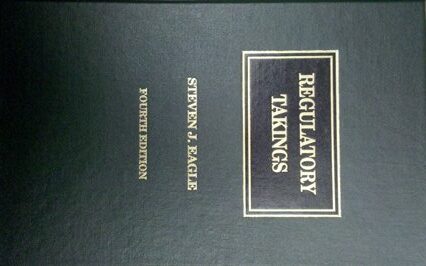
Eagle_reg_takings_cover I just received my copy of the latest edition of Professor Steven J. Eagle‘s definitive treatise Regulatory Takings (Lexis/Nexis, 4th ed. Dec. 2009).

Like the earlier editions, this is a must-have for every land use and property law attorney’s back bookshelf.

Chapters include “Property Rights and Their Sources,” “The Ascendancyof Land Use Regulation,” “Analytical Issues in Regulatory TakingsLitigation,” and “Regulatory Takings Remedies.”

The book is available here (oddly, the Lexis-Nexis web site only has the 3d edition for purchase, but I expect that to be remedied shortly).

From the preface to the fourth edition:

Thisbook is about “regulatory takings,” which is a relatively new term, but not an entirely new idea. The underlying concept is stated simply — government may “regulate” private property, but not to the extent that it constitutes a “taking,” under the United States Constitution, or a state constitution. Owners need not be compensated for losses

Continue Reading Eagle On Regulatory Takings (4th ed. 2009)

Four amicus briefs have been filed in Macerich Management Co. v. United Brotherhood of Carpenters and Joiners of America Local 568, No. 09-235 (cert. petition filed Aug. 24, 2009), urging the Supreme Court to review United Brotherhood of Carpenters and Joiners of America Local 848 v. National Labor Relations Bd., 540 F.3d 957 (9th Cir. 2008). In that case, the Ninth Circuit held that six rules applied by shopping centers to restrict picketing andhandbilling by union members violated the California Constitution’s freespeech clause and therefore impermissibly interfered with protectedunion activity. The decision required shopping centers to allow speech adverse to the shopping centers’ financial interests on their properties. We summarized the Ninth Circuit’s decision here.


Continue Reading Amicus Briefs Supporting Cert: Is Forcing A Property Owner To Allow Adverse Speech A Taking?

In a lengthy opinion — it comes in two volumes — the Ninth Circuit again takes on a mobile home rent control ordinance, this time with a better result than usual for the property owners. The court determined the ordinance worked a taking, and remanded the case for a calculation of just compensation. Guggenheim v. City of Goleta, No. 06-56306 (Sep. 28, 2009). Because the case is long, we haven’t had a chance to digest it yet, but here’s the court’s conclusion:

We therefore reverse the district court’s judgment on the takings claim and remand to the district court for further proceedings. On remand, the district court may of course consider  any materials presented by either party that are relevant to determining the total amount of just compensation due to the Park Owners. See, e.g., Cienega Gardens, 331 F.3d at 1354. As noted in Part III.A.1

Continue Reading New Ninth Circuit Case: Mobile Home Rent Control Ordinance Takes Property