The Supreme Court of Montana’s opinion in Tai Tam, LLC v. Missoula County, No. DA21-0660 (Nov. 15, 2022) starts off like a somewhat typical land use dispute turned into a constitutional fight. The property owner sought subdivision approvals for a 28-acre parcel to allow residential development, and the County denied the applications because “the proposal failure to adequately mitigate the loss of agricultural soils.” Slip op. at 2.(Oh, and “bird habitat.” Slip op. at 3.)

Next, the complaint, alleging some of the usual claims: due process, equal protection, and takings, and a statutory claim under Montana law. The trial court dismissed all claims: the statutory claims for failure to get in before the 30-day limitations period, and the constitutional property claims based on the court’s conclusion that the plaintiff lacked a “property” interest.

We’ll let you read the part of the opinion in which the court reversed the dismissal
Continue Reading Montana: Owning The Land Is Enough To Plead A Property Interest: Property Means “Rights Inherent In Ownership,” Not Extent Of Govt Discretion

Here’s the latest in a case we’ve been following.

In this cert petition, business owners on the losing end of a Co-19 shutdown order assert that the Sixth Circuit got it wrong when it concluded that the “overriding public purpose” of the shutdown orders should be given what amounts to dispositive weight under the “character of the government action” Penn Central factor.

The Sixth Circuit correctly (in our view) rejected the district court’s rationale that the takings claim could be rejected simply because “the state acts pursuant to its police powers to protect public health.” Slip op. at 15. But the Sixth Circuit didn’t stop there, and affirmed the dismissal because the “character” of responding to the Co-19 emergency was so overwhelming that it outweighed the other two factors (which the court had already concluded “weigh in favor of the Plaintiffs”).

As we explained in an article on

Continue Reading New Cert Petition: There Must Be A Real Emergency Before Commandeerings Are Exempt From Compensation

CA

One from the U.S. Court of Appeals for the First Circuit.

In In re Financial Oversight & Management Board for Puerto Rico, No. 22-1048 (Nov. 22, 2022), the court affirmed the district court’s 12(b)(6) dismissal of a takings claim because the government didn’t actually force the plaintiff credit unions into buying what the complaint alleges are “worthless government-issued securities,” even where “the defendants knew – but did not disclose – that these would be losing investments given the precarious state and dire financial situation in which Puerto Rico found itself at the time.” Slip op. at 1.

Conned into purchasing junk bonds? That’s on you.

This is another Takings Clause claim arising out of the Puerto Rico governmental bankruptcy. [Disclosure: we represent some of the property owners/Respondents in that other matter, now at the cert stage in SCOTUS.] The complaint alleged that in a series of meetings over

Continue Reading Shame On You: Govt Exerting “Irresistible Pressure” On (But Not Forcing) You To Buy Worthless Bonds Isn’t A Taking

Here it is, the official agenda and program for the 40th ALI-CLE Eminent Domain & Land Valuation Litigation Conference, February 2-4, 2023 (with a special event the evening of Wednesday, February 1, 2023 to entice you to arrive early).

Screenshot 2022-11-18 at 13-35-13 ALI CLE PA NY VA TX FL Continuing Legal Education

Here’s the brochure with the complete agenda, schedule, and faculty listing. But to tempt you, here are some of the highlights of the program:

  • Everything Old is New Again: Why Today’s Practitioners Need to Understand the Original Meaning of the Takings and Just Compensation Clauses
  • Private Utility Takeovers – Lessons From a 67 Day Trial

  • Valuation Issues When Billboards and Signs are Condemned

  • Setting Client Expectations and Identifying Red Flags

  • Developing Property Right Issues in Texas – Questions and Answers from the Bench: A View From the Bench (with Texas Supreme Court Justice Jimmy Blacklock)

  • Eminent Domain and Regulatory Takings Updates: Important Decisions You Need to Know

  • Ethics:


Continue Reading Here’s The Program For The 40th ALI-CLE Eminent Domain & Land Valuation Litigation Conference, Feb 1-4, 2023, Austin

Check it out: our Pacific Legal Foundation colleagues Jim Burling, Jon Houghton, and Jeff McCoy, along with Jeremy Hopkins (Cranfill & Sumner, North Carolina), share with us the latest on property rights, Sackett, takings, the future of Penn Central, and the upcoming SCOTUS arguments in Wilkins v. United States (is the Federal Quiet Title’s statute of limitations jurisdictional?).

Don’t miss it.Continue Reading Video: “The Future of Private Property Regulation in America”

To “slow the spread” in the early days of the Co-19 thing, the City ordered businesses to shut down. But not Wal-Mart, liquor stores, or churches. Golden Glow, a tanning salon objected, and told anyone who would listen that it could operate without person-to-person contact. Sorry, no exceptions.

Federal lawsuit followed, alleging the claims you might expect: equal protection and takings claims. Predictably, the district court granted summary judgment to the City.

And just as predictably, in Golden Glow Tanning Salon, Inc. v. City of Columbus, No. 21-60898 (Nov. 8, 2022), the U.S. Court of Appeals for the Fifth Circuit affirmed. The opinion, as you might expect is short.

Was Golden Glow treated differently from other businesses similarly situated without a rational reason? No. First, Golden Glow is similar to other shut down businesses: “[e]ach class of shut-down business provides recreational, social, or, as some would say, ‘nonessential’ services

Continue Reading Tanning Beds v. Liquor Stores – No Equal Protection, No Physical Take, No Lucas Take For Co-19 Biz Shutdown Order

Ideker Farms, Inc. v. United States, No. 21-1849

As written up in the FedCircuitBlog (a must-follow for all you federal takings mavens):

It concerns the federal government’s liability for taking private property. Specifically, in this case, the Federal Circuit will review the conclusion of the Court of Federal Claims that the government’s action was the cause-in-fact of flooding damage and that, as a result, a taking-by-flooding occurred. The government appeals the CFC’s judgment, while Ideker Farms cross-appeals.

Behrens v. United States, No. 22-1277

Also from the FedCircuitBlog:

Behrens v. United States, which concerns a claim the federal government was liable for taking land for public use through the National Trails System Act. Specifically, in this case, the Federal Circuit will review the determination by the Court of Federal Claims that the plaintiffs were not entitled to compensation because the scope of the easement in question was broad

Continue Reading CAFED Hears Arguments In Two Takings Cases

Takingspanel

For the last week, the blog has been a bit idle. That hasn’t been because we’re slowing down, but was mostly the result of our blog platform being worked on behind-the-scenes, which knocked a lot of the hosted blogs offline, this one included. But things look good now, so here we are.

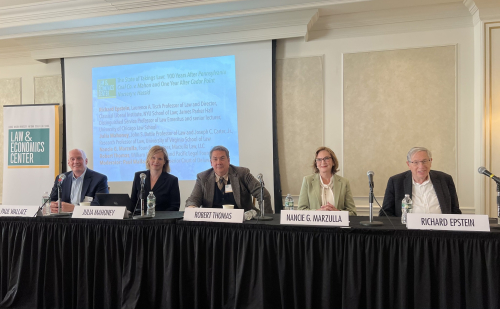
We were also on the road, traveling to New York for the Seventeenth Meeting of the American College of Business Court Judges, where we were able to join an august panel of takings mavens (pictured above, L-to-R: Judge Paul Wallace, Professor Julia Mahoney, some guy, Nancie Marzulla, and Professor Richard Epstein) to talk about the state of takings law.

The title of our program was “The State of Takings Law: 100 Years After Pennsylvania Coal Co. v. Mahon and One Year After Cedar Point Nursery v. Hassid,” and we spent our time discussing and debating

Continue Reading What’s “The State of Takings Law: 100 Years After Pennsylvania Coal Co. v. Mahon and One Year After Cedar Point Nursery v. Hassid”? Incoherent (But Getting Better)

Many Honolulu residents don’t like short-term (less than 30 day) rentals. Whether fueled by NIMBY-ism, a genuine belief that tourists should stay out of residents’ neighborhoods and be limited to accommodations built for transients, or the belief that long-term rentals to locals somehow promote more affordable housing, the anti-transient renter vibe is most definitely there.

The no-less-than-thirty-days restriction wasn’t enough, however, and recently the City and County of Honolulu made it illegal to rent for less than three months (90 days). The ordinance stated the reasons:

Short-term rentals are disruptive to the character and fabric of our residential neighborhoods; they are inconsistent with the land uses that are intended for our residential zoned areas and increase the price of housing for O‘ahu’s resident population by removing housing stock from the for-sale and long-term rental markets. The City Council finds that any economic benefits of opening up our residential areas

Continue Reading Federal Court: Honolulu’s 3-Month Minimum Rental Term Preempted By State Law (And Would Be A Taking Of Vested Rights)

Clint Schumacher’s Eminent Domain podcast is one of those things that we almost shouldn’t post about. After all, every episode is worth your time. But this one is especially good. After all, it features our law firm colleague and friend Jon Houghton, discussing what you all know is one of our fave topics, regulatory takings.

As Clint describes it:

Jon Houghton of Pacific Legal Foundation joins the podcast today to talk about regulatory takings. This is a complex area of the law, but Jon is a true expert and breaks it down into understandable pieces. He discusses how practitioners can assess when a regulation has risen to the level of a taking. He also discusses regulatory taking issues and cases that are current.

So even though we always say “check out the Eminent Domain Podcast,” we’re saying it again. Check it out.Continue Reading Jon Houghton On Regulatory Takings – Eminent Domain Podcast