Skip to content

Euclidsymposium

With the 100th anniversary of Village of Euclid v. Ambler Realty Co. nearly upon us in 2026, we’ve put together a series of events designed to reexamine the case that set the stage for a century’s-worth of intense land use regulations and restrictions.

Are Euclid‘s assumptions and conclusions still valid? If the original separation-of-uses and nuisance-prevention rationale of zoning made sense, does that rationale apply when “zoning” has become the shorthand for extremely granular regulation of property’s uses? What of the role of judicial review and a return to Nectowian review? 

Our Euclid series begins with a call for papers, and a follow-up conference at which these articles will be presented and discussed. For more, see the call for papers: “Euclid Turns 100: Rethinking an Antiquated Case and Reimagining Euclidean Zoning for the Century Ahead.” The link also has a few suggestions about

Continue Reading Call For Papers: “Euclid Turns 100: Rethinking an Antiquated Case and Reimagining Zoning for the Century Ahead”

Here’s the latest in a case we’ve been following.

In Englewood Hospital & Medical Center v. State, No A-16-24 (July 16, 2025), the New Jersey Supreme Court rejected physical and regulatory takings claims made by hospitals which are required to treat nonpaying patients even though the Medicare reimbursements available will not cover the hospitals’ costs. 

Here’s the bottom line:  

Under the facts as presented in this case, we hold that charity care is not an unconstitutional “per se” physical taking of private property without just compensation. It does not grant an affirmative right of access to occupy hospitals; it does not give away or physically set aside hospital property for the government or a third party; and it does not deprive hospitals of all economically beneficial use of their property. We also hold that charity care is not an unconstitutional “regulatory” taking of private property without just compensation.

Continue Reading NJ: Forcing Hospitals To Lose Money To Treat Nonpaying Patients Isn’t A Taking

JLEPcover

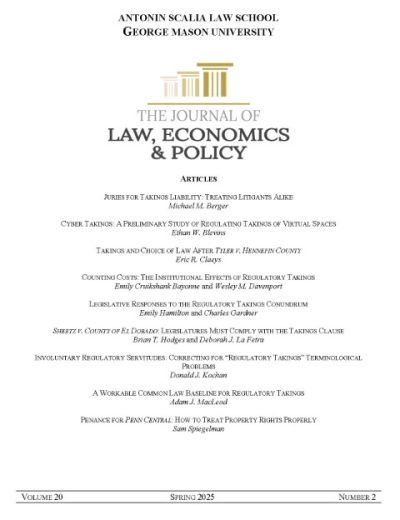
Last year, we attended a conference devoted to the future of regulatory takings, hosted by the Antonin Scalia School of Law (George Mason U), and Pacific Legal Foundation.

The publisher, the Journal of Law, Economics, and Policy has released the articles and essays from that conference, and made them available here

Here’s the list of articles:

  • Michael M. Berger, Juries for Takings Liability: Treating Litigants Alike
  • Ethan W. Blevins, Cyber Takings: A Preliminary Study of Regulating Takings of Virtual Spaces
  • Eric R. Claeys, Takings and Choice of Law After Tyler v. Hennepin County
  • Emily Cruikshank Bayonne and Wesley M. Davenport, Counting Costs: the Institutional Effects of Regulatory Takings
  • Emily Hamilton and Charles Gardner, Legislative Responses to the Regulatory Takings Conundrum
  • Brian T. Hodges and Deborah J. La Fetra, Sheetz v. County of El Dorado: Legislatures Must Comply With the Takings Clause
  • Donald J. Kochan, Involuntary Regulatory Servitudes:


Continue Reading New Property Rights Symposium Published – “Too Far: Imagining the Future of Regulatory Takings”

DSCF3117
If you know, you know.

Sad birthday wishes to what just might be our most un-favorite decision ever, Penn Central Transp. Co. v. New York City, 438 U.S. 104 (1978), which turns 46 today. This in addition to the unhappy Kelo-versary earlier this week. A takings and regulatory takings one-two punch! 

Time has not treated the opinion well. Practitioners, judges, and legal scholars across the spectrum have called the three-factor Penn Central test for an ad hoc regulatory taking “demanding,” “fuzzy,” a four-part test, “neither defensible as a matter of theory nor mandated as a matter of precedent,” and “problematic” and “mysterious.”

No one but the Supreme Court professes to understand what that case means. Courts mess up the basic meaning of the factors, treat what is supposed to be a fact-centric “ad hoc

Continue Reading Not A Great Week For Property Rights Anniversaries: Penn Central Turns 46 Today

Please add this one to your podcast listening queue: the latest episode of Bound by Oath, produced by John Ross at the Institute for Justice. BBO isn’t a typical podcast, but more of an audio documentary as we have noted before. If you aren’t a subscriber, you really should be. 

This episode focuses on regulatory takings, and the sleight-of-law that governments frequently employ to avoid the merits of takings claims, or perhaps worse yet to avoid paying compensation even after ordered to. Cases detailed include DeVillier, Agins, First English, Violet Dock Port, Ariyan. This episode is a great companion piece to BBO‘s episodes on Euclid (zoning), Pennsylvania Coal (reg takings), and Berman (Public Use). 

Put on your “self-executing” hat and take a listen! 

Here’s the description of the episode:

The Fifth Amendment says that the government must pay just compensation when it takes

Continue Reading Must-Listen Podcast: “Neat Takings Tricks” (Bound by Oath, S3, E3)

In this order, the U.S. District Court for the Northern District of Illinois temporarily enjoined enforcement of Chicago suburb Glen Ellyn‘s prohibition on renting property for less than 30 days.

Blakelick owns a five-bedroom single family home that when purchased was not located in Glen Ellyn. Since 2022, it has been offering the home for short-term rental on platforms like Airbnb. But in 2024, the property was annexed by the Village of Glen Ellyn. Blakelick continued to rent the property for less than 30 days. 

The dispute apparently began six months earlier when a neighbor began complaining about noise, culminating in the threat to “do everything in [his] capability to see to it that such use of property is banned in this area.” Slip op. at 2. Apparently he was successful, because in 2025, the Village, now having jurisdiction over the property, adopted an ordinance prohibiting owners from

Continue Reading Property Owner Likely To Succeed On Claim That Prohibition Of Short-Term Rentals Is A Penn Central Taking

We’re back to bump stocks. Indeed, we have covered cases raising similar issues so we’re not going into too much detail on the U.S. Court of Federal Claims’ recent decision in The Modern Sportsman, LLC v. United States, No. 19-449 (May 8, 2025), and we’ll just assume you, like us, have been following along with this issue.

Suffice it to say that the federal government adopted regulations defining these devices as prohibited machine guns and gave those in possession 90 days to either turn them over to the government, or to destroy them. The plaintiffs destroyed their bump stocks and then sued the federal government for a taking.

The CFC dismissed the complaint under the government’s “police power” authority to prohibit contraband and noxious items. As we noted in this post, the line between uncompensated destruction and compensated takings was not as clear at the CFC saw it (the Armstrong rationale cannot be ignored, even where a taking may be for a very good public reason), and thus the Federal Circuit affirmed, but shifted the rationale from police power to a lack of a private property interest. After the Supreme Court denied cert, “that was that.” Slip op. at 2.

Meanwhile, other bump stock owners challenged the validity of the administrative rule declaring these things machine guns. And there, the owners found more success, with the Supreme Court eventually concluding that the agency lacked the authority to adopt the bump stock rule. The owners here “then asked this Court to revive this lawsuit, which the Court did … [t]he next day, plaintiffs amended their pleadings to add an illegal exaction claim in addition to their takings claim.” Slip op. at 3. 

The government sought dismissal, arguing that the bump stock owners alleged a physical taking but the government hadn’t physically seized anything. It merely required the owners to destroy the bump stocks: as the CFC put it, the government “acknowledges that plaintiffs alleged that ‘the Rule required bump stock owners to destroy or surrender the devices to ATF.’ Reply 2. That does not pass muster for the government, however, because the government ‘did not seize any devices or otherwise physically invade plaintiffs’ property.’ Id. at 3.” Slip op. at 4. In short, we didn’t actually seize anything of yours, plaintiffs; we merely required you to destroy your property. Really. 

The CFC wasn’t having any of that, and rejected this too-clever-by-half argument:

The Court cannot agree. Let us be clear that the government need not literally force private persons to turn over their property for a taking to occur; a legal requirement is sufficient. For example, in Horne, the Supreme Court held that an administrative order requiring raisin croppers to “give a percentage of their crop to the Government, free of charge” effected a compensable appropriation. 576 U.S. at 355. The government did not literally oust the farmers from possession of the raisins, yet a taking occurred because the order made a “formal demand” backed by fines and penalties. Id. at 362, 367–68. It is the same here. The Rule plainly states: “This final rule requires the destruction of existing bump-stock-type devices.” 83 Fed. Reg. at 66,549. It then instructs: “Individuals who have purchased bump-stock-type devices prior to the implementation of this rule must destroy the devices themselves prior to the effective date of the rule or abandon them at their local ATF office.” Id. Finally, it makes clear that “individuals are subject to criminal liability . . . for possessing bump-stock- type devices after the effective date of regulation.” Id. at 66,525. These statements undoubtedly constitute a formal demand to destroy or transfer possession of bump stocks, satisfying the standard under Horne.

Slip op. at 4-5.

If this argument strikes you as nonsense, welcome to our world, where arguments like this are put forth with a straight face on a regular basis. 

And if that wasn’t enough, the government next argued that the regulations didn’t actually require the owners to destroy their bump stocks, “but ‘merely clarified’ the ‘longstanding statutory law’ banning machineguns.” Slip op. at 5. “Put plainly, the government essentially argues that the Rule is an informational document apprising the public of pre-existing legal obligations.” Id. The CFC held “[t]hat too is incorrect.” Id. That seems to be putting it mildly. What do you think would have happened to bump stock owners who didn’t comply with this “informational” rule and held on to their bump stocks?

Short story: the complaint alleged a physical taking.

Next, however, the CFC rejected the exaction claim, based on the remedy sought. As we know, the CFC is limited to awarding monetary damages in these kind of cases. The CFC held that an “exaction” generally “involves money that was ‘improperly paid, exacted, or taken from the claimant.'” Slip op. at 7 (quotations omitted). Here, the CFC held, no money changed hands and there’s no statute otherwise authorizing a claim for money damages:

In sum, plaintiffs cannot be said to have paid money, directly or “in effect,” for a very straightforward reason: They lost personal property, not money. Indeed, plaintiffs have not alleged that they spent any money for any purpose; or paid any money to any In sum, plaintiffs cannot be said to have paid money, directly or “in effect,” for a very straightforward reason: They lost personal property, not money. Indeed, plaintiffs have not alleged that they spent any money for any purpose; or paid any money to any

Slip op. at 8-9.

The CFC wrapped up by — get this — calling out the property owners’ lawyers for failing to expressly clarify that one of the cases they cited and relied on didn’t actually hold that an exaction could be a demand for “money or property,” only money. Slip op. at 9. The court acknowledged that the citation didn’t actually misquote the case, but that the lawyers should have been more candid that they were arguing for an extension of the law, and that the case limited exactions to money.

We’re fine with that (especially in the AI era), and requiring advocates to be candid. 

But where’s the call-out of the government’s horse hockey arguments, noted above? Dead silence, of course. In our view, the borderline frivolous, time-and-expense wasting, divorced-from-reality arguments the government made are equally if not more deserving of censure. 

Call us if that ever happens. We’ll wait.

The Modern Sportsman, LLC v. United States, No. 19-449 (Fed. Cl. May 8, 2025)

Continue Reading CFC: Allegation That Gov’t Ordered Destruction Of Bump Stocks Pleaded Physical Takings Claim

1000002646

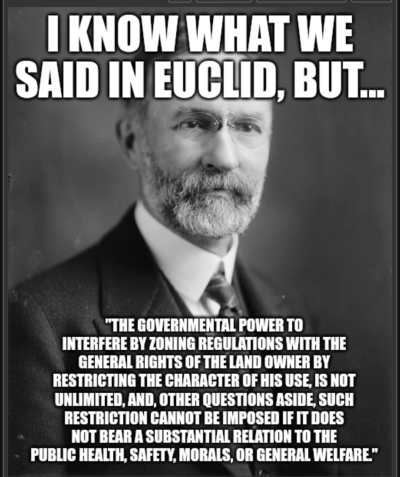
It was on this day in 1928 when the U.S. Supreme Court issued its second most famous decision about zoning, Nectow v. City of Cambridge., 277 U.S. 183 (1928). 

We say “second” because everyone knows that the first is the Court’s decision issued just two years earlier which generally upheld comprehensive use, height, and density regulations as a valid exercise of the government’s police power to regulate property uses to further the public health, safety, welfare, or morals. See Village of Euclid v. Ambler Realty Co., 272 U S. 365 (1926). 

Partly because of the hype surrounding Euclid and the broad governmental embrace of exclusionary land use policies that Euclid unleashed, we think that Nectow has not received the attention it is due. After all, it should be seen as the companion case to Euclid: it was authored by same Justice who wrote Euclid (Justice Sutherland)

Continue Reading Happy 97th Birthday, Nectow v. City of Cambridge!

Here’s the latest in a case we’ve been following closely (and disclosure: our firm filed an amicus brief in the Texas Supreme Court).

First, the bottom line: in The Commons at Lake Houston, Ltd. v. City of Houston, No. 23-0474 (Mar. 21, 2025), the Texas Supreme Court held that merely because a regulation is a justified exercise of police power does not insulate it from a claim that it goes too far and is also a taking requiring compensation. 

The Texas Court of Appeals held that the city could not be liable for a taking for an ordinance that limited development and use within the city’s 100-and-500-year floodplains because the ordinance was a valid exercise of police power and otherwise survived the rational basis test.

As we wrote here, that seems like utter nonsense to say that a valid police power reason categorically insulates a government action

Continue Reading Breaking: Texas Takings Law Enters The 20th Century!

Today we have a guest post by New York colleague Jennifer Polovetsky, who writes about an exactions case that is headed for the New York Court of Appeals. Disclosure: our firm represents the property owners in that court. 

Thanks to Jennifer (and to the New York Law Journal) for allowing us to republish her intriguing piece.

_____________________________

NY Zoning Law Mandating Contributions Deemed an Unconstitutional Taking

by Jennifer Polovetsky

A few years ago, on December 15, 2021, the City of New York (the City) amended §143–13 of the City Zoning Resolution (the ZR Amendment). A portion of this ZR Amendment required property owners to pay a mandatory, nonrefundable contribution to the SoHo–NoHo Arts Fund (Arts Fund), as a precondition to filing for a permit to convert joint living-work quarters for artists (JLWQA) to unlimited residential use.

What is the problem with the ZR Amendment, you may ask? Well, according


Continue Reading Guest Post (Jennifer Polovetsky): “NY Zoning Law Mandating Contributions Deemed an Unconstitutional Taking”