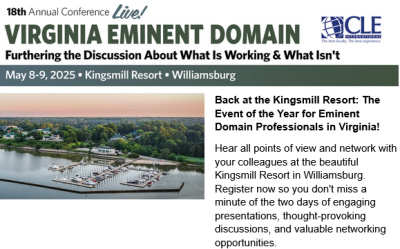
Virginia eminent domain 2025

Virginians: now is a good time to register for the Virginia Eminent Domain Conference, May 8-9, 2025, at the Kingsmill Resort in Williamsburg.

We have spoken and attended the Conference in past editions, and can report that it is excellent. We’re looking forward to joining friends and colleagues again in The Burg in the spring. Check out the faculty and agenda, and then register and reserve your spot.

We’ll see you there.Continue Reading Virginia Eminent Domain Conference: May 8-9, 2025, Williamsburg

1992 Aerial Photo Island2
Shands Key, with the City of Marathon in the background

This just in: in Shands v. City of Marathon, No. 3D21-1987 (Fed. 5, 2025), Florida’s Third District Court of Appeals sitting en banc held that the city’s downzoning of property (Shands Key, shown above in an exhibit from the Key West trial we participated in in June 2021) from General Use (density: one home per acre) to Conservation Offshore Island (one home per 10 acres; Shands Key is just under 8 acres) effected a Lucas taking because it deprived the owners of economically beneficial uses of their land. This, notwithstanding the possibility of the owners selling the property to a third party, who could have donated the property to city in return for a chit to move up in the city’s development queue.

We’re not going to go into too much detail or offer our opinion because this

Continue Reading Fla Ct App (en banc) In Takings Case: “failing to vindicate a right expressly stated in the Constitution is not judicial restraint but judicial abnegation. That we must not do.”

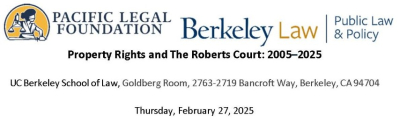
Property_rights_and_the_roberts_court_Agenda_

Register now and plan on joining us on Thursday, February 27, 2025 at the U.C. Berkeley Law School for a one-day conference: “Property Rights and the Roberts Court: 2005-2025.”

Here’s the agenda. Here’s a description of the program:

For much of the past century, property rights were relegated to second-class status compared to the rest of the Bill of Rights. However, under the Supreme Court leadership of Chief Justice John Roberts, this trend has begun to shift.

In recognition of the 20th anniversary of the Chief Justice’s elevation to the Supreme Court, Pacific Legal Foundation is partnering with Berkeley Law’s Public Law and Policy Program to host a day-long conference exploring the major property rights developments and future of property rights law in the Roberts Court.

We’ll hear from two different panels of renowned legal scholars and accomplished litigators, as well as a keynote lunch discussion between

Continue Reading Join Us: “Property Rights and The Roberts Court: 2005-2025” (Feb. 27, 2025, UC Berkeley Law School)

Here’s the latest in a case (and issue) we’ve been following.

In this latest iteration of what we call the “SWAT takings” issue, the Sixth Circuit, like every other federal appellate court, denied the owner of property severely damaged in the course of a police dislodging of a criminal suspect. But the court applied a different analysis. Instead of (incorrectly, we think) looking and whether the police were acting with the scope of their (ha!) police power, the court concluded that the police had a “privilege” to enter, so thus could destroy in the course of that entry, the petitioner’s property.

In short, your bundle of sticks never included the right to exclude the po-po.

Here’s the Question Presented:

A few weeks ago, this Court denied certiorari in Baker v. City of McKinney, 23-1363, a case about whether the Fifth Amendment’s Takings Clause re-quires compensation when a

Continue Reading New Cert Petition: SWAT Takings, Part X

The facts in D.A. Realestate Inv., LLC v. City of Norfolk, No. 23-1863 (Jan. 16, 2025), a recent decision from the U.S. Court of Appeals for the Fourth Circuit, are fairly sympathetic. And the opinion starts off with a tantalizing quote:

In 1761, Massachusetts lawyer James Otis exclaimed “one of the most essential branches of English liberty is the freedom of one’s house. A man’s house is his castle.” John Adams’s Reconstruction of Otis’s Speech in the Writs of Assistance Case, in Collected Political Writings of James Otis 12–13 (Richard Samuelson, ed. 2015). American law has embraced that principle since our nation’s founding. U.S. Const. amend. V. But we have also long recognized that “all property in this country is held under the implied obligation that the owner’s use of it shall not be injurious to the community.” Mugler v. Kansas, 123 U.S. 623, 665 (1887).

Slip op.

Continue Reading CA4: Challenge Public Use/Pretext Under Due Process And § 1983, Not Inverse

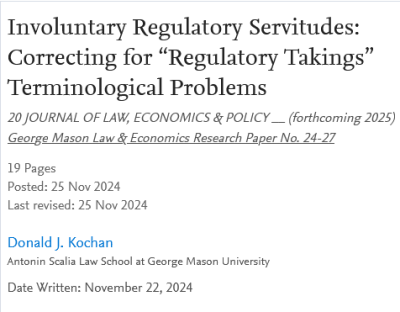
Screenshot 2024-12-09 at 16-13-02 Involuntary Regulatory Servitudes Correcting for “Regulatory Takings” Terminological Problems by Donald J. Kochan SSRN

Check this out, a new SSRN posting by lawprof Donald Kochan (George Mason/Scalia Law).

If this one is not a direct sequel to his earlier work on re-branding the “takings clause” (a piece we think is excellent and is part of the materials we teach in our Eminent Domain course at William and Mary Law), it does at least seem like a spiritual successor.

Here, Professor Kochan suggests that we’re being unclear when we use the term “regulatory takings” to describe those instances where an exercise of some governmental power other than eminent domain results in what feels like an eminent domain taking from the property owner’s viewpoint.

Instead, he argues, we should focus on the burdens the regulations place on an owner’s use (what the common law described as a servitude). To us, that seems very consistent with the Supreme Court’s approach, and proposals from other commentators. And it does focus the inquiry on the right question, namely what effect has a regulation put on an owner’s property rights. As that suggests, this should be a property-centric inquiry, and not on such unknowables such as the “character of the government action,” or whether an owner has “distinct investment-backed expectations.”

Here’s the Abstract:

This essay challenges the use of the term “regulatory takings” in our takings jurisprudence and scholarly discussion. The words we choose when developing doctrine matter. They can, even subconsciously, affect—by reducing, enlarging, distorting, limiting, or accurately shaping—the perceived and functional quality and character of the things they describe.

The better way to frame the inquiry underlying what is often called regulatory takings law should be to determine not whether there is a “regulatory taking” – some special kind of taking – but instead whether there is a regulation that amounts to a taking. Segmenting the judicial treatment of regulatory effects into a specialized analysis that takes it farther and farther away from an enterprise focused on equivalency between the private law of voluntary servitudes and the public law of what we should be calling involuntary regulatory servitudes. Regulations that restrict some but not all sticks in the property rights bundle should be characterized as the involuntary equivalent of the voluntary instrument, mechanism, or transfer that would have been necessary to achieve a parallel result. The essay proposes an alternative test for determining whether a regulation should be deemed a taking based on a comparison between the effect on the bundle from the regulation and determining whether the same effect in the private marketplace would have required a consensual, mutually beneficial exchange with appropriate compensation. This would better serve the meaning and purposes of the so-called Takings Clause.

The essay also documents the usage history of the regulatory takings label. To be sure, “regulatory takings” was not a dominate part of the takings lexicon before 1981. The first law review publication available in Westlaw to use the term “regulatory takings” is from 1965. The first court opinion to use the term came in a footnote in 1977. Briefing in advance of the 1980 U.S. Supreme Court decision in Agins v. Tiburon involved significant invocations of “regulatory takings” language across nearly a dozen briefs. But, the U.S. Supreme Court in its Agins opinion never uses the phrase “regulatory takings.” The first major court opinion to use “regulatory takings” language is the dissenting opinion by Justice William Brennan—joined by Justices Stewart, Marshall, and Powell—in the 1981 case of San Diego Gas & Elec. Co. v. City of San Diego. And, the Brennan dissent may have entrenched the term in the takings lexicon and is likely the impetus for widespread adoption of the term after 1981.

A must-read for all you takings…uh, dirt law…mavens.
Continue Reading New Article (Donald Kochan): “Involuntary Regulatory Servitudes: Correcting for ‘Regulatory Takings’ Terminological Problems”

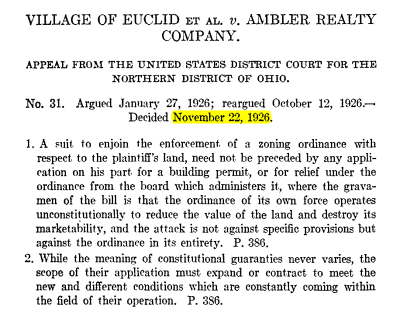
Euclid_front98 years old, and still going (for better or worse)

On this day in 1926, the United States Supreme Court issued its landmark opinion in Village of Euclid v. Ambler Realty Co., 272 U.S. 365 (Nov. 22, 1926).

You know this one (and can you call yourself a dirt lawyer if you don’t?). It’s the one in which the Supreme Court first upheld — against a facial due process challenge — the validity of this thing we call “zoning.” While in the intervening century, zoning has become a catch-all term for all sorts of regulatory restrictions on the uses of real property, land users know that “zoning” — ackshually — refers only to the regulation and separation of uses, and restrictions on density, and height regulation. At least that’s how it began.

While “Euclid” and “Euclidean zoning” have become part of the land use

Continue Reading (Un?)Happy Euclid Day!

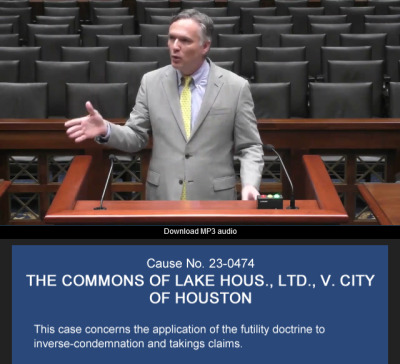
Screenshot 2024-11-04 at 12-34-18 Texas Supreme Court
Charles McFarland, arguing.

Here’s the latest in a case we’ve been following closely (and disclosure: our firm filed an amicus brief in the Texas Supreme Court).

In The Commons of Lake Houston, Ltd. v. City of Houston, the Texas Court of Appeals held that the city could not be liable for a taking for an ordinance that limited development and use within the city’s 100-and-500-year floodplains because the ordinance was a valid exercise of police power and otherwise survived the rational basis test.

As we wrote here, that seems like utter nonsense to say that a valid police power reason categorically insulates a government action from a takings challenge. After all, the entire regulatory takings doctrine is built on the notion that an otherwise-valid exercise of government power (here, the police power, delegated from the State to the city) can so impact an owner’s property rights that

Continue Reading Oral Arguments In Texas Takings Case: If The Govt Limits Use For Healthsafetywelfaremorals, Is It Exempt From Takings?

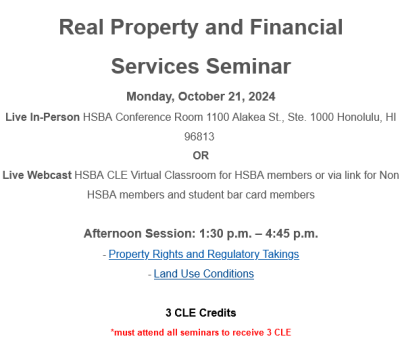
Screenshot 2024-10-11 at 08-06-50 RPFSS

Hawaii lawyers (and those barred in the 808), take note: On October 21, 2024, the Hawaii State Bar Association will hold its annual Convention, and as always there’s a full lineup of CLE programs so you can meet your MCLE requirements.

Thanks to the Real Property & Financial Services Section, there’s a significant dirt law component. First, there’s “Property Rights and Regulatory Takings” the program on which we are presenting along with Dwight Merriam and lawprof Shelley Saxer. Here’s the official description:

This course will provide a survey of property rights and regulatory takings with an emphasis on recent decisions from the United States Supreme Court. Panelists include distinguished faculty and practitioners that will address impact fees, development rights, taking claims, rent controls, and other current issues.

Following us will be a program on “Land Use Conditions” with Cal Chipchase, Brad Saito, and a lawyer

Continue Reading Hawaii Dirt Lawyers: Don’t Miss “Property Rights & Regulatory Takings” CLE At The HSBA Convention (In-Person & Webcast)

If there’s a silver lining in the U.S. Court of Appeals for the Sixth Circuit’s opinion in Slaybaugh v. Rutherford County, No. 23-5765 (Sep. 3, 2024), a case about what we call “SWAT takings” (police destroy someone’s property in order to dislodge a criminal suspect), it’s that the court did not adopt the usual “this was a really, really good exercise of the municipality’s police power so there’s no taking” approach.

But even though it applied a different analysis, the result was the same: no taking. Instead of the “police power” rationale, the court dug into the substance a bit more and determined that the police were “privileged” to physically invade and destroy the Slaybaugh property.

The court first acknowledged that owners generally have the right to exclude:

In arguing their prima facie takings claim, the Slaybaughs contend that police infringed on their property rights by invading

Continue Reading No SWAT Takings In CA6: Police’s Power To Arrest Includes Privilege To Damage Property