Screenshot 2023-06-16 at 07-52-47 How Did Property Rights Fare at the Supreme Court What Happened in the 2022 Term and What's Next ALI CLE

On Wednesday, August 9, 2023 at 1:00 – 2:00 p.m. (Eastern Time), please join us for ALI-CLE’s web program, “How Did Property Rights Fare at the Supreme Court? What Happened in the 2022 Term and What’s Next.”

Here’s the course description:

This has been a blockbuster U.S. Supreme Court term for property law, with the Court deciding three major property cases: Tyler v. Hennepin County (government’s keeping the excess value when seizing and selling a home to satisfy a property tax debt is a taking), Wilkins v. United States (is the federal Quiet Title Act’s statute of limitations a jurisdictional bar?), and Sackett v. EPA (the scope of Clean Water Act wetlands jurisdiction). To gain a better understanding these opinions, the current state of takings and property law, and what these cases mean for your practice, join a distinguished panel of experts for this one-hour webcast. The faculty will


Continue Reading Join Us August 9, 2023: ALI-CLE’s “How Did Property Rights Fare at the Supreme Court? What Happened in the 2022 Term and What’s Next”

In Livingood v. City of Des Moines, No. 22-0586 (June 9, 2023), the Iowa Supreme Court held that the city’s use of the Iowa’s process by which the government can satisfy all or part of a taxpayer’s debt to a public agency by grabbing someone’s tax refund. In a nutshell, after trying to collect the debt by more conventional means:

the income offset program allows the department of administrative services to collect debts for public agencies by offsetting the debts against any income tax refund owed to a taxpayer. The city entered into a memorandum of understanding with the department of administrative services to use the income offset program.

Slip op. at 4-5.

The debt owed in Livingood is for traffic violations caught on camera.

Is it a taking under the Iowa Constitution to not give the taxpayer/cam-violator the full amount of tax refund?

No. First, the court held

Continue Reading Iowa: City Of The Monks Keeping Part Of Your Tax Refund Isn’t A Taking, Red-Light Runners

Here are what others are saying about Supreme Court’s recent ruling in Tyler v. Hennepin County, No. 22-166 (U.S. May 25, 2023), the case in which the Court unanimously held that the county’s keeping the excess equity in Ms. Tyler’s home over what she owed in property taxes and fees is an uncompensated taking of private property.

  • As usual, lawprof Ilya Somin was first out of the gate with “Major Unanimous Supreme Court Victory for Property Rights in Tyler v. Hennepin County” (“While the Supreme Court decision left some notable issues unresolved, it nonetheless sets a significant precedent. Most obviously, the jurisdictions that currently authorize home equity theft—some twelve states and the District of Columbia—will no longer be allowed to do so. In addition, the holding that states cannot just redefine property rights at will has important implications for other property rights issues. It makes it harder


Continue Reading Tyler Takings Round-Up

DSCF3117
If you know, you know.

Pacific Legal Foundation (that’s us) has put out a call for papers about “Rethinking Penn Central.” Here’s the details (pdf).

Here’s some of the suggested topics:

  • Can Penn Central be salvaged or does it need to be fully replaced?
  • If it is to be replaced, what should the new test be?
  • Alternatively, what improvements can be made to Penn Central that would address problems raised by critics without uprooting the test entirely?
  • Is economic loss primarily relevant to compensation owed rather than the threshold question of whether a taking has occurred?
  • Can a more categorical approach, like those taken in cases including Cedar Point Nursery v. Hassid, Hodel v. Irving, or Lucas v. South Carolina Coastal Council, adequately address regulatory takings?
  • What insights does the original meaning of the Takings Clause offer regarding how to fix or replace Penn


Continue Reading Rethinking Penn Central: A Call For Symposium Papers

Caesar
We’ll be rendering to unto Caesar, but first we must
decide: classic or creamy?

That was quick: it seems like it was only yesterday — or maybe more accurately, less than a month ago — that we were listening in live to the Supreme Court as it heard arguments in Tyler v. Hennepin County, No. 22-166, our law firm’s case which argues that Hennepin County’s keeping the excess equity in Ms. Tyler’s home over what she owed in property taxes and fees is an uncompensated taking of private property and also violates the Excessive Fines Clause.

This morning, the Court issued this unanimous opinion authored by Chief Justice Roberts (again proving he’s the Court’s “property guy”), in which the Court held that the County’s seizing Ms. Tyler’s condo to satisfy her tax debt and then “keeping the change” is a taking. It’s a relatively short opinion with no

Continue Reading Unanimous SCOTUS: “state law cannot be the only source” Of Property Rights, And “traditional property law principles” As Enforced By The Takings Clause Play A Role

When we last visited Sheetz v. El Dorado County, we finished with “stay tuned” because we suspected that the California Court of Appeal’s opinion concluding that the County’s traffic mitigation fee is immune from Nollan/Dolan nexus-and-rough-proportionality review because the legislature imposed the fee on everyone (and Sheetz was not subject to paying it because of an ad hoc agency decision) was not going to be the last word, either in the case or on the legislative exactions issue.

Well, now the predicted other shoe drop: the property owner has filed this cert petition, with this Question Presented:

George Sheetz applied to the County of El Dorado, California, for a permit to build a modest manufactured house on his property. Pursuant to legislation enacted by the County, and as the condition of obtaining the permit, Mr. Sheetz was required to pay a monetary exaction of $23,420 to help finance

Continue Reading New Cert Petition: The Supreme Court Should Resolve The Legislatively-vs-Administratively Imposed Exactions Issue

Sidewalk

A good opinion from the U.S. Court of Appeals for the Sixth Circuit in Knight v. Metro. Gov’t of Nashville, No. 21-6179 (May 10, 2023), holding that conditions imposed on every development — and not just ad hoc administratively-imposed conditions — must conform to the Nollan-Dolan-Koontz close nexus and rough proportionality standards.

You takings and land use mavens can stop right there, because you know what this means: the Sixth Circuit has added to the growing split in the lower courts about whether legislatively-imposed conditions on development which cover everyone are, as some courts characterize them, mere land use regulations subject only to Euclid‘s rational basis review, or are constrained by N-D-K ‘s requirements (see here, and here for examples). The Supreme Court has been presented with the lower court disagreement, but so far has not stepped in and resolved the issue.

The Sixth Circuit experienced

Continue Reading CA6: Legislative Conditions Are Subject To Nexus-And-Proportionality Requirements

We’re not going to dwell too much on the U.S. Court of Appeals’ opinion in Fox v. Saginaw County, No. 22-1265 (Apr. 28, 2023), because even though it is a case involving the “home equity theft” takings issue argued at the Supreme Court last week, this one tells us more about civil procedure than takings. 

The Fox case is a class action, and several of the defendant counties may engage in the practice of seizing property and liquidating it to satisfy a tax debt (and then keep any excess), but they didn’t do it to the lead plaintiff Mr. Fox.

The district court held that the class action could proceed, but the Sixth Circuit said no: Fox may have standing to assert the one county that kept his equity has taken his property, but has no standing to assert claims against the other governmental defendants because those defendants

Continue Reading No Class: CA6 Rejects Class Certification For Home Equity Theft Takings Case

52851572390_8ab246acf3_o
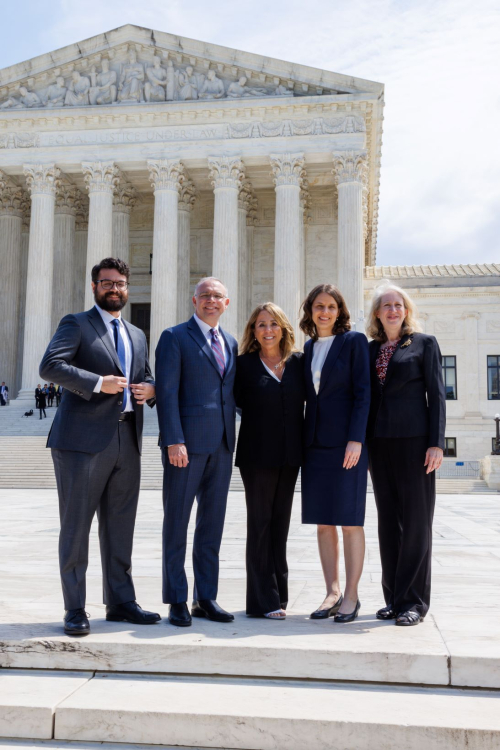
Our Pacific Legal Foundation Property Rights Litigation Tyler team,
and Counsel of Record Christina Martin (second from right)

Here are your links to the buzz about Tyler v. Hennepin County, No. 22-166, our law firm’s case which argues that Hennepin County’s seizure of Ms. Tyler’s condo and then keeping the excess equity over what she owed in property taxes and fees, is an uncompensated taking of private property, and also violates the Excessive Fines Clause.


Continue Reading Tyler SCOTUS Takings Argument Round-Up

Coffee
Coffee is for closers.
(Yes, we were up and at the desk at 4 a.m. local time

to listen live. We just needed a direct injection of coffee.)

Here is the transcript, and the audio recording of today’s U.S. Supreme Court arguments in Tyler v. Hennepin County, No. 22-166, our law firm’s case which argues that Hennepin County’s keeping the excess equity in Ms. Tyler’s home over what she owed in property taxes and fees, is an uncompensated taking of private property, and also violates the Excessive Fines Clause.

We will bring you the analysis of the arguments and the pundits’ predictions in a subsequent posts. But for the time being here these are in case you missed out listening live. Stay tuned.

Transcript, Tyler v. Hennepin County, No. 22-166 (U.S. Apr. 26, 2023)

Continue Reading Today’s Takings SCOTUS Oral Argument Transcript And Recording: Tyler v. Hennepin County