Screenshot 2023-08-26 at 10-33-05 Brigham-Kanner Property Rights Conference

Heads-up: the registration page for the 20th Brigham-Kanner Property Rights Conference, October 26-27, 2023, at the William and Mary Law School in Williamsburg, Virginia, is now up.

Early registration is a good thing because space is limited, especially at the Wren Building banquet on the 26th, at which the 2023 B-K Property Rights Prize will be presented to Prof. Gregory Alexander.

So please don’t miss out.
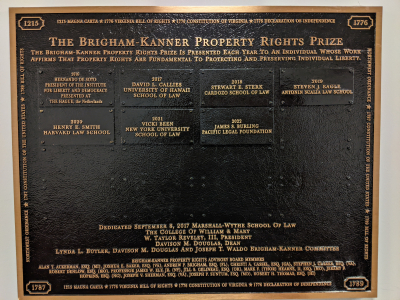
2022 BK plaque
The Property Rights Hall of Fame (second plaque)

If you are not already familiar with the Conference, it is (in our opinion) the best one-day event on property and property rights theory and practice. Expressly designed to bring together the legal academy and the practicing dirt law bar, the conference is where we discuss the burning property and property rights issues of the day. Here’s the 2023 Program:

  • Property and Propriety (or a Well-Ordered Society): A Tribute to Gregory S.

Continue Reading Register Now For The 20th Brigham-Kanner Property Rights Conference, Oct. 26-27, 2023

ExecOrder

The two-plus years under the declared Co-19 emergency surely have given Hawaii’s executive-branch officials a clear vision of how much easier they could get their agendas accomplished without all that pesky democracy.

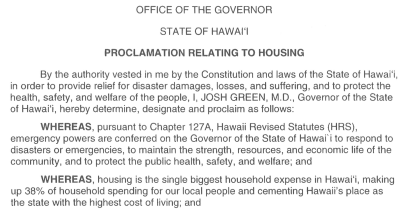
Hawaii’s Sweeping Emergency Management Act: Governor is the “Sole Judge”

Hawaii’s Emergency Management Act gives state and county executives broad and nearly unreviewable authority to suspend a wide spectrum of the usual laws, regulations, and rules. As we wrote in Hoist The Yellow Flag and Spam® Up: The Separation of Powers Limitation on Hawaii’s Emergency Authority, 43 U. Hawaii L. Rev. 71 (2020), Hawaii’s Act confers among the nation’s most muscular and sweeping powers. For example, the governor is the “sole judge of the existence of the danger, threat, or circumstances giving rise to a declaration of a state of emergency.” The Act’s one limitation — the 60-day time limit on how long an

Continue Reading What If The Hawaii Governor’s Cutting Of The Gordian Land Use/Environmental Knot Actually Works?

Screenshot 2023-07-31 at 08-01-31 Necessity Exceptions to Takings

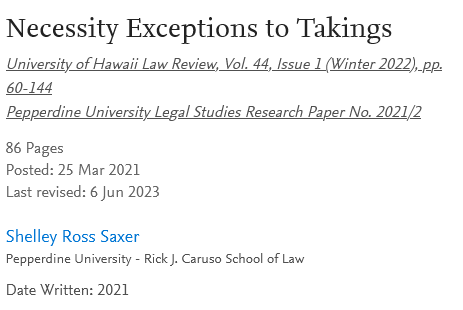
Worth checking out: a new article from Pepperdine Law School’s Shelley Ross Saxer, published in the University of Hawaii Law Review, “Necessity Exceptions to Takings,” 44 U. Haw. L. Rev. 60 (2022). [Disclosure: as noted in the author’s note, we reviewed an earlier draft of the piece and provided some thoughts.]

Here’s the Abstract:

The doctrine of necessity has strong roots in the common law of tort and property going back hundreds of years. In the United States the doctrine has been applied in various situations to negate judicial review of constitutional challenges to government action, most recently in some of the wildfire and flood claims resulting from disasters. But now, the states’ responses to the COVID-19 pandemic have brought one of these necessity doctrines—the public health necessity relying on Jacobson v. Massachusetts—to the forefront as courts across the country review constitutional challenges to state public

Continue Reading New Article – “Necessity Exceptions to Takings” (Shelley Ross Saxer)

Not saying Kelo

A big thanks to friend and colleague Paul Henry for bringing to our attention this article by Andrew Stuttaford, UFOs and Eminent Domain.

No, it (unfortunately) is not the latest tenure-making scholarly law journal article (but we can dream, can’t we?), but a piece in National Review.

It details a proposal to release federal documents relating to UFOs. Nice. But buried in the measure is this (according to Reuters):

Under the measure, records must be publicly disclosed in full no later than 25 years after they were created unless the U.S. president certifies that continued postponement is necessary because of a direct harm to national security.

It also establishes that the federal government would have “eminent domain” over any recovered technologies of unknown origin and any biological evidence of “non-human intelligence” that may be controlled by private individuals or entities.

Who among us is going to be

Continue Reading New Article: “UFOs and Eminent Domain”

 A short one from the Florida District Court of Appeals (First District).

In D’Arcy v. Florida Gaming Control Comm’n, No. 1D21-3606 (May 24, 2023), the court held that the voters of Florida adopted Amendment 13 to the Florida Constitution that outlawed betting on greyhound racing (indeed betting all dog racing), it did not effect a Penn Central taking of the property of the owner of a greyhound racing business.

The trial court granted the state summary judgment, and the appeal court affirmed. The court also pointed out that the Amendment didn’t ban dog racing outright, merely betting on dog racing. Slip op. at 3. The court focused on a single Penn Central factor, the “expectations” question and held that “given then heavily regulated field of gambling, D’Arcy did not have a reasonable expectation that the investment in dog racing could not be severely impacted by regulation.” Id.

It is

Continue Reading Don’t Release The Hounds! No Taking When Florida Voters Outlawed Dog Race Gambling

The voters of South Lake Tahoe, California, adopted an ordinance that forbade the city from issuing short-term rental permits for properties in residential zones unless the owner was a permanent resident of the city, and declared that all short-term rental permits would expire three years later. The trial court granted the city summary judgment on all claims raised by an association of property owners who rented short-term. 

In South Lake Tahoe Property Owners Group v. City of South Lake Tahoe, No. C093603 (June 20, 2023), the California Court of Appeal mostly agreed, holding that the owners’ vested rights and state law preemption claims did not survive. But the court disagreed with the trial court’s dismissal of a (dormant) Commerce Clause challenge to the residency component. As noted in this recent Fifth Circuit decision, local ordinances that discriminate between residents and non-residents are (or at least could be) too

Continue Reading Cal Ct App: Prohibition On Short-Term Rentals Might Have A Commerce Clause Problem

Here’s the latest in an issue we’ve been following.

Let’s say the government thinks you have committed a crime (or someone else has). To investigate, it seizes property as evidence or potential evidence. But after things wrap up and it no longer needs the property as evidence, the government doesn’t return it to its owner. Taking or no taking?

Some courts say it could be a taking. Others say no.

In Jenkins v. United States, No. 22-1378 (June 28, 2023), the U.S. Court of Appeals for the Federal Circuit said maybe. Or at least it isn’t not a taking simply because the government was lawfully exercising its police power. And if there may be open questions about the whether the owner sought recovery of the property through available procedures or outright abandoned it, then a court entering summary judgment for the government isn’t right.

Most of the

Continue Reading CAFED: Just Because The Govt Seized Property As Evidence Doesn’t Mean It Can Keep It Without Compensation

We’re not going to dwell all that much on the California Court of Appeal’s recent opinion in Discovery Builders, Inc. v. City of Oakland, No. A164315 (June 22, 2023), mostly because it seems entirely predictable.

The developer thought it had an agreement with the city to pay certain fees (dare we say “exactions”) the city required in order to approve and provide what the court calls “project oversight.” The contract “provided that the fees set forth in the agreement satisfied ‘all of the Developer’s obligations for fees due to the City for the Project.'” Slip op. at 1. You know where this is headed, don’t you?

That’s right, eleven years later while the project was still underway, the city adopted new ordinances imposing new impact fees. When the developer sought additional building permits … no permit without paying the additional exactions. The trial court thought the contract took care

Continue Reading Chump Alert! Developer’s Claim That City Can Be Held To Its Contract Limiting Exactions Goes About As Well As You’d Expect

In this very short (but apparently published) opinion, the U.S. Court of Appeals held that it was not right to dismiss a claim on the pleadings and that factual development is warranted, even where the complaint alleges that a municipal land use ordinance is arbitrary and capricious, and the city claims it has a rational basis for the ordinance.

And when we say “short,” we mean it. Here’s the entirety of the opinion:

Plaintiffs here appeal the Rule 12(b)(6) dismissal of their complaint alleging that the City of New Braunfels’s zoning regulation banning short-term rentals of residential properties in certain areas of the city is unconstitutional. The district court ordered dismissal by approving a few conclusory paragraphs in the magistrate judge’s recommendation. This court’s relevant case law, however, indicates that some factual development may often occur in these cases, and that summary judgment may often follow. See, e.g

Continue Reading CA5 Makes Short Work Argument That Asserting A Rational Basis For A Short-Term Rental Ban Is Enough To Secure Pleadings Dismissal Of Arbitrary And Capricious Challenge

Screenshot 2023-06-16 at 17-28-39 TJB SC Orders & Opinions 2023 June June 16 2023

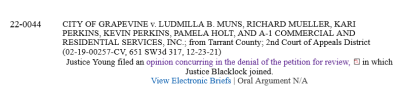
In this order, the Texas Supreme Court declined to review a case we’ve been following, in which the court of appeals held that Grapevine’s total ban on short-term renting of property — banning even owners who had been doing so for a while — might be a taking. The court held that even though the owners did not possess a classic vested right to continue using their properties to rent on a short-term basis, they owned their properties and that was enough. Property ownership comes with the “fundamental” right to rent it out and there’s no need to show more, such as a vested right under state law. More details on the city’s ban and the court’s reasoning here.

The city sought discretionary review and somewhat unusually, the property owners agreed that this is an important issue worthy of the Supreme Court’s review.

But even with everyone

Continue Reading Texas Supreme Court: We Want To Resolve Whether Short-Term Renting Property A Natural Right, Just Not In This Case