We’re not going to dwell too much on the U.S. Court of Appeals’ opinion in Fox v. Saginaw County, No. 22-1265 (Apr. 28, 2023), because even though it is a case involving the “home equity theft” takings issue argued at the Supreme Court last week, this one tells us more about civil procedure than takings. 

The Fox case is a class action, and several of the defendant counties may engage in the practice of seizing property and liquidating it to satisfy a tax debt (and then keep any excess), but they didn’t do it to the lead plaintiff Mr. Fox.

The district court held that the class action could proceed, but the Sixth Circuit said no: Fox may have standing to assert the one county that kept his equity has taken his property, but has no standing to assert claims against the other governmental defendants because those defendants

Continue Reading No Class: CA6 Rejects Class Certification For Home Equity Theft Takings Case

52851572390_8ab246acf3_o
Our Pacific Legal Foundation Property Rights Litigation Tyler team,
and Counsel of Record Christina Martin (second from right)

Here are your links to the buzz about Tyler v. Hennepin County, No. 22-166, our law firm’s case which argues that Hennepin County’s seizure of Ms. Tyler’s condo and then keeping the excess equity over what she owed in property taxes and fees, is an uncompensated taking of private property, and also violates the Excessive Fines Clause.


Continue Reading Tyler SCOTUS Takings Argument Round-Up

Coffee
Coffee is for closers.
(Yes, we were up and at the desk at 4 a.m. local time

to listen live. We just needed a direct injection of coffee.)

Here is the transcript, and the audio recording of today’s U.S. Supreme Court arguments in Tyler v. Hennepin County, No. 22-166, our law firm’s case which argues that Hennepin County’s keeping the excess equity in Ms. Tyler’s home over what she owed in property taxes and fees, is an uncompensated taking of private property, and also violates the Excessive Fines Clause.

We will bring you the analysis of the arguments and the pundits’ predictions in a subsequent posts. But for the time being here these are in case you missed out listening live. Stay tuned.

Transcript, Tyler v. Hennepin County, No. 22-166 (U.S. Apr. 26, 2023)

Continue Reading Today’s Takings SCOTUS Oral Argument Transcript And Recording: Tyler v. Hennepin County

SCOTUS

Tomorrow, Wednesday, April 26, 2023, at 10:00 a.m. Eastern Time, the U.S. Supreme Court will be hearing oral arguments in Tyler v. Hennepin County, No. 22-166, our law firm’s case which argues that Hennepin County’s keeping the excess equity in Ms. Tyler’s home over what she owed in property taxes and fees, is an uncompensated taking of private property, and also violates the Excessive Fines Clause.

Listen to the arguments live, here.

We posted some preview links earlier this week here. But wait, there’s more!


Continue Reading More SCOTUS Takings Previews (Argument Tomorrow, 10am ET)

Take a deep dive into the arguments and amicus briefs

This Wednesday, April 26, 2023, the U.S. Supreme Court will hear oral arguments in Tyler v. Hennepin County, No. 22-166, our law firm’s case which argues that Hennepin County’s keeping the excess value in Ms. Tyler’s home over what she owed in property taxes and fees, is an uncompensated taking of private property, and also violates the Excessive Fines Clause.

Here are links to programs, summaries, and events to help you understand the arguments and issues, as well as registration for post-argument analysis:


Continue Reading Get Ready For SCOTUS Takings Arguments (Wednesday, April 26, 2023)

Screenshot 2023-04-11 at 20-42-01 Deep Dive and Amicus Review Tyler v. Hennepin County

Here at our law firm, we’re getting ready as one of our colleagues prepares to argue the Supreme Court’s next takings case in a couple of weeks. Yes, this is what we’ve alternatively called the “home equity theft” or the “keep the change” case where government seizes property to satisfy the owner’s tax debt, and after liquidation of the property and satisfaction of the debt, keeps any excess equity instead of returning the balance to the (former) homeowner.

The case is Tyler v. Hennepin County, No. 22-166, and it’s set for argument on the last day of this term’s argument calendar, Wednesday, April 26, 2023.

In the meantime you should check out the parties’ merits briefs and the beaucoup amici briefs (mostly filed in support of the property owner) on the Court’s docket.

But you should also see what others have to say, and how they are

Continue Reading Tyler v. Hennepin County Previews: Get Yourself Prepared For The Next SCOTUS Takings Arguments

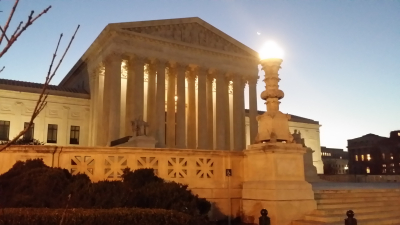
20151208_064159

Here’s the merits brief, filed yesterday in the above-depicted Court by our law firm colleagues, headed by Counsel of Record Christina Martin in Tyler v. Hennepin County, No. 22-166, a case and an issue we’ve been following closely. This is the one, where, as recounted in the petition:

Hennepin County confiscated 93-year-old Geraldine Tyler’s former home as payment for approximately $15,000 in property taxes, penalties, interest, and costs. The County sold the home for $40,000, and, consistent with a Minnesota forfeiture statute, kept all proceeds, including the $25,000 that exceeded Tyler’s debt as a windfall for the public. In all states, municipalities may take real property and sell it to collect payment for property tax debts. Most states allow the government to keep only as much as it is owed; any surplus proceeds after collecting the debt belong to the former owner. But in Minnesota

Continue Reading Property Owner’s SCOTUS Merits Brief: “Under no circumstances can government have an unbounded ability to confiscate entire properties of any size for even the most minimal tax debts.”

We already know that in Rafaeli, LLC v. Oakland County, 952 N.W.2d 434 (2020), the Michigan Supreme Court held that a homeowner has a property interest in the equity in her home, and that if she fails to pay the full amount of her property taxes and the government forecloses, the government can’t keep the proceeds in excess of the amount of the tax delinquency.

But did this ruling apply retroactively to cases where the foreclosure and sale (and the government keeping the change) occurred before the Rafaeli opinion was issued? That was the issue the Michigan Court of Appeals considered in Schafer v. Kent County, No. 356908 (Sep. 22, 2022).

Long story short: yes, the Rafaeli ruling is one upholding the Michigan Constitution, and did not so much establish a new principle of law as “returned the law to that which was recognized at common law and

Continue Reading Mich App: Supreme Court’s Takings Ruling Is Retroactive Because It Is Not A New Rule, But Returned To Common Law

Check out the U.S. Court of Appeals for the Sixth Circuit’s opinion in Harrison v. Montgomery County, No. 20-4-51 (May 11, 2021). It’s short, readable. And, most importantly, involves a subject that’s near and dear: takings, and the myriad potential traps that await an unsuspecting property owner making such a claim.

If you’ve ever asserted a takings claim, you know what we mean. The other side may argue you are too late (statute of limitations, for example), or too early (ripeness, in one form or another), or, remarkably, you are both too early and too late (yeah, that happens). Or simply that property questions are not worthy of the court (abstention). And these arguments are often not presented in a clear way — more like “here’s a bunch of reasons to throw this case out Judge, see which one you like” — and

Continue Reading Sixth Circuit Says No To Res Judicata As The Latest Williamson County Workaround

Our Louisiana friends have a great word — lagniappe — that we’re not sure we understand precisely, but to us has always meant that little something extra. As Mark Twain wrote, “[i]t is the equivalent of the thirteenth roll in a ‘baker’s dozen.’ It is something thrown in, gratis, for good measure.” As far as we can tell, however, it’s meant to be something you give to others, not a little something extra you keep for yourself.

Maybe that message didn’t make its way up to Michigan, because until the Michigan Supreme Court’s ruling in Rafaelli, LLC v. Oakland, County, No. 156849 (July 17, 2020), local governments apparently were free to treat themselves to a little something extra when they foreclosed on property for the owner’s failure to keep up with their property tax payments. They would sell the property, pay themselves the taxes owed, and then pocket anything

Continue Reading Michigan: Gov’t Keeping The Change From Tax Delinquency Sale Is A Taking