Today’s case is a short one, but worth the short bit of your time it takes to read it.

In Borders-Self Storage & Rentals, LLC v. Ky. Transp. Cabinet, No. 2019-CA-000217 (July 2, 2020), the Kentucky Court of Appeals held that the assessed value of property for property tax purposes is admissible if the value was fixed by the property owner, and the condemnor offers it as an admission against interest. But if the landowner offers the same property tax assessed value, it is not admissible.

The Court of Appeals didn’t make up this uneven rule, but was merely applying a long-standing rule in Kentucky, first adopted by the Kentucky Supreme Court in Culver v. Commonwealth, Department of Highways, 459 S.W.2d 595, 597-98 (Ky. 1970). And the Court of Appeals has to follow Supreme Court precedent.

After Borders upgraded the property, it commissioned an appraisal which, in accordance
Continue Reading Kentucky App Ct: Even Though We Don’t Agree, Tax Assessment Is Admissible In Eminent Domain Only By Condemnor Against Property Owner

The town grabs, then sells property for failure to pay property taxes. The sales price is more than the tax lien. Does the town have an obligation to give the owner the difference, or can it keep it unless the owner sues?

Thanks to a colleague who sent us the case, we know that was the issue facing the New Hampshire Supreme Court in Polonsky v. Town of Bedford, No. 2019-0339 (Apr. 24, 2020). Short story: yes, the town needs to affirmatively give the extra money back, and no, the town can’t keep it unless and until the owner sues to get it. To read the statutory scheme otherwise would result in an unconstitutional taking.

Check it out (quick read, only 13 pages). 

A couple of notes:

  • The owner asserted his rights under part I, article 12 of the New Hampshire Constitution (“no part of a man’s property shall


Continue Reading NH: Govt Keeping Excess Proceeds Of Tax Sale Is A Taking

6a00d83451707369e2022ad3b86fce200d-800wi

You overwhelmingly asked for Nashville, and we’re bringing it to you!

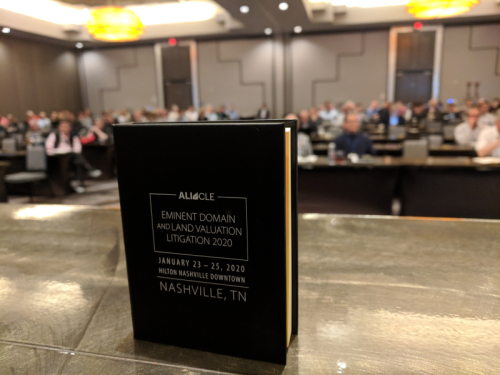
Get ready, and hold your place now: here’s the list of programs and speakers for the 36th Annual ALI-CLE Eminent Domain and Land Valuation Litigation Conference, to be held at the Downtown Nashville Hilton, January 23,- 25, 2020. Two-and-a-half days with top-notch national faculty (lawyers from both sides, judges, legal scholars, appraisers, relocation experts, and others).  

Early registration and group rates are available now

Here are just some of the programs:

  • Featured Presentation: Property Rights as Civil Rights: Seeking Justice Though the Fourth and Fifth Amendments. Hon. Jonathan Apgar, Jamila Johnson, Alan Ackerman. Moderator: Leslie Fields.
  • Making Sense of the New Rules After Knick v. Township of Scott: Where Do I Go, What Do I Do? David Breemer, Smitha Chintamaneni, Professor Bethany Berger. Moderator: Professor Steven Eagle.
  • When A River Runs Thought It: Water Rights and


Continue Reading Here’s The Agenda And Faculty For The 2020 ALI-CLE Eminent Domain And Land Valuation Litigation Conference, Nashville, Jan 23-25, 2020

What, you may ask, does the challenge by Hawaii’s counties to the proposed constitutional amendment which was on the ballot (until just a few minutes ago) have to do with the usual topics of this blog?

Not a whole lot (although we do cover property tax and election law issues occasionally), but as always, there’s a takings hook. Read to the end. 

The ballot measure proposed to amend the Hawaii Constitution’s property tax provision (article VIII) which currently delegates to the counties the exclusive power to levy property taxes. The measure, proposed by the legislature read:

Shall the legislature be authorized to establish, as provided by law, a surcharge on investment real property to be used to support public education? 

The counties, offended that the State would horn in on their property tax monopoly, challenged the ballot question as misleading. This would be a dilution of the counties’ property taxation power, not

Continue Reading HAWSCT Removes Property Tax … Oops, “Surcharge on Investment Real Property” – Measure From The Ballot

20180717_135234_HDR

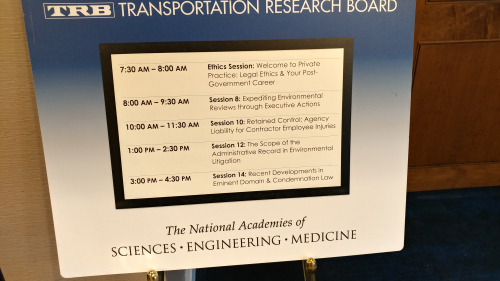
Here are the cases and other items I either spoke about or mentioned at today’s Transportation Research Board‘s 57th Annual Workshop on Transportation Law in Cambridge, Massachusetts:


Continue Reading Links And Materials From Today’s Transportation Research Board Session

Here’s a newly-filed cert petition which asks the Supreme Court to review a Sixth Circuit decision in which the county auctioned the Church’s property to satisfy a tax lien, then kept the difference between the owed taxes plus costs, and the proceeds from the sale. The court dismissed the claim under Williamson County because it concluded that the Church could have pursued compensation from the county under state procedures.  

Here are the Questions Presented:

When Wayside Church fell behind on the property taxes for its youth camp, Van Buren County foreclosed and sold the youth camp for $206,000. After satisfying the church’s $16,750 in penalties, taxes, and fees with the proceeds from the sale, the County pocketed the remaining 91% of the property’s value as a windfall required by Michigan’s property tax law. Likewise, the County kept the surplus when it seized and sold Myron Stahl’s land and Henderson

Continue Reading New Cert Petition: Overrule Williamson County!

The Sixth Circuit’s majority opinion in Wayside Church v. Van Buren County, No. 15-2463 (Feb. 10, 2017) isn’t all that exciting — after all, it was a takings case brought in federal court, and you know what that means: Williamson County — but do give it a read. The facts are somewhat unusual, even if the court’s ultimate conclusion is not.

It involved the intricacies of Michigan’s General Property Tax Act, a statute which allows municipalities to the foreclose on properties that are delinquent in paying property taxes. The municipalities are allowed to auction off the properties and keep the money, even if the auction proceeds exceed the delinquent taxes. That’s what happened here.

Wayside didn’t pay its property taxes, the County foreclosed, obtained fee simple title, and auctioned the property. The sales price of $206,000 exceeded the minimum bid price, which had been calculated by adding up the back

Continue Reading 6th Circuit: Michigan Statute Allows Recovery Of Money, So Takings Claim Not Ripe For Federal Court

 IMG_20160929_102807
During. Good crowd.

20160929_074511
Before. Note the power strips on the tables.
Well played, Caesar’s, well played
.

To supplement your written materials, here are the decisions and other materials which we spoke about this morning at the CLE International Eminent Domain seminar:


Continue Reading Links And Notes From Today’s Las Vegas Eminent Domain Seminar

An interesting post at Honolulu journalist Ian Lind’s blog, “City’s explanation of discrepancies in real property tax assessments don’t satisfy,” commenting on a recent piece in the Honolulu Star-Advertiser about the City and County of Honolulu’s method for appraising residences for property tax purposes (“Home price, taxable value can diverge“). 

If appraisal of real property is more art than science, then appraisal of property for property tax purposes is more like graffiti than art.Continue Reading City’s “Mass Valuation” For Property Taxes

There’s a category of cases in which it isn’t difficult, with reasonable accuracy, to predict the ultimate outcome without knowing much about the substantive law. The recent ACA and marriage cases, for example. You kind of just know how they’re going to come out. Bush v. Gore, 531 U.S. 98 (2000), was another one of those. Because the practical and political forces at play in those and similar cases overwhelm the legal objections no matter how technically and logically correct they appear, and the justices in the majority probably end up making their decisions based on pragmatic as well as their (perceived) policy inclinations. The opinions and dissents get dressed up with citations to precedent and the like, but what really seems to drive these cases is their practicalities. 

It seems to us that today’s 5-4 decision in Arizona State Legislature v. Arizona Independent Redistricting Comm’n, No. 13-1314 (June 29

Continue Reading Hawaii’s Reapportionment Commission Breathes A Sigh Of Relief: SCOTUS Upholds Arizona Redistricting Commission