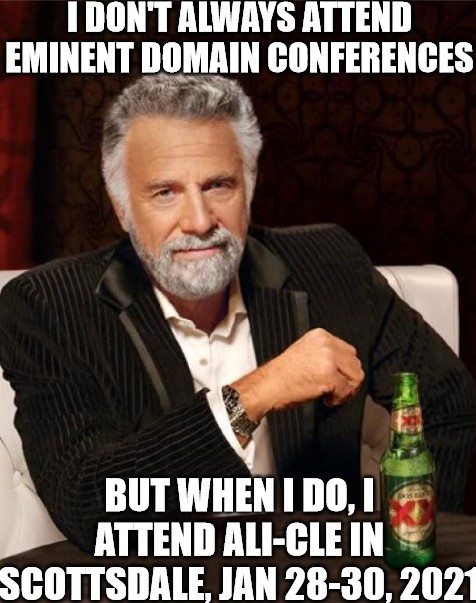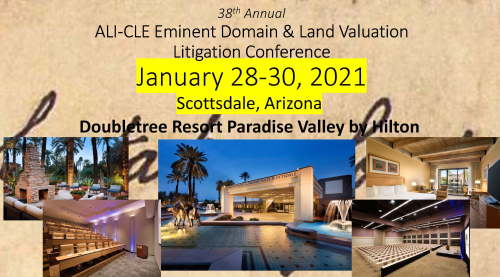
For the Millennials:


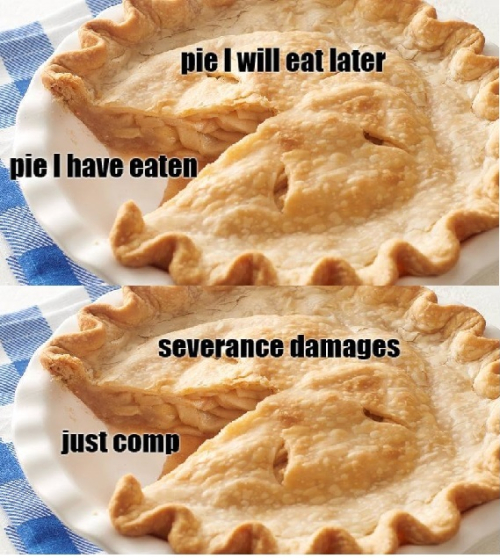
Picture 1: how normal people see pie.
Picture 2: how you see pie if you’re coming to the
ALI-CLE Eminent Domain Conference.
If you get the above, you probably are already set to join us next week for the 37th Annual ALI-CLE Eminent Domain and Land Valuation Litigation Conference in Nashville. (If not, shame on you!).
And having just reviewed the latest registration list, I can report that we have an all-time record attendance. But there’s still room for those of you still not committed. Register here. Don’t miss out. There will be pie. Continue Reading Record Attendance (But There’s Still Time For You Last-Minute Filers) At Nashville ALI-CLE Eminent Domain Conference
If there’s one downside to the law school experience from the teacher’s side of the lectern, it’s grading. Especially at a law school like William and Mary that has a pretty strict mandatory curve.
In an upper-division course like “Eminent Domain and Property Rights Law,” where we’re dealing with some very high-level stuff and the quality of the students is uniformly excellent, that makes for some hard choices at this time of year. But we’ve wrapped up grading, and have submitted the official scores.
Although I cannot share with you all the papers themselves, I don’t think my students would mind if I give you a sampling of the topics and titles, just so you can see how the next generation of lawyers is thinking about this area of law:
Here’s the latest in a case (and issue) we’ve been following.
In Puntenney v. Iowa Utilities Board, 928 N.W.2d 829 (Iowa 2019), the Iowa Supreme Court answered a question that has been making its way around: what “public” does the “public use” requirement cover? For the Iowa Constitution, for example, does a taking have to be of direct benefit to the people of Iowa?
The court there addressed the issue by not answering the the question directly, but by concluding that the Iowa public is indirectly served by the taking of private property for a pipeline, even though there are no “onramps” or “offramps” for the oil in Iowa. The taking would have the other, usual, butterfly effect Iowa benefits: some jobs, cheaper gas, and the like. Kentucky and West Virginia courts have reached the opposite conclusion (the taking must directly serve the people of the state), but Ohio and
Continue Reading New Cert Petition: It’s Not Enough For A Condemnor To Invoke A “Classic” Public Use
A very short opinion we’ve been meaning to post for a while.
In Hickman v. Ringgold County, No. 19-0123 (Nov. 6, 2019), the Iowa Court of Appeals considered property owners’ claim that the taking of their land to create a access road for the neighboring concrete plant was not a valid public use. Seemed like a pretty good claim. After all, Iowa prohibits economic development takings:
“public use” or “public purpose” or “public improvement” does not mean economic development activities resulting in increased tax revenues, increased employment opportunities, privately owned or privately funded housing and residential development, privately owned or privately funded commercial or industrial development, or the lease of publicly owned property to a private party.
Iowa Code § 6A.22(2)(b).
And, in the type of testimony that would make every municipal lawyer cringe, a county supervisor admitted the taking was “to further develop the economics of the county”
Continue Reading “That said…” A Prohibited Economic Development Taking Is OK If It Is For A Road
You can also fly, drive, or bike to the upcoming 37th Annual ALI-CLE Eminent Domain & Land Valuation Litigation Conference. in Nashville. Limited space still available, so don’t delay further and register now. We’re on track to record attendance, so you don’t want to miss the best nationally-focused three-day program on our area of law.
Takings, Knick, compensation, appraisals … and a bit of fun thrown in. We have many new attendees, and many new speakers, too. Continue Reading (Nearly) Last Chance To Join Us In Nashville For ALI-CLE’s Eminent Domain Conference
If you get this, you need to attend the 37th Annual ALI-CLE Eminent Domain & Land Valuation Litigation Conference, January 23-25, 2020, in Nashville.
And if you don’t get this, you need to attend more.
Register here. Continue Reading Space Still Available For ALI-CLE Eminent Domain Conference, Nashville Jan 23-25, 2020
Quick quiz: a taking of private property for a public flood protection property is a “public use,” right?
Yes, but that wasn’t quite what the property owner had a problem with in a recent decision from the North Dakota Supreme Court, City of Fargo v. Wieland, No. 2019-153 (Dec. 12, 2019).
Rather, it was in the way the Resolution of Taking was worded. The owner asserted the wording was too vague, and allowed a “take now, decide what to do with the property later approach” that a California court had rejected in this case (and which a New Jersey court agreed with in this case). The ND court disagreed, concluding that the wording “flood protection project” and “real and meaningful flood protection” to be good enough to give the owner notice of what the condemnor was taking, and why. The court also affirmed that this issue was properly
Here’s the amicus brief we filed yesterday in a public use case we’ve been following that asks whether pretext and private benefit are irrelevant as long as the condemnor invokes a “classic” public use. In this case, the Colorado Supreme Court overturned the court of appeals’ conclusion that even though the purported purpose of the taking was to provide future possible public infrastructure, the overwhelming private benefit today meant the taking was not for public use.
Southeastern Legal Foundation, Cato Institute, Owners’ Counsel, and NFIB Small Business Legal Center joined in the brief, which argues that the unusual circumstances (an obviously self-interested condemnor) lead to a reasonable suspicion that “a private purpose is afoot” (as Kelo put it), and thus the usual presumption of conceivable basis review is not warranted, and indeed, the courts should look at these type of takings with a particularly skeptical