The latest episode of the Is That Even Legal?” podcast features a familiar voice, that of former Eminent Domain Podcast host, Clint Schumacher who joins host Bob Sewell as a guest to discuss takings by eminent domain, and by overregulation. 

Clint joins the ITEL Podcast to discuss a situation that has been in the news lately, the possible taking of American-born Pope Leo XIV’s childhood home in Illinois to preserve it. What was just an old house yesterday is today history worth preserving, apparently!

Here’s a description of the episode:

What happens when the government decides it needs your land? Does the Constitution really allow officials to seize your family home, farm, or business property against your will? The answer might disturb you.

Attorney Clint Schumacher, a leading eminent domain expert, joins us to unravel the complex world where constitutional rights, property ownership, and government power collide. Schumacher
Continue Reading New “Is That Even Legal” Pocast Ep: “This Land Is Your Land…Till It’s Not” (Clint Schumacher)

Bradyfrontpage

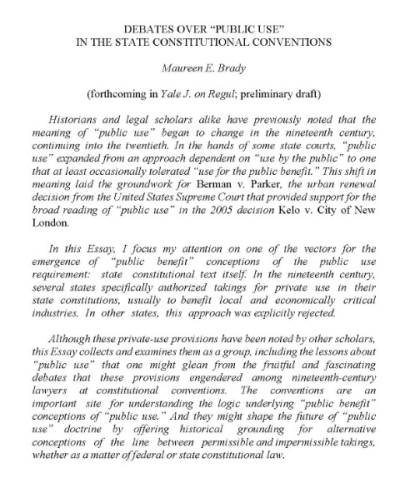
Be sure to check out the latest scholarship from lawprof Molly Brady, which sheds new light on the public use question in eminent domain, “Debates Over ‘Public Use’ in the State Constitutional Conventions,” forthcoming from the Yale Journal of Regulation. 

Here’s the Abstract:

Historians and legal scholars alike have previously noted that the meaning of “public use” began to change in the nineteenth century, continuing into the twentieth. In the hands of some state courts, “public use” expanded from an approach dependent on “use by the public” to one that at least occasionally tolerated “use for the public benefit.” This shift in meaning laid the groundwork for Berman v. Parker, the urban renewal decision from the United States Supreme Court that provided support for the broad reading of “public use” in the 2005 decision Kelo v. City of New London.

In this Essay, I focus my

Continue Reading Forthcoming Article: Maureen Brady, “Debates Over ‘Public Use’ in the State Constitutional Conventions,” Yale J. Regulation

Kelo page - Copy

It hardly seems like two decades have passed. After all, it was a mere 10 years ago we were lamenting “Kelo At 10: Still Stinks, And A Decade Has Not Lessened The Odor.” 

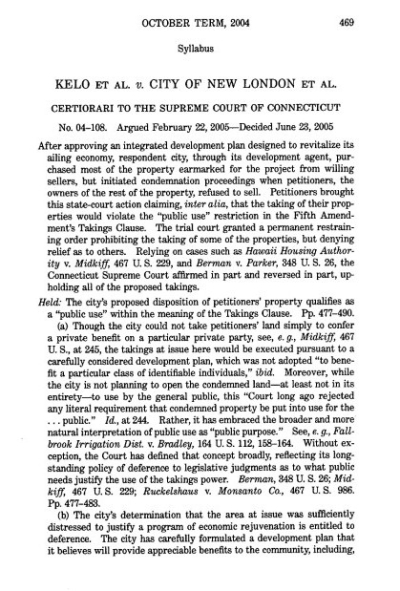
But yes, it was twenty years ago today … the U.S. Supreme Court, by the thinnest of margins, held in Kelo v. City of New London, 545 U.S. 469 (June 23, 2005) that there’s nothing inherently suspect about “economic development” takings to justify a higher level of judicial scrutiny than the judges-as-poodles standard of review applied in Public Use challenges to takings for every other reason.   

Susette Kelo’s home was taken on the claim that it was needed as part of the package of incentives to lure a pharmaceutical company to set up shop in New London, which would in turn, raise the overall economic climate in the city. That butterfly-effect theory was

Continue Reading Unhappy 20th Anniversary, Kelo v. City of New London

It seems very appropriate that we’re posting the Texas Court of Appeals’ decision in Burgess v. City of Wentworth Village, No. 02-24-00252 (June 19, 2025) today, the twentieth anniversary of Kelo v. New London.

Because on the Kelo-versary, we start as the Burgess opinion did: an epigram wherein the court quoted a concurring opinion recognizing the inherent unfairness of eminent domain and how just compensation is very often inadequate:

On occasion, to serve a public purpose, a citizen’s private property must be taken without his consent. We tolerate such intrusions because society cannot function without roads, schools, military facilities, and other vital infrastructure. Eminent domain also requires “just” or “adequate” compensation, to be sure. U.S. Const. amend. V; Tex. Const. art. I, § 17(a). But the condemnation process is complicated, time-consuming, and sometimes confusing. And no compensation can accurately value the sweat, tears, pride, love, beauty, and

Continue Reading Texas App: No, A Taking For A “Short-Game Practice Area” Isn’t Entitled To Judicial Deference Under Post-Kelo Changes

Check out the latest episode of the Lunch Hour Podcast, featuring lawprof Donald Kochan, “Property Rights, Regulation, and the Rule of Law.”

Here’s the description:

In this episode of The Lunch Hour with Federal Newswire, host Andrew Langer sits down with Professor Donald Kochan of the Antonin Scalia Law School at George Mason University. They explore why property rights form the foundation of a free and prosperous society, how regulatory takings impact individual autonomy, and what the legal implications are for recent lawsuits against oil companies in Louisiana. Professor Kochan breaks down the concept of “involuntary regulatory servitude,” the role of third-party litigation financing—including foreign influence—and how courts can sometimes undermine economic development through retroactive liability.

Topics Discussed:

  • The foundational role of property rights in society
  • Regulatory overreach and due process
  • Economic impact of property law on tribal lands
  • Louisiana lawsuits and retroactive environmental liability
  • Third-party


Continue Reading New Podcast: “Property Rights, Regulation, and the Rule of Law with Donald Kochan”

Misusingheader

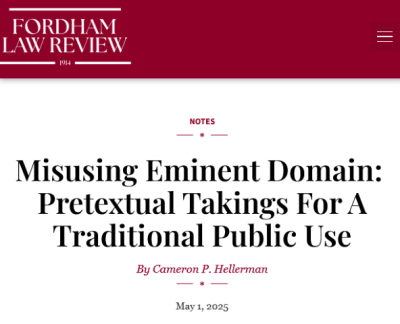
Check out this recently-published student note: Cameron P. Hellerman, Misusing Eminent Domain: Pretextual Takings For A Traditional Public Use, 93 Fordham L. Rev. 2229 (2025).

The article considers the Second Circuit’s decision in Brinkmann v. Town of Southhold, about what we call “spite takings” — those in which the government’s stated public purpose supporting the taking is not the actual reason. That issue is now being considered by another court in Rhode Island.

Here’s the summary:

Eminent domain is a powerful tool at the disposal of local, state and federal governments.  The Fifth Amendment to the U.S. Constitution imposes two conditions on this sovereign power:  the taking must be for “public use,” and the condemner must pay “just compensation” to the property owner.  There are minimal guardrails in place to police potential misuse of the eminent domain power in the courts.  The U.S. Supreme Court equates “public use”


Continue Reading New “Spite Takings” Article: “Misusing Eminent Domain: Pretextual Takings for a Traditional Public Use” (Fordham L. Rev.)

In Muskingum County Convention Facilities Auth. v. Barnes Advertising Corp., No. CT2024-0134 (May 22, 2025), the Ohio Court of Appeal upheld the Authority’s taking of two billboard easements where the stated purpose was for a “new facility serving the City of Zanesville and Muskingum County community[.]” Slip op. at 3.

OK, but what public use is that “new facility” for? How about we describe it by cutting-and-pasting the language in the statute which gives us the authority to take facilities, which defines “facility?” Check it out:

The CFA’s petition to appropriate the billboard easements states that “[t]he [CFA] is currently undertaking a public project to develop a new facility serving the City of Zanesville and Muskingum County community.” That petition describes the “new facility” as “any convention, entertainment, or sports facility, or combination of them, located within the territory of a convention facilities authority, together with all

Continue Reading Ohio App: Reciting The Statutory Definition Is Enough To State A Public Use

One of the frustrations of challenging the power to take is … let’s say you win. Yay! You’ve stopped the taking!

So now what? Go back to your life safe in the belief that your property rights are secure? Maybe. If the government has had enough and says “no mas,” your win may be the end of it.

But what if the government really really wants your property? Can it come at you again, armed with with the blueprint your successful public use challenge just provided for how to do it right this time? Probably. There are few situations where the usual “one shot” principle in civil cases — also known as claim preclusion (res judicata to you traditionalists) — ties a condemnor’s hands and prevents it from taking a second, or third, or more shot.

So what about settling your public use challenge? If you

Continue Reading CA8: You Believed The County When It Promised In The Settlement Agreement To Not Take Your Land In The Future? Shame On You!

In the wake of Kelo, the people of Virginia overwhelmingly amended their state constitution (the vote was 75% in favor) to make it much clearer about what qualifies as a public use supporting an exercise of eminent domain, what doesn’t qualify, and how public use is proven:

That the General Assembly shall pass no law whereby private property, the right to which is fundamental, shall be damaged or taken except for public use. No private property shall be damaged or taken for public use without just compensation to the owner thereof. No more private property may be taken than necessary to achieve the stated public use. Just compensation shall be no less than the value of the property taken, lost profits and lost access, and damages to the residue caused by the taking. The terms “lost profits” and “lost access” are to be defined by the General Assembly.

Continue Reading Statute Authorizing Fiber Optic Installation On Railroad Property Authorizes Takings For Nonpublic Use, Violating Virginia’s Post-Kelo Constitutional Amendment

We had to read the facts of the Tennessee Court of Appeals’ opinion in City of Pigeon Forge v. RLR Investments, LLC, No. E2023-01802-COA-R3-DV (Apr. 20, 2025) a couple of times over, just to make sure we were understanding what was going on. But the effort was worth it, just because of the unusual arguments presented. Check it out.

RLR owned two adjacent properties, the first used for a hotel, the second for a duplex, parking area, and open green space. So far so good. The city took portions of each for a greenway. It also took temporary construction easements on each parcel. Check. The city sought immediate possession. Got it. The owner objected to public use and the quick take, but the trial court agreed with the city, and entered an order of possession. Understood.

Here’s where it gets squirrelly. RLR, the property owner, sought to enforce the order

Continue Reading It’s The Vibe: Taking Of Condemnee’s Property To Replace Property Taken From Condemnee Is A Public Use