The California Supreme Court has agreed to review and resolve a lower (California) court split regarding the standard of review a court should apply in challenges to a government taking of a privately-owned public utility.

In Town of Apple Valley v. Apple Valley Ranchos Water, No. E078348M (Feb. 13, 2025), the California Court of Appeal held that when a privately-owner public utility objects under the California Eminent Domain Code to the public use of a governmental takeover of the utility, the court must review the Resolution of Necessity with extreme deference (gross abuse of discretion). This means the reviewing court starts off with the presumption that the resolution is valid and its conclusions are true, and that no additional evidence may be considered to counter that conclusion.

One other Court of Appeal held otherwise, and the California Supreme Court agreed to resolve the divergence of analysis. Here’s

Continue Reading Cal Supreme Court Reviewing Necessity Challenge To Public Utility Takeover
We’re not even going to pretend we know what’s going on that spurred the Supreme Court of India to issue this ruling in Delhi Ag. Marketing Bd. v. Devi (Dead), No. 10757 (Mar. 20, 2025), either in the opinion itself, or especially behind the scenes.

But any judicial opinion that starts off like this will certainly grab our attention:

Turning the law of land acquisition on its head, the astonishing events that this appeal is founded on need to be narrated in some detail.

Slip op. at 1. Count us intrigued. (And besides, not knowing anything about India’s law of expropriation has never stopped us before, has it? See here and here, for example.)

With that out of the way, let’s go. 

Way back in the day (and here we’re talking 1963, so like really way back), the Board acquired 33 acres from Devi for a grain market.

Continue Reading India: There’s No Givebacks In Eminent Domain – Agreement To Return 3 Bighas And 5 Biswas To Former Owner Void

Wondering what happened to that case we posted about last week, where our outfit is representing property owners in a federal court challenge to a Rhode Island town’s efforts to take their land by eminent domain?

Well, here’s the latest. The court just issued this Temporary Restraining Order. Read it for the details. This is our case, so we’re not going to say more here.

But for further details about what brought this about, read Christian Britschgi’s piece at Reason, “Town Secretly Seizes Developers’ Property Then Threatens Them With Trespassing Citation” (Mar. 18, 2025).

Temporary Restraining Order, SCLS Realty, LLC v. Town of Johnston, No. 25-00088-MRD-PAS (D. R.I. Mar. 19, 2…

Continue Reading Latest In Public Use Eminent Domain Pretext Challenge: Federal Court TRO

Purpose

Before we go further, a disclosure: this is one of ours.

Here’s the Complaint for Violations of Constitutional and Civil Rights, filed yesterday by the Santoro Family in federal court in Rhode Island. This lawsuit challenges, under the Public Use Clause, a RI town’s eminent domaining the family’s land for the ostensible purpose of building a new municipal campus

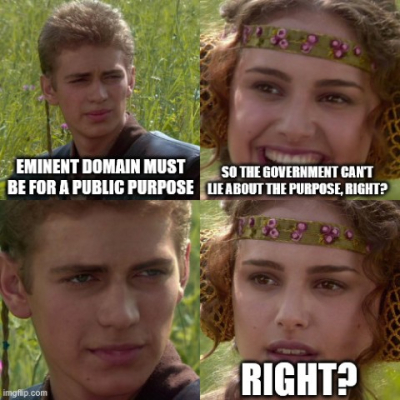
Sounds like a “classic” public use, you say? Not so fast. As alleged in the complaint, the actual use, purpose, and necessity for the taking is something else: to stop the Santoros from building 250+ low- to moderate-income housing.

Because this is one of ours, we won’t say more. But here’s the story, from the Complaint:

1. SCLS Realty, LLC, and Sixty Three Johnston, LLC, family-owned homebuilders whose members are Lucille Santoro, Salvatore Compagnone, Ralph Santoro, and Suzanne Santoro (the plaintiff LLCs are referred to herein jointly as

Continue Reading Challenge To Sham Eminent Domain: The Government Can’t Lie About Why It Takes Property

We had the New Jersey Appellate Division’s opinion in Township of Jackson v. Getzel Bee, LLC, No. A-0590-23 (Jan. 31, 2025) in our queue to digest, when our colleague Joe Grather beat us to the punch with his analysis “Appellate Court Rejects Condemnation Due to Lack of Public Use or Purpose.”

So instead of repeating Joe’s summary and analysis, we’re going to recommend you read his. The short story is that the Township used eminent domain to take property, with the avowed public use being “open space,” which is generally a qualifying public use. The owner objected and the Appellate Division agreed that yes, open space may be a public use, but here, the record pointed to the property actually being used as a “currency” to “exchange for open space.” As Joe writes:

I’m not so sure we agree with the idea that the constitutional “public use&rdquo

Continue Reading NJ App Div: No Taking To Use The Property To Trade For “Open Space”

Screenshot 2025-02-22 at 17-56-19 The Supreme Court’s Big “Kelo” Mistake Was Trusting Economic Development Plans – The Center for Economic AccountabilityBy John C. Mozena

Students of the Supreme Court’s infamous-the-day-it-was-decided decision in Kelo v. City of New London know that the legal issue presented and decided by the Court was somewhat narrow, but that the decision had a broad cultural impact such that Susette Kelo’s SCOTUS 5-4 loss was merely a precursor to widespread political and moral victories.

Legally narrow issue? Yes, recall that the question presented in that case was whether takings for “economic development” are so particularly untrustworthy and susceptible to abuse that they require the judiciary to depart from the usual rational basis review and cast a more skeptical “heightened scrutiny” eye on what the Court in Berman said was a legislative judgment “well-nigh conclusive,” and Midkiff equated with run-of-the-mill exercises of the police power.

The Kelo majority held no, that at least in the case as presented, the taking of a home and neighborhood on the

Continue Reading Is Having A “Redevelopment Plan” Enough To Justify Public Use Rational Basis Review?

Check out In re Condemnation of Property in Rem (Appeal of Clemens), No. 1101CD23 (Feb. 4, 2025), one from the Pennsylvania Commonwealth Court.

The Town exercised eminent domain to take property, stating it was taking the land for public recreational purposes. That can’t be the Town’s true purpose, argued the landowner, because the Town doesn’t have a carefully developed recreation plan.” And you need a plan. Moreover, argued the owner, the Town has no authority to take property for open space.

First, the court held that “[n]othing in the Township Code or the Eminent Domain Code requires a ‘carefully developed plan’ for recreational purpose before a declaration of taking can be filed.” Slip op. at 18. What about that Pennsylvania case that seems to say you need a plan? Distinguishable. Having a plan helps to show the taking’s real purpose — but the absence of a plan doesn’t

Continue Reading No Plan? No Problem! Condemnation Statute Does Not Require A “Carefully Developed Plan”

Property_rights_and_the_roberts_court_Agenda_

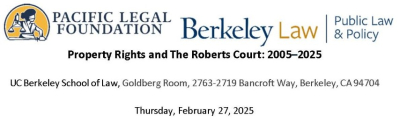
Register now and plan on joining us on Thursday, February 27, 2025 at the U.C. Berkeley Law School for a one-day conference: “Property Rights and the Roberts Court: 2005-2025.”

Here’s the agenda. Here’s a description of the program:

For much of the past century, property rights were relegated to second-class status compared to the rest of the Bill of Rights. However, under the Supreme Court leadership of Chief Justice John Roberts, this trend has begun to shift.

In recognition of the 20th anniversary of the Chief Justice’s elevation to the Supreme Court, Pacific Legal Foundation is partnering with Berkeley Law’s Public Law and Policy Program to host a day-long conference exploring the major property rights developments and future of property rights law in the Roberts Court.

We’ll hear from two different panels of renowned legal scholars and accomplished litigators, as well as a keynote lunch discussion between

Continue Reading Join Us: “Property Rights and The Roberts Court: 2005-2025” (Feb. 27, 2025, UC Berkeley Law School)

The facts in D.A. Realestate Inv., LLC v. City of Norfolk, No. 23-1863 (Jan. 16, 2025), a recent decision from the U.S. Court of Appeals for the Fourth Circuit, are fairly sympathetic. And the opinion starts off with a tantalizing quote:

In 1761, Massachusetts lawyer James Otis exclaimed “one of the most essential branches of English liberty is the freedom of one’s house. A man’s house is his castle.” John Adams’s Reconstruction of Otis’s Speech in the Writs of Assistance Case, in Collected Political Writings of James Otis 12–13 (Richard Samuelson, ed. 2015). American law has embraced that principle since our nation’s founding. U.S. Const. amend. V. But we have also long recognized that “all property in this country is held under the implied obligation that the owner’s use of it shall not be injurious to the community.” Mugler v. Kansas, 123 U.S. 623, 665 (1887).

Slip op.

Continue Reading CA4: Challenge Public Use/Pretext Under Due Process And § 1983, Not Inverse

Screenshot 2025-01-12 at 09-35-14 Taking Old Ladies’ Homes A Comparative Exploration of Eminent Domain in

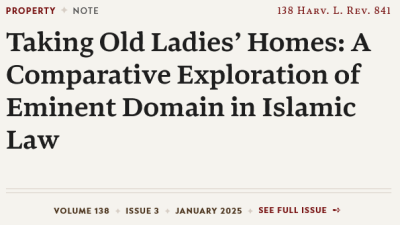
Check this out, a just-published unsigned student piece: Note, “Taking Old Ladies’ Homes: A Comparative Exploration of Eminent Domain in Islamic Law,” 138 Harv. L. Rev. 841 (2025).

Not that we have any background to be able to evaluate the author’s assertions, but at the very least, the piece is very interesting (you learn stuff!), and does reach the conclusion that forced acquisitions are not absolutely necessary to “develop[] advanced built environments and economic systems[.]” See id. at 862 (“It is not enough to assume that any society, or indeed any modern society, requires a particular form of eminent domain or the eminent domain power itself.”).

Here’s a summary.

This Note is therefore likely the first exploration of premodern Islamic discourses and practices of “eminent domain.” It will argue three things about forced appropriation of property for public purposes in premodern Islamic law: First, that unlike in Anglo-American

Continue Reading New Article (Note): “Taking Old Ladies’ Homes: A Comparative Exploration of Eminent Domain in Islamic Law,” 138 Harv. L. Rev. 841 (2025)