


No sooner was the ink dry on the Supreme Court’s opinion in Knick v. Township of Scott, than the Court’s decision started to have some effect.

First, the Court granted another pending cert case on takings ripeness and sent back down to the Ninth Circuit for more in light of Knick.

And now this order from the Seventh Circuit in a case that had been argued (listen above, or download here), but held pending Knick. Jensen v. Village of Mount Pleasant, No. 18-2187 (7th Cir. July 3, 2019). 

This was a case where the federal district court had dismissed the owners’ Fifth Amendment claims as unripe under Williamson County. After argument in the Seventh Circuit, the Supreme Court granted cert in Knick, and the Seventh Circuit delayed deciding the case until the Supreme Court decided Knick. 

Shortly after the Supreme Court opinion, the Seventh Circuit

Continue Reading Knick Already Taking Effect, Even Where It Isn’t Necessary
Eminent domain lawyers know that even though the U.S. Supreme Court ruled against the property owner in Kelo, it acknowledged that there was a (slight?) hope in some cases where the condemnor’s stated public use or purposes is actually “pretext” to private benefit.

Pretext may be present in at least three situations: (1) when eminent domain is used to transfer the private property of one party to another private party where the magnitude of public benefits outweighs the private benefit; (2) when eminent domain is used for a one-to-one transfer of private property without a comprehensive, integrated, and carefully considered development plan; and (3) where a particular private party is identified before the taking. See Kelo v. City of New London, 545 U.S. 469, 478 & n.6 (2005). 

But in the 15 years since Kelo, the Court has never agreed to take up the question of how a property

Continue Reading Why Eminent Domain Lawyers Should Read The Supreme Court’s Census Case

The Colorado Supreme Court issued an opinion in a case we’ve been following on public use in eminent domain. in which it reframed the Questions Presented.

In Carousel Farms v. Woodcrest Homes, No. 2018SC30 (June 10, 2019), the court reversed the court of appeals’ conclusion that a taking lacked a public purpose because even though the public might use the roads and sewers which the utility district (formed for the specific purpose of taking the property which the private-benefitted developer could not acquire by negotiation) said it would install in the future did not outweigh the overwhelming private benefit in the present. In the Court of Appeals’ words, “[w]hen the primary purpose of a condemnation is to advance private interests, even if there will be an eventual public benefit, the condemnation is not for a public purpose.” 

The Supreme Court turned that analysis upside down, concluding that a

Continue Reading Colorado: A Lot Of Private Benefit Today Does Not Overcome Smattering Of Possible Public Future Benefit

Here’s one we’ve been waiting to drop for a while, on an issue we wrote about earlier this week.

In Puntenney v. Iowa Utilities Board, No. 17-0423 (May 31, 2019), the Iowa Supreme Court — taking a different view than Kentucky — held that a pipeline which runs through Iowa, but which does not have any “offramps” for oil in Iowa, will nonetheless promote the public convenience and necessity” for the people of Iowa.

The court’s reasoning boils down to this: a pipeline is a “traditional” public use.

The court first adopted Justice O’Connor’s Kelo dissent (along with the reasoning of Hathcock, Norwood, and SWIDA), concluding that economic development alone does not qualify as a public use under the Iowa Constitution:

Like our colleagues in Illinois, Michigan, Ohio, and Oklahoma, we find that Justice O’Connor’s dissent provides a more sound interpretation of the public-use requirement. If

Continue Reading We Are The World: Iowa SCT Finds Dakota Access Pipeline Will Promote The Public Convenience For Iowa, Even If Iowans Don’t Get Any Of The Pipeline’s Oil

An issue we’ve been tracking for a while — are takings for pipelines for the public’s benefit? — raises another question: how is “the public” defined?

Some courts, like Kentucky’s, define the public as the public which the jurisdiction serves. In the Bluegrass Pipeline case, for example, the court of appeals held that a natural gas pipeline which went through Kentucky, but did not have any offramps for the natural gas in Kentucky — was not “in public service” as required by that state’s eminent domain statutes. A Pennsylvania court adopted a similar rationale (even though it held a private pipeline could exercise eminent domain power because it planned gas offramps in Pennsylvania).

And in City of Oberlin v. FERC, No. 18-1248, the U.S. Court of Appeals for the D.C. Circuit recently heard oral arguments about whether FERC can consider

Continue Reading Are Pipelines For The Public’s Benefit? If So, What Public?

In City of Dublin v. RiverPark Group, LLC, No. 18AP-607 (May 9, 2019), the Ohio Court of Appeals (Tenth District), the city exercised eminent domain — via Ohio’s version of “quick take” (immediate possession, not title) — to take an easement “for the purposes of constructing roadway improvements … and a shared-use path adjacent to River Drive.” Slip op. at 2.

The owner answered, but did not deny the city’s taking power or the necessity of the taking. But later, a different entity which claimed an interest in the property intervened, asserting in its proposed answer that the city lacked the power to do a quick take because the taking was not for roadway purposes. The new party sought to eject the city from the land, which it had already occupied. The Ohio quick take statute limits a municipality’s quick take power to “making or repairing roads.” But the

Continue Reading Ohio App: Owner Can’t Object To An Illegal Quick Take, Except By Filing A Trespass Action, And Obtaining An Injunction

North Dakota, as you might expect, can be cold in the winter. So cold that railroad switches need to be heated, else they get… frozen. The railroad uses refillable propane tanks, but these need to be refilled from time to time. And North Dakota is so cold in the winter that sometimes, the propane trucks can’t get to the tanks to refill them. Frozen switches. 

Enter MDU, the Montana-Dakota Utilities Company. The railroad asked MDU to install a natural gas pipeline, “believing that natural gas by pipeline would increase reliability and decrease the cost associated with heating the switch.” The cheapest and most practical place to locate this pipeline was on Behm’s land: “MDU claimed that other routes for the pipeline would be too expensive or might in the future require modification or removal of the pipeline. 

Behm didn’t see it that way. He objected, asserting the taking was not

Continue Reading Frozen: “Necessity” In Eminent Domain Can Mean Mere Convenience (Or Anything Else The Condemnor Says)

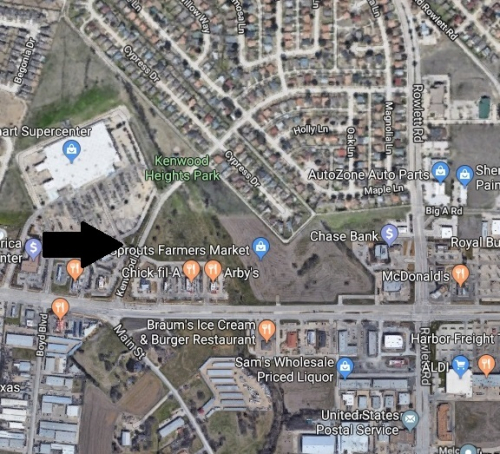
Rowlettmap

Here’s one we’ve been waiting to drop. In KMS Retail Rowlett, LP v. City of Rowlett, No. 17-0850 (May 17, 2019), a deeply divided Texas Supreme Court held that a statute — adopted in response to Kelowhich seems to limit eminent domain power, also contains a massive hole: according to the court, it doesn’t apply to “transportation projects.” 

The statute — Texas Gov’t Code § 2206.001 — bars four kinds of takings:

  • if the taking confers a private benefit on a specific private party
  • if the taking is pretextual, and although it purports to be for public use, is actually for private benefit
  • economic development takings
  • if the taking “is not for a public use”

But the statute also provides, “[t]his section does not affect the authority of an entity authorized by law to take private property through the use of eminent domain for: (1) transportation projects, including

Continue Reading Texas: Transportation Projects Exempt From Post-Kelo Limitations On Eminent Domain Power

Here’s what we’re reading today, in between real work:

Continue Reading Friday Reading: Pipeline Injunctions, Justifying Kelo, And Maui Groundwater Case

Remember that Christopher Nolan movie from a few years ago, “Inception,” with its dream-within-a-dream storyline?

Well, that’s what a recently-filed cert petition which asks the U.S. Supreme Court to jump into California’s inverse-condemnation-liability-for-wildfires issue reminds us of with its taking-within-a-taking argument, as detailed in the Question Presented:

Whether it is an uncompensated taking for public use in violation of the Fifth and Fourteenth Amendments for a State to impose strict liability for inverse condemnation on a privately owned utility without ensuring that the cost of that liability is spread to the benefitted ratepayers.

Let’s see if we are keeping the argument straight: it’s a taking to hold a private entity which possesses the delegated power of eminent domain liable for a taking for burning down private property unless the utility is also entitled to pass the cost of any taking judgment on to those who benefit from

Continue Reading New Cert Petition: Fifth Amendment Requires California To Spread The Cost Of Wildfire Inverse Condemnations To Ratepayers