If you, like us, went to law school to avoid things like this:
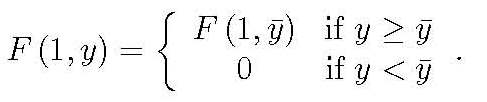
Untitled Extract Pages

then perhaps this recently-published paper is not going to be your cup of tea.

But seriously, folks, this one might be worth your time, even if you are numbers-challenged, because it is a look at the “holdout” issue from the standpoint of economists.

In “Private Takings,” the authors “examine[] the implications associated with a recent Supreme Court ruling, Kelo v. City of New London.” From the Introduction:

This paper examines the implications associated with a recent Supreme Court ruling, Kelo v. City of New London. Kelo can be interpreted as supporting eminent domain as a means of transferring property rights from one set of private agents — landowners — to another private agent — a developer. Under voluntary exchange, where the developer sequentially acquires property rights from landowners via bargaining, a holdout problem arises.

Continue Reading New Article: “Private Takings” (via Fed Reserve Bank of Chicago)
Muskogee-map

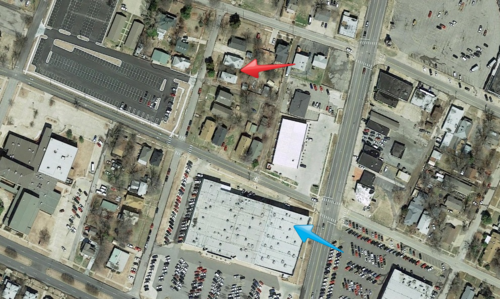
A must-read from the Oklahoma Court of Appeals. In City of Muskogee v. Phillips, No. 111,501 (Nov. 21, 2014), the court invalidated a taking, concluding that it was not a public use under the Oklahoma Constitution for a city to condemn private property for a parking lot when the primary apparent beneficiary of the parking lot would likely be the owner of a nearby office building whose tenants were responsible for an increase in on-street parking in the neighborhood.

Quick background: the federal government leased a privately-owned office building for a call center (the blue arrow on the above map). Employees of the call center parked on the street in the neighborhood. The city decided to build a parking lot and parking structure “for the health and safety of the Citizen’s [sic] of Muskogee by reducing the volume of on-street parking in the areas near and surrounding” the call

Continue Reading OK App: Taking A Home For A Parking Lot, When Primary Beneficiary Is Private, Is Not A Public Use

For those of you who couldn’t join us at the William & Mary Law School last month for the Brigham-Kanner Property Rights Conference (see our report here), the law school has made videos of the four panel presentations available here

They’re high quality videos, so be prepared for big downloads, but the presentations are worth it. While they are all good, our favorite was the impromptu discussion/debate during the third panel, “Balancing Private Property and Community Rights,” featuring panelists Kames Burling (Pacific Legal Foundation), Professors Richard Epstein (NYU), Steven Eagle (Geo. Mason), Mark Poirer (Seton Hall), and James Stern (William & Mary). 

Continue Reading Brigham-Kanner Property Rights Conference – Panel Videos Now Available

Here’s what caught our eye today:

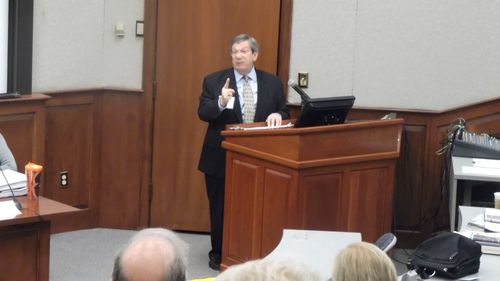
  • Last evening, we attended lawprof Gregory S. Alexander‘s talk at the U. Hawaii Law School, “Five Easy Pieces: Recurrent Themes in American Property Law.” You know it’s not a real academic talk until the speaker uses the words “normative” and “neologism,” and Professor Alexander did not disappoint. But seriously, it was a thought-provoking hour, focused on our favorite topic, property law. A video was made, and hopefully the law school will post it on line so you can watch. We’ll link to it when they do. 
  • Va. high court to look at Beach eminent domain appeal,” from the Hampton Roads newspaper, about a case which the Virginia Supreme Court just accepted. The case was triggered when the trial court refused to allow the jury to hear evidence of the DOT’s first appraisal and deposit, which was higher than its final appraisal


Continue Reading Thursday Round-Up: “Five Easy Pieces” Talk, Re-appraisals, Foie Gras Ban Lives, Kelo In China, Kelo Movie

  DSCF2208

You can’t have rights without advocates.”

                              – Michael Berger

We’re at the William and Mary Law School in Williamsburg, Virginia today for the 11th Brigham-Kanner Property Rights Conference. As we’ve noted earlier, Michael Berger is this year’s B-K Prize honoree, for his career contributions to property law and his “scholarly work and accomplishments [which] affirm that property rights are fundamental to protecting individual and civil rights.”

The list of past recipients is an All-Star roster of property scholars and jurists, including lawprofs Frank Michelman, Richard Epstein, James Ely, Carol Rose, Thomas Merrill, and Supreme Court Justice Sandra Day O’Connor (the latter perhaps more for where she ended up in her Supreme Court career than where she started). See the plaque on the Law School’s wall for the complete list of

Continue Reading 2014 Brigham-Kanner Property Rights Conference Report: Honoring Michael Berger

Banner

If you haven’t already, please mark you calendars: the agendas and faculty lists for the February 5-7, 2015 ALI-CLE eminent domain programs in San Francisco have been finalized. Registration is ongoing, and there’s even a few more days left for the early registration discount. Substantial group discounts are also available. 

We’re talking, of course, about Eminent Domain and Land Valuation Litigation (the “masters” program, now in its 32nd year), and Condemnation 101: How to Prepare and Present an Eminent Domain Case (the boot camp or refesher course on eminent domain fundamentals).  We’re the co-Planning Chair of the Eminent Domain and Land Valuation Litigation program along with Joe Waldo, and we think we’ve assembled an exciting agenda, presented by a faculty comprised of the nation’s best-of-the-best in our field of law.

Some highlights:

  • Eminent Domain National Law Update – Amy Brigham Boulris, Gunster, Yoakley & Stewart, P.A.,


Continue Reading ALI-CLE 2015 Eminent Domain and Land Valuation Litigation & Condemnation 101 Agendas And Faculty Announced

Here’s a very important case from the Pennsylvania Supreme Court (Middle District). The question before the court in Reading Area Water Auth. v. Schuylkill River Greenway Ass’n , No. J-13-2014 (Sep. 24, 2014) was this:

The primary question raised is whether a municipal authority may exercise its eminent domain powers to condemn an easement over privately-owned land, where the sole purpose of the easement is to supply a private developer with land to install sewer drainage facilities needed for a proposed private residential subdivision.

Slip op. at 1. 

Short answer: no.

The Schuylkill River Greenway Association, true to its name, intends to build a public walking and recreational trail on land it owns along the bank of the river in conjunction with Bern Township. Unfortunately (for the Association), the property next to their is slated for development into an “adult residential subdivision,” and it needed access to the river’s water. We

Continue Reading Pennsylvania: No Public Use To Condemn, When “Sole Purpose” Of Taking Benefits Private Developer

We’re tied up in court today, so don’t have time to post up the latest cases which have crossed our desk in the past few days.

We will get to them soon, but in the meantime, check out this story (“The Stubborn ‘Nail Houses’ That Refuse to Get Demolished“) from Gizmodo (a blog about tech gear) about eminent domain holdouts, including one particularly endearing woman who refused to go gentle into that good night.  

We”ll return to our regularly scheduled programming shortly. Continue Reading “Nail Houses” And Eminent Domain

A reminder: the 11th annual Brigham-Kanner Property Rights Conference is coming up on October 30-31, 2014, at the William and Mary Law School in Williamsburg, Virginia. As we noted earlier, Michael Berger will receive the Brigham-Kanner Prize, so this one is special – he’s the first practitioner to receive the Prize.

More here, from W&M, including agenda and registration information. Here’s the flyer.

We’re going – hope to see you there. 

11th Annual Brigham-Kanner Property Rights Conference – Oct 30-31, 2014 – Michael Berger

Continue Reading October 30-31, 2014: Brigham-Kanner Property Rights Conference @ William & Mary Law

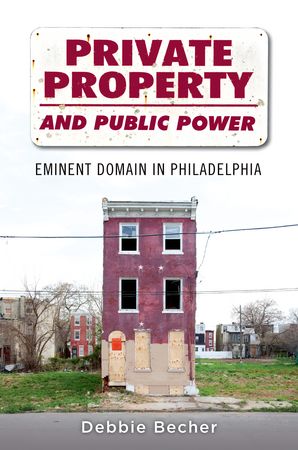
9780199322541_450After a couple of days detouring to election law, today we’re back to our usual programming.

We caught wind of an upcoming book (September 2014), “Private Property and Public Power: Eminent Domain in Philadelphia,” by Barnard College Professor Deborah Becher. “Her book—the first comprehensive study of a city’s eminent domain acquisitions—explores how and why Philadelphia took properties for private redevelopment between 1992 and 2007.” Sounds intriguing. More information about the book here.

Here’s an interview with Professor Becher about the book and her study, which lists some of her more controversial — and debatable — conclusions. Highlights:

  • “The problem is that pundits and activists present the transfer of ownership to a new private owner as the fundamental problem. They say that if government were to take property for a school, a highway, or a public park, abuse wouldn’t be an issue, and that all takings for new


Continue Reading Upcoming Book: Private Property and Public Power – Eminent Domain in Philadelphia