Here’s one with a somewhat unusual twist: the condemnee objecting to the taking by a public utility district was the state.

In Public Utility Dist. No. 1 of Okanogan Cnty. v. State of Washington, No. 88949-0 (Jan. 29, 2015), the Washington Supreme Court affirmed the power of the county utility district to take an easement over “school trust lands” for the construction of an high-voltage, high-capacity transmission line and corridor. The land was owned by the public and held in trust for schools, was “a portion of the largest publicly owned tract of shrub-steppe habitat in the Methow Valley,” and was being used for cattle grazing. The grazing leases generated $3,000 per year for the state’s public schools, and also acknowledged that the land may be subject to easements and condemnation. 

The court first concluded that an environmental organization could intervene to address the power of the utility district to take

Continue Reading Washington: State Trust Land Can Be Condemned By County Utility
The wheels of justice may grind slowly, but they do grind. Yesterday, the Ninth Circuit granted a motion we filed back in June 2013, and permitted us to file this amicus brief on behalf of the Western Manufactured Housing Communities Association in a case that is scheduled to be argued in mid-February 2015, Rancho de Calistoga v. City of Calistoga, No. 12-17749.  

The case is a federal court challenge to a California wine-country municipality‘s decision to deny a rent increase for a mobilehome park subject to the city’s rent control ordinance. The complaint alleged that the city’s failure to allow the ground lease rent to increase to $624 violated the park owner’s rights under the takings, due process, and equal protection clauses. The District Court eventually dismissed the complaint for failure to state a claim for relief under Rule 12(b)(6), because, among other things, the park

Continue Reading 9th Circuit Amicus Brief: How To State A Valid Claim After Lingle – Regulatory Taking, Private Taking, Or Due Process?

This is a longer post, but since we think this case may be going further and is worth watching, we’re going to hit it up in some detail.

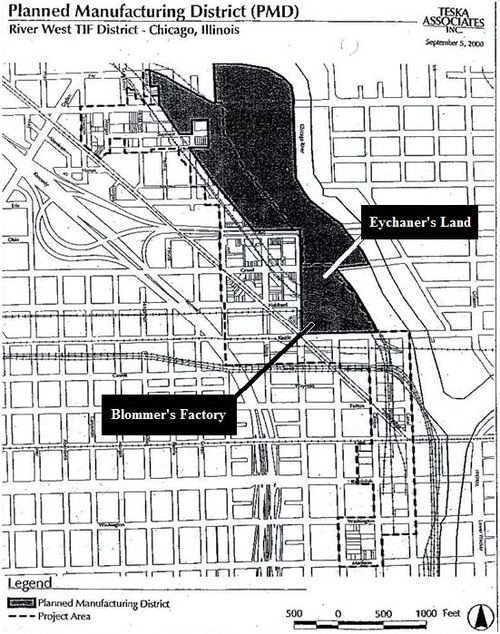
In City of Chicago v. Eychaner, No. 05L050792 (Jan. 21, 2015), the Illinois Appellate Court upheld the taking of private vacant land near the Chicago Loop (Eychaner’s Land on the map below) so that it could be transferred to the owners of a nearby chocolate factory (Blommer’s Factory).

The court viewed this “A-to-B” taking as merely a part of an area redevelopment and tax increment finance plan, which would keep the chocolate factory from moving out as the area gentrified.


1131833

The opinion contains a long recitation of the reasons for the taking, how the Planned Manufacturing District (PMD) was designed to “protect[] the 2,800 industrial jobs located in the area, [to] prevent[] residential encroachment on the existing manufacturing facilities, and

Continue Reading The Chicago Way: City Taking Non-Blighted Property For Economic Development Was Not Pretextual Because … Studies

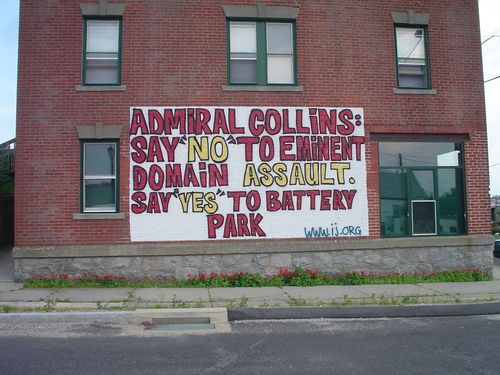
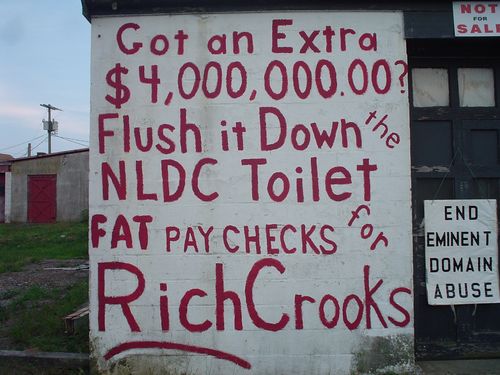
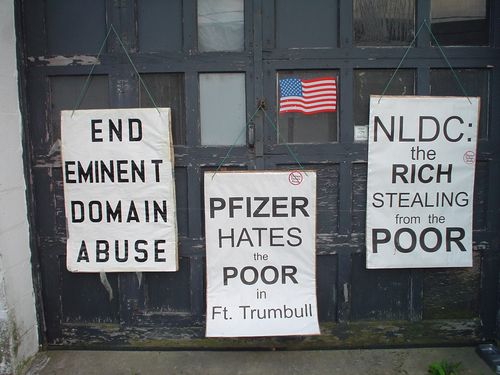
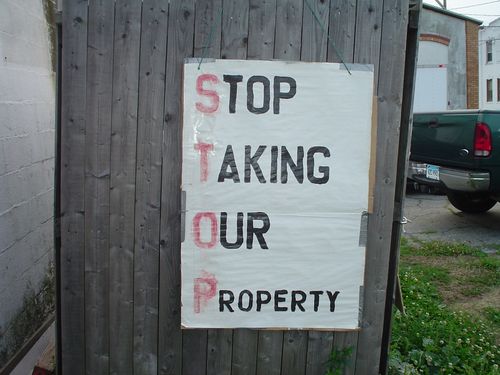
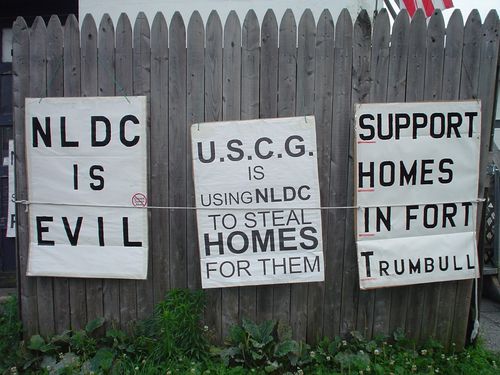
Following up on our earlier post about anti-eminent domain signs are the below, courtesy Dwight Merriam, of the Kelo neighborhood in New London, Connecticut, during the time of the strife. See also the book Dwight edited for the ABA about the case. 

The signs have long since been removed. Along with the properties themselves

Picture1

Picture2

Picture3

Picture4

Picture5

Continue Reading Speaking Of Eminent Domain Protest Signs…

In Rutherford Elec. Membership Corp. v. 130 of Chatham, LLC, No. 13 SP 95 (Sep. 2, 2014), the North Carolina Court of Appeals reversed the dismissal of an eminent domain complaint filed by a private company that sought to take property located in two counties.

In cases where a private company seeks to condemn private property, North Carolina law allows the filing of a special proceeding in the county in which the property is located. The trial court dismissed the complaint because the property to be taken was partially located in the county of venue, and partially in another county, and the court concluded it lacked subject matter jurisdiction. The court refused to allow the condemnor to amend its petition to cover only the land located in the proper county

The court of appeals reversed, although it conceded that the process was “in conflict,” and urged the legislature to

Continue Reading NC App Considers Multi-Jurisdictional Eminent Domain

Under Nebraska eminent domain law, the condemnor is required to make a “good faith” effort to negotiate with the property owner before it files an eminent domain action. See Neb. Rev. Stat. § 76-704.01(6).

In Camden v. Papio-Missouri River Natural Resources District, No. A-13-266 (Aug. 26, 2014), the court concluded that the condemnor had not made these efforts. Here’s what occurred:

  • The NRD contacted the property owners, and made an offer of $67k for the desired easements.
  • The owner said “from now on, talk to my lawyer.”
  • The NRD did so, and sent the owners’ lawyer a revised proposed purchase agreement.
  • The owners, through their lawyer, rejected the offer. They valued the loss at $750k.
  • The owners also proposed an alternative to only monetary compensation.
  • The NRD responded that the counteroffer was unresonable, and thus stafff would not recommend the NRD board accept it, but suggested the


Continue Reading Neb App: Condemnor Did Not Make Jurisdictional Good Faith Effort To Negotiate

Being a short opinion (2 pages), you could read the entirety of the New York Appellate Division’s decision in Eisenhauer v. County of Jefferson, No. 14-00510 (Nov. 14, 2014) more quickly than we could summarize it. 

But yes, the taking of private property for expansion of the runway at a public airport is a public use. 

Eisenhauer v. County of Jefferson, No. 14-00510 (N.Y.A.D. Nov. 14, 2014)

Continue Reading NY App Div: “Virtually Any Project That May Confer” Public Benefit Is Consistent With The Public Use Clause

W’re not going to say much about the U.S. Court of Appeals for the Third Circuit’s decision in Columbia Gas Transmission, LLC v. 1.01 Acres, No. 13-4458 (3d Cir. Sep. 26, 2014), since the opinion is not too long, and the court’s conclusion is pretty “straightforward” as it noted:

The issue before us is straightforward: does Columbia Gas Transmission, LLC (“Columbia”), have the right of eminent domain to obtain easements over the land of objecting landowners, outside of the existing right of way, in order to replace deteriorating pipeline? The answer is equally straightforward and clear: yes. 

The regulatory authority given to natural gas companies such as Columbia actually anticipates replacement outside the existing right of way as we discuss below, and contains no adjacency requirement. The issue before us, then, whether Columbia has a right to replace the pipeline outside of the existing right of way, is actually

Continue Reading 3d Cir: Pipeline Company Has “Right” Of Eminent Domain

Here’s the Washington Court of Appeals in City of Bellevue v. Pine Forest Properties, Inc., No. 71827-4-1 (Dec. 22, 2014):

Without question, condemnation of the property for construction of the East Link Project and the City’s road improvement project is a public use.

Slip op. at 15. There’s more detailed analysis in the court’s 25 page opinion, of course, but you really didn’t need to read more than the above, did you?

City of Bellevue v. Pine Forest Properties, Inc., No. 71827-4-1 (Wash. App. Dec. 22, 2014)

Continue Reading Wash App: Temporary Taking For Rail Project Construction Staging A Public Use

Continuing with our year-end opinion dump, here’s the conclusion of the Texas Court of Appeals in City of Blue Mound v. Southwest Water Co., No. 02-13-00343-CV (Nov. 13, 2014):

Because as a matter of law the City is attempting to condemn Appellees’ water and wastewater system as a going concern, because as a matter of law Appellees are entitled to compensation for going-concern value as an element of this purported taking, because the general Texas condemnation statutes provide no mechanism for the awarding of going-concern value as held in Lone Star Gas Co., and because Lone Star Gas Co. remains binding precedent, we hold that Appellees conclusively established their entitlement to summary judgment on the ground that no statutory procedures exist authorizing the City’s condemnation suit in this case in district court.

Slip op. at 29.

City of Blue Mound v. Southwest Water Co.

Continue Reading Tex App: City Can’t Condemn Wastewater Facilty