


The latest front has opened in the ongoing (and spreading) issue about Mortgage Resolution Partners’ efforts to convince municipalities to use their powers of eminent domain to take underwater mortgages.

Here’s the Complaint, filed today in the U.S. District Court for the Nothern District of California, which seeks public disclosure by the Federal Housing Finance Agency of its relationship with banks. As reported in this story, “[t]he agency has threatened legal action against Richmond [California] and other cities planning to use the eminent domain tactic and may deny credit to locals seeking mortgages[.]”   

The article quotes the Executive Director of New Jersey’s ACLU:

Using money from private investors, Ofer said towns would pay the mortgage holders’ fair market value and then restructure mortgages into lower principal payments that are more favorable for homeowners. About 700 to 1,000 homes in Irvington could potentially benefit from eminent domain takeovers

Continue Reading New FOIA Complaint Seeks Information About Underwater Mortgage Eminent Domain Issue
Cornell lawprof Robert Hockett, the guy who by all accounts thought up of the idea of using eminent domain to take “blighted” (underwater, but mostly performing) mortgages, was interviewed on “Air Occupy” about the scheme yesterday. Here’s the podcast (we originally embedded the podcast below, but the darn thing was set to play automatically and it was just supremely irritating, so we deleted it and provided the link instead).

He goes into his thoughts on the motive of the opponents, among other things.

One thing we can’t figure: how an organization (although perhaps “decentralized, hacktivist collective” would be more acceptable to the group), can get within five feet of supporting a plan that was proposed, funded, and pushed by a bunch of the same “Wall Street” types who supposedly caused the problem. Anarchy breeds strange bedfellows?Continue Reading Cornell Lawprof Talks About His Plan To Take Underwater Mortgages

DSCF1269

During a break at the recent ABA State and Local Government Law Fall meeting in Santa Fe, New Mexico, we took a short ride up to the town of Los Alamos for a little “nuclear tourism” at the site of the current National Lab, and, of course, the place where the first two atomic bombs were designed and build in World War II. Los Alamos was chosen as the site because it was remote, away from the prying eyes of foreign spies and the American public. That’s still probably true.

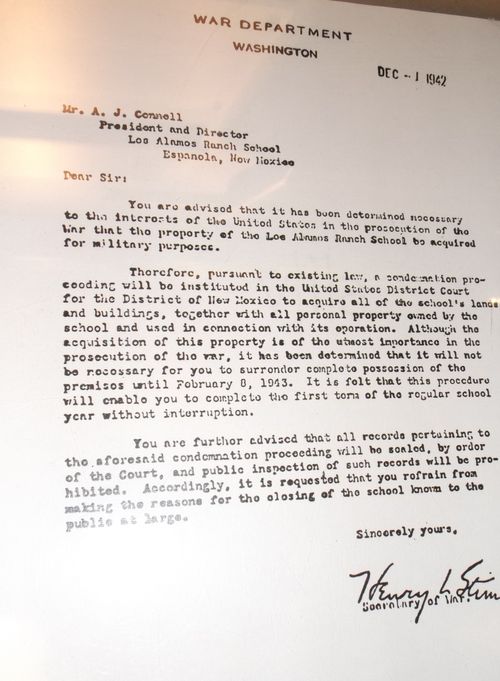
So we’re at the Bradbury Science Museum, when colleague Dwight Merriam pointed out the above letter, which tells us how the U.S. Government acquired the land it needed for the Manhattan Project. In case you can’t read the photo, here’s a transcription of the letter:

War Department

Washington

DEC — 1 1942

Mr. A.J. Connell
President and Director

Continue Reading The Eminent Domain Angle In Nuclear Tourism

The Honolulu City Council has proposed a charter amendment that asks the voters to approve eliminating the Mayor’s current veto power over the Council’s eminent domain resolutions.

The Resolution doesn’t directly say that, of course, but what it does command is that after the Council adopts a resolution to take property, the city administration must within 90 days start the condemnation action. In other words, no mayoral veto. Currently under the Charter, the Mayor may veto resolutions of taking:

Resolutions authorizing proceedings in eminent domain shall not be acted upon on the date of introduction, but shall be laid over for at least one week before adoption. Such resolutions shall be advertised once in a daily newspaper of general circulation and may be advertised, as deemed helpful, in other newspapers at least three days before adoption by the council. Not less than three copies of such resolutions shall be filed

Continue Reading Should The Honolulu Charter Eliminate The Already Minimal Check Of A Mayoral Veto On Eminent Domain Resolutions?

Check this out: the lawprof who thought up the underwater mortgage taking plan, Cornell’s Robert Hockett, along with his co-author, the “Founder and Chief Strategy Officer” of Mortgage Resolution Partners (the venture capitalists who are funding the scheme and who stand to benefit from it), have posted a new article in the Harvard Law & Policy Review, “A Federalist Blessing in Disguise: From National Inaction to Local Action on Underwater Mortgages.”

One guess what the article concludes.

In case you have not been paying attention, here’s the abstract:

While it is widely recognized that the mortgage debt overhang left by the housing price bubble and bust continues to operate as the principal drag upon U.S. macroeconomic recovery, few seem to appreciate just how locally concentrated the problem is. This paper takes the measure of the national mortgage debt overhang problem as a cluster of local problems

Continue Reading Surprise – New Article In Mortgage Resolution Partners Law Review: Use Of Eminent Domain To Take Mortgages OK!

It’s Monday and we’ve got a petition due Tuesday, so we’re not going to spend too much time on posting today. But we did want to update you on the latest on the mortgage front.

  • A San Francisco federal judge concluded that it was too early to bring the lawsuits challenging the takings. This means that the case is just not quite ripe (although it looks like it is ripening fast), not, as some media outlets have been reporting, that the judge approved of the MRP/Richmond eminent domain scheme. 
  • Our Florida colleague Carlos Kelly sends this report from the “Legal Scoop on Southwest Florida Real Estate,” a publication of his firm. Read his Update: Condemnation of Underwater Mortgages here. Many good links to other stories and reports.
  • An Arizona reader sends this item, “Using


Continue Reading The Latest On The Mortgage Takings Issue

 Norfolk

Earlier today, the Virginia Supreme Court, in PKO Ventures, LLC v. Norfolk Redevelopment and Housing Authority, No. 121534 (Sep. 12, 2013), invalidated takings of non-blighted properties which were part of a larger area designated as blighted.

In 2007, Virginia adopted a statute requiring that if property is taken to eliminate blight, the property itself must be blighted. That might seem like an obvious proposition, but as readers certainly know, since the U.S. Supreme Court’s decision in Berman, it has been ok to take the baby with the bathwater under the Fifth Amendment, and as long as a legislator rationally could have believed that taking a perfectly fine property would somehow help alleviate other blight, then the courts would not stand in the way.

The Virginia statute defines “blighted property” as one that is in bad shape “at the time of the filing of the petition for condemnation,”

Continue Reading Virginia S Ct: No Taking Of Non-Blighted Property That Happens To Be In An Area Designated “Blighted”

Dwight Merriam, familiar to our readers for the items of interest he frequently forwards, as a co-author of a recent brief in the New York rent control case, chapter author in the seminal eminent domain treatise Nichols on Eminent Domain, for being the editor of the ABA’s annual “Cutting Edge” land use books, the author of “The Complete Guide to Zoning” (which could be our favorite book on the subject), and the moderator of perhaps the most well-attended legal teleconferences on the planet (we understand this recent example had over 800 participants), has authored “Eminent Domain for Underwater Mortgages: A Cure Worse Than the Disease?,” a piece for The Abstract, the magazine of the American College of Mortgage Attorneys. 

It’s a good quick summary of the facts in the case of the plan for the city of Richmond, California to

Continue Reading Merriam On Taking Underwater Mortgages: “Lindsay Lohan has a greater chance of staying out of trouble than the city of Richmond”

Here’s the cert petition filed earlier this week, asking the Supreme Court to review the Ninth Circuit’s decision in MHC Financing Ltd. P’ship v. City of San Rafael,714 P.3d 1118 (9th Cir. 2013).

That’s the case in which the Ninth Circuit overturned the District Court’s ruling (after two trials) that MHC had proven a Penn Central taking and was entitled to just compensation for the City’s mobilehome rent control ordinance. The panel’s rationale was that MHC purchased the mobilehome park with the oppressive regulations already in place, so it had no “investment backed expectations” of operating free of the regulations.

We posted our thoughts on the Ninth Circuit’s ruling here, so we won’t go into the details of the cert petition, except to note two things:

  • We didn’t get how the Ninth Circuit just ignored Palazzolo. We still don’t.
  • The second Question Presented (below) is particularly fasinating.


Continue Reading New Regulatory Takings Cert Petition: 9th Circuit Made Hash Of Penn Central