


August 31, 2012 was a big day in the Texas Supreme Court for takings and condemnation lawyers. The court issued three major opinions in our favorite area of law. The first involves a question of public use, the second inverse condemnation, and the third valuation. Trifecta.

Instead of putting our gloss on the opinions, we’ll just post them and excerpts of the summaries from the Supreme Court of Texas Blog.

  • City of Austin v. Whittingthon, No. 10-0316 – From the Supreme Court of Texas Blog: “This is a potentially major takings case about when government can take property for private (rather than public) benefit. The City of Austin took a parcel of land in downtown that was, in short order, folded into a private development. A jury concluded that this taking was made in bad faith, and the court of appeals agreed. Divided 7-2, the Texas Supreme
Continue Reading Big Takings Day In The Texas Supreme Court

According to the Washington Post, a Texas county judge has concluded that TransCanada is a common carrier, and therefore may exercise eminent domain to take property for its Keystone XL pipeline.

In an unusual twist (but one which we fully expect to see more of as smartphones become ubiquitous), the court apparently informed the parties of his decision by an email or text from his iPhone:

Dear Counsel,
 
My rulings as follows:
 
Transcanada’s MSJ is GRANTED
Transcanada’s NEMSJ is GRANTED
Crawford’s Plea to the Jurisdiction is DENIED
 
Mr. Freeman would you please forward orders consistent with my ruling for my signature?
 
Sent from my iPhone

At least he didn’t include an LOL or 🙁 to add further insult to the injury. Continue Reading Judge Not BFF To Landowner, Grants MSJ To Condemnor Via iPhone. SRSLY.

Today’s American Banker has a story on the latest development in the let’s-use-eminent-domain-to-take-underwater-mortgages scheme: the Federal Housing Finance Agency has sent a strong shot across the bow of local governments contemplating such a move (e.g., San Bernadino, Chicago, even Berkeley):

Uh, don’t.

Full statement here, or below. The American Banker story is unfortunately behind a paywall, so we can’t bring it to you here, but we do have the highlights from a trio of Owners’ Counsel of America commentators who are quoted, us included:

“San Bernardino County cannot condemn federal property,” said Gideon Kanner, professor of law emeritus at Loyola Law School in Los Angeles and a longtime eminent domain expert. The FHFA is “a federal agency and the Feds can take the property of a state or city but the state or a local entity cannot take federal property.”

Robert Thomas, an attorney at the

Continue Reading “Hey Look, Free Money!” Fed Agency Has Problems With The Plan To Take Underwater Mortgages

20120803_134704
Here are the cases and links that I discussed at today’s ABA session on eminent domain:

  • Kelo – Remember the holding of the case: the Court majority rejected the petitioners’ call to adopt a blanket rule that all takings supported only by claims of economic development violate the Public Use Clause of the Fifth Amendment. In declining to adopt the rule, the Court left open challenges based on lack of a comprehensive plan, claims that the advanced public use is a pretext to hide a predominant private purpose, and the old “A-to-B” private taking.
  • City of Stockton v. Marina Towers LLC (Cal. Ct. App. 2009) – The case in which the court held that the city’s resolution of necessity was so “nondescript [and] amorphous,” and “so vague, uncertain and sweeping in scope that it failed to specific the ‘public use’ for City sought acquisition of the property.”


Continue Reading Resources From Today’s ABA Eminent Domain Session

For those who listened in to the just-concluded “Recent Developments in Eminent Domain” teleconference, thank you. Here are the links to the cases and briefs that we discussed that were not included in your written materials. Also, click on the link above to order the audio CD of the program if you missed out.

  • Are interlocutory public use determinations immediately appealable? Some courts say no. Others say yes
  • More on the California Supreme Court’s opinion validating the legislature’s elimination of redevelopment agencies. Follow the issue at the California Eminent Domain Report

Continue Reading Links From Today’s Eminent Domain Teleconference

Mark your calendars for next Tuesday, July 17, 2012, at 1:00 p.m. Eastern (noon CT, 11:00 a.m. MT, 10:00 a.m. PT, 7:00 a.m. Hawaii Time) for “Recent Developments in Eminent Domain,” a live audio program sponsored by Lorman Education.

It’s a 1.5 hour teleconference discussing some of the more important recent court decisions about our favorite topics, eminent domain, inverse condemnation, and regulatory takings.

I’m the sole faculty member, so you get to hear me chatter for about an hour and fifteen minutes, and we’ll save 15 minutes or so for questions. I’ll be covering the latest in public use, just compensation, and related topics. Here is the registration and CLE credit information. Hope you can join us. Continue Reading Upcoming Teleconference: Recent Developments In Eminent Domain

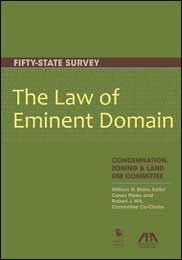
5310412_bigJust published: the ABA Section of Litigation (Condemnation, Zoning, and Land Use Committee) has released The Law of Eminent Domain — A Fifty State Survey (First Chair Press 2012). This book is a “single resource for eminent domain practitioners … a reference for questions about eminent domain and condemnation procedure in every state and the District of Columbia.” It’s a handy desk reference for how common issues in eminent domain are handled in each jurisdiction. Each state chapter covers the same topics:

  • Who is Eligible to Condemn?
  • What can be Condemned?
  • The Condemnation Proceedings
  • Procedure to Challenge Condemnation
  • Inverse Condemnation
  • Just Compensation Issues
  • How are Various Ownership Interests Treated?
  • Abandonment
  • Attorney’s Fees and Costs

We authored the Hawaii chapter. Our Owners’ Counsel of America colleague Bill Blake served as the editor, and many of our friends and colleagues from across the nation authored their state’s chapter. It’s a great reference

Continue Reading New Book: The Law of Eminent Domain (A Fifty State Survey)

Those disappointed by the Supreme Court’s decision in the ACA cases have searched for a silver lining in an otherwise devastating defeat: five justices would prohibit the Commerce power from reaching inaction, a Machiavellian CJ Roberts took the long view, that this is the Chief’s Marbury v. Madison moment. Yeah, other than that, Mrs. Lincoln, how was the play?

Others have suggested, quite correctly, that the fate of Obamacare now rests in the hands of the people. Opponents have vowed to repeal it, citing the nearly universal popular revulsion with the Court’s majority decision in Kelo v. City of New London as an example where one side lost the battle, but might have secured the upper hand in the long run.

Here’s our thoughts on why that’s unlikely, or at least why the comparisions to Kelo are inapt:

  • In Kelo, the property owners were


Continue Reading Is The Obamacare Decision The New Kelo?

We haven’t followed the Obamacare cases except as interested observers, and have largely avoided digging deep into the opinions, preferring to allow minds immeasurably superior to ours to provide the high-altitude view. However, we naturally scanned the majority opinion for any tie-in to our favorite topic, eminent domain.

Starting on page 33, the Chief Justice writes about the “functional” approach to legislative labeling, pursuant to which the majority concluded that the requirement to purchase insurance (the “mandate”) was a constitutional exercise of Congress’ taxation power, even though Congress did not call it a “tax,” and indeed packaged and sold it as anything but a tax. The majority concluded, “[t]hat constitutional question [is] not controlled by Congress’s choice of label.” Slip op. at 34. The opinion then provides examples where the Court held that particular exactions “not labeled taxes nonetheless were authorized by Congress’s power to tax,” because the Court

Continue Reading Does The “If It Looks Like A Tax And Walks Like A Tax, It Is A Tax” Rule Apply To Public Use?