


The Minnesota Supreme Court today heard oral arguments in Eagan Economic Development Authority v. U-Haul Company of Minnesota. The case asks from where a redevelopment authority derives its eminent domain power. We digested the court of appeals’ decision here.

Update: a report on the argument is posted here.

Here’s the summary of the issues presented from the Minnesota Courts site:

In 2001, the city established Cedar Grove as a tax increment financing district and adopted a redevelopment plan for the district. That redevelopment plan provided that before formal consideration of the acquisition of any property, the city would require a binding development agreement. In 2007, after negotiations to purchase the properties stalled, appellant Eagan Economic Development Authority took the properties by eminent domain. The district court granted the condemnation petitions; the court of appeals reversed, concluding that the economic development authority exceeded the scope of its

Continue Reading Minnesota Supreme Court Hearing Eminent Domain Delegation Appeal
Today, the Hawaii Supreme Court filed this Order Granting and Accepting Application for Transfer (Dec. 21, 2009), in County of Hawaii v. C&J Coupe Family Ltd. P’ship, transferring the appeal from the Intermediate Court of Appeals. [Disclosure: my Damon Key colleagues and I represent the property owners in this case.]

This is the property owners’ appeal of the County of Hawaii’s attempts to take a Kona family’s property. The first round of appeals resulted in County of Hawaii v. C&J Coupe Family Ltd. P’ship, 119 Haw. 352, 198 P.3d 615 (2008) (available here), which held that a property owner has a right to challenge thegovernment’s assertion that a taking is for public use. In reviewing ataking, courts have an obligation to take seriously a property owner’sclaim that the government’s stated public purpose is a pretext maskingits true purposes. The court held that substance matters, not form,when government

Continue Reading HAWSCT To Hear Pretext And Private Benefit Appeal

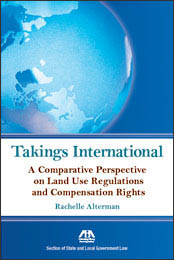
5330205_big Next month, the ABA Section of State & Local Government Law will be publishing a book by Professor Rachelle Alterman, Takings International: A Comparative Perspective on Land Use Regulations and Compensation Rights:

Everywhere in the world, land use law and regulation affect realproperty values–either increasing or decreasing them. Regulatorytakings is the potential raw nerve of land use regulation, yetpolicymakers and civic groups have tackled the issue without theperspective that a cross-national exchange of ideologies, laws, andpractices can provide.

Takings International is the firstlarge-scale effort devoted to this controversial issue, providing avast platform of comparative knowledge on direct, indirect,categorical, and partial takings. Written for legal professionals,academics, urban and regional planners, real estate developers, andcivil-society groups, the book analyzes thirteen advanced economycountries representing a variety of legal regimes, institutionalstructures, cultures, geographic sizes, and population densities.

Thecomparative prism yields some surprising and counterintuitiveobservations. In a climate of intensifying controversies about propertyand

Continue Reading New Book – Takings International: A Comparative Perspective on Land Use Regulations and Compensation Rights

For better or worse, the U.S. Supreme Court’s 1954 decision in Berman v. Parker,348U.S. 26 (1954) marks the legal genesis of modern public use jurisprudence. The Court’s opinion in the case is pretty thin on facts, however, and does not provide any real clue regarding what was going on, or how the case came about.

Now, thanks to Albany Law’s Amy Lavine, you can discover the backstory. Urban Renewal and the Story of Berman v. Parker (posted on SSRN here). It’s fascinating reading. From the abstract:

TheSupreme Court’s 1954 decision in Berman v. Parker serves as thefoundation for much of our modern eminent domain jurisprudence,including the controversial 2005 Supreme Court decision in Kelo v. NewLondon. But the story behind the case starts well before 1954, and itcarries implications that are relevant today. It’s a story that playedout in many cities across the nation, just as it did in

Continue Reading Behind The Music: Berman v. Parker

In the editorial “Eminent Domain in New York,” (Dec. 13, 2009), the New York Times opines about the two recent eminent domain decisions from the New York state appellate courts:

A New York State appellate court has misguidedly put a roadblock in theway of Columbia University’s expansion plans, ruling that the statemisused eminent domain to help Columbia assemble the land it needs.This decision conflicts with the relevant law and will make it muchharder for the university to move ahead with a project that wouldbenefit the surrounding neighborhood and the entire city.

The editorial is referring to Kaur v. New York State Urban Dev. Corp.,2009 NY Slip Op 08976 (Dec. 3, 2009), in which the New York SupremeCourt, Appellate Division (First Department) struckdown the attempted taking of land north of Columbia University in NewYork City because of the record reflected the condemnor’s claim the properties are”blighted” was a

Continue Reading NY Times Editorial On Eminent Domain: Columbia Case “Completely Out Of Step With Eminent Domain Law” And Is “Weakly Reasoned.” Really?

In State ex rel. Bd. of Regents v. McCloskey Brothers, No. 105228 (Dec. 8, 2009), the Oklahoma Supreme Court held that Oklahoma State University can take property for creation of an “athletic village.” Here’s the entirety of the public use holding:

The landowner argues that the taking was not for a proper public purpose as required by the Oklahoma Const. art 2, §§ 23-2461 because the land was to be used as an “athletic village” instead of some use which would further the academic goals of the University. The Regents argue that the proposed use is a public use/public purpose. The question of whether a proposed taking is for a “public use” is a judicial question. Nevertheless, here, the Legislature has already expressly declared such use a public use by its enactment of 70 O.S. 2001 § 4001,63 in which the Regents are authorized to take land for the

Continue Reading University’s Taking For “Athletic Village” Is For Public Use

On December 16, 2009, from 2 – 3 pm EST, ALI-ABA is presenting “The Aftermath of Atlantic Yards: Eminent Domain in New York,” a 1 hour program about the decision of the New York Court of Appeals in Goldstein v. New York State Urban Development Corp., No. 178 (Nov. 24, 2009):

The recent ruling by the New York State Court of Appeals ruled that itis lawful for the state to seize private land for use by privatedevelopers. The New York appeals-court ruled that the constitutionallows the state entity to seize the downtown Brooklyn land to improveblighted conditions. Land owners had argued that the area was notblighted, but instead a stable neighborhood. The decision is a blow toprivate land owners who have argued that they are defenseless when thegovernment deems their land necessary for eminent domain or the “publicgood.”

Join our panel of experts as they discuss the issues

Continue Reading Mark Your Calendars: ALI-ABA Program “The Aftermath of Atlantic Yards: Eminent Domain in New York”

Read this opinion: Kaur v. New York State Urban Dev. Corp., 2009 NY Slip Op 08976 (Dec. 3, 2009).

The New York Supreme Court, Appellate Division (First Department) struck down the attempted taking of land north of Columbia University in New York City because of the record reflected overwhelming private benefit:

In this case, the record overwhelmingly establishes that the truebeneficiary of the scheme to redevelop Manhattanville is not thecommunity that is supposedly blighted, but rather Columbia University,a private elite education institution. These remarkably astonishingconflicts with Kelo on virtually every level cannot be ignored, and render the taking in this case unconstitutional. 

We covered the case here and here. The NY Times report is here, and the Columbia U newspaper reports here.

More, after a chance to digest the opinion.Continue Reading New York Court Finds “True Beneficiary” Of Manhattanville Taking Is Columbia U., Not Public