The homeowners threatened with eminent domain for the Atlantic Yards project in Brooklyn, New York have filed a petition for a writ of certiorari in Goldstein v. Pataki, 516 F.3d 50 (2d Cir. 2008).

The petition points out the schizophrenic nature of Public Use analysis after Kelo: on one hand, the Court’s holding that “pretextual” takings are prohibited, and incidental public benefits are not enough, seems to invite inquiry into the motivations of the condemnor and the “actual purpose” of the taking.  On the other, the Court’s continuing reliance on the sweeping language of Berman and Midkiff may suggest that any reason that is “conceivable” would insulate a taking from further judicial scrutiny.  The Second Circuit in Goldstein chose the latter path.  As I wrote here:

The crux of the issue in Goldstein was whether factual allegations of pretext could be trumped by the invocation of the

Continue Reading Cert Petition in Goldstein v. Pataki: How to Plead Kelo Pretext

In Forbes, law prof Richard Epstein writes “The Taking of Port Chester” about the Didden v. Village of Port Chester case.  The facts of Didden are particularly egregious — in return for a private developer’s promise to withholdan exercise of eminent domain, a landowner was offered a choice: givethe developer $800,000, or a one-half interest in the owner’s planneduse of the property.  The owner had plans to put in a CVS Pharmacy, but the developer convinced the Village that his plan to put in a Walgreen’s was better, and the Village agreed to use eminent domain to stop Mr. Didden.  Professor Epstein writes:

It takes no financial wizardry to see that the expenses on both sidesof this high-priced battle are a social waste if all they do is replacea CVS pharmacy with a Walgreens. The Port Chester saga reveals theinstitutional flaw of modern takings law. Undue

Continue Reading Epstein on the Didden Case

In a post at PrawfsBlawg, “Takings, a Second Time,” University of Chicago Law Professor Richard Epstein discusses his new book Supreme Neglect: How to Revive the Constitutional Protection for Private Property, a follow-up to Takings: Private Property and the Power of Eminent Domain (1985):

There is a sneaky character of great constitutional provisions. Theshorter they are, and the more common their language, the moredifficult the task of their interpretation. Private property, forexample, is not just a two-word phrase, but it represents an entireworld view, which necessarily needs to be distilled from sourcesexternal to the text. Takings, public use and just compensation arealso terms that come easily off the tongue, but are hard to explicatein any coherent fashion. In the next few blog posts I shall workthrough some of the key arguments on these issues. But for the moment,I will just note that I am quite proud that

Continue Reading Epstein Blogs His New Takings Book

Disappointing news out of the Missouri Supreme Court.  In City of Arnold v. Tourkakis, No. SC88647 (Mar. 18, 2008), the court held that both chartered and non-chartered Missouri cities have the power to use eminent domain to take property for “redevelopment.”  The issue in the case was whether Article VI, section 21 of the Missouri Constitution allowed only larger “chartered” cities to use the power.  Background on the case here, and a summary of the issues by the Castle Coalition here.

The court’s 6-1 decision is posted here.Continue Reading Missouri Supreme Court: Both Large and Small Cities May Use Eminent Domain for Redevelopment

512n15x1gdl_ss500_In “Defend the Castle!,” Professor Gideon Kanner referenced a British vaudeville song by the Clancy Brothers, “They’re Moving Father’s Grave to Build a Sewer.” He wrote:   

And speaking of entertaining stuff that’s related to eminent domain —and Lord knows there is precious little of that —  there is also awonderful old British vaudeville song entitled “They’re movin’ father’sgrave to build a sewer.” It was recorded by the Clancy Brothers andshould be available on one of their CDs. It too is great fun.

I had not heard of the Clancy Brothers or the song before, but sure enough, their “Greatest Hits” album is available from Amazon (with free samples), and I downloaded one version of the song from Napster

They’re moving father’s grave to build a sewer,
They’re moving him regardless of expense.
They dug up his remains,
To put in five-inch drains,
To irrigate some

Continue Reading They’re Moving Father’s Grave to Build a Sewer

In “Defend the Castle!” Professor Gideon Kanner adds to my recent review of “The Castle,” a comedy about an Australian family’s fight to preserve their home from a Kelo-esque taking. Professor Kanner clarifies the Australian condemnation law:

And by the way, speaking of things Australian, we might mention thatthe Aussie term for eminent domain is “resumption.” It is derived fromthe fact that the original Crown land grants in Australia had aprovision reserving to the the Crown the right to resume title uponpayment of compensation.

Read the full post here.Continue Reading More on “The Castle”

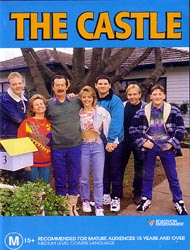
The_castle_poster_3The Kerrigan home will never make the pages of Australian House Beautiful: it sits in the flight path of the Melbourne airport, massive power lines run overhead, the back yard used to be a toxic landfill, and the owner has installed a few — ahem — “unauthorized” additions including a greyhound kennel, a massive TV aerial, and a faux chimney. 

But despite its faults, it’s home — “The Castle” — and tow-truck driver Darryl Kerrigan intends to protect it from “compulsory acquisition” (Australia’s version of eminent domain) when the airport authority, backed by a large corporation, decides it needs to take the neighborhood for an expanded runway.  The family’s peaceful existence is shattered by thetake-it-or-leave-it offer from the local council for paltrycompensation. 

I finally got my hands on an original Australian version of this 1997 comedy about a slightly offbeat family’s attempt to resist a

Continue Reading Movie Review: Kelo Down Under

There’s still time to register for the “Advanced Land Use and Zoning Law” seminar to be held on Wednesday, February 20, 2008 at the Ala Moana Hotel in Honolulu. 

Topics include vacation rentals, big box zoning, affordable housing exactions, landowner liability for rockfalls, an environmental law update, and a summary of recent key decisions from Hawaii and other jurisdictions on land use and related issues.  The faculty is comprised of my Damon Key Land Use Practice Group colleagues Greg Kugle, Mark Murakami, Robert Harris, and Noelle Catalan.  I’ll be covering the topic “U.S. Supreme Court, Regulatory Takings, and Eminent Domain Update.”

Full agenda and registration information here.  Hope you can make it — if you do, stop by and say hello.Continue Reading Land Use Seminar: February 20, 2008

In Goldstein v. Pataki, No. 07-2537-cv (Feb. 1, 2008), the US Court of Appeals for the Second Circuit held that a property owner failed to state a claim for Kelo “pretext.”  While paying lip service to the notion that in reviewing a motion to dismiss under Fed. R. Civ. P. 12(b)(6), the district court and the court of appeals are supposed to take as true the factual allegations in the complaint and view them in the light most favorable to the plaintiff (see slip op. at 3-4), the court held that the complaint did not plead enough facts to show pretext.

The crux of the issue in Goldstein was whether factual allegations of pretext could be trumped by the invocation of the Berman-Midkiff-Kelo legal standard of conceivable public use.

In other words, the appellants have effectively conceded what Rosenthal found to have been a complete defense to a public-use

Continue Reading Pleading Kelo Pretext: What About Justice Kennedy?