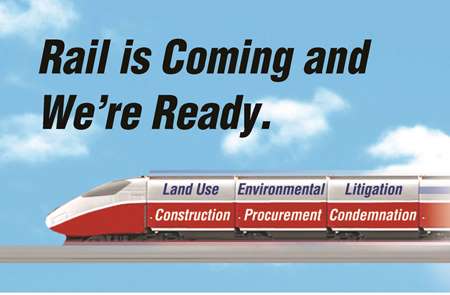
Railiscoming

[To reserve your space, please email your RSVP to me or Mark, or call either of us at (808) 531-8031.]

On Thursday, March 5, 2015, from 6:00 – 7:15 p.m. at the Farrington High School Cafeteria (1564 North King Street, Honolulu, Hawaii), we’re inviting property owners, businesses, and residents whose rights may be impacted by the Honolulu rail project to join us for an informational meeting about the rights of property owners when their property is targeted for acquisition for public transit projects, and how to protect those rights. 

Here’s the invite which we sent out:

Hawaii’s Constitution requires “just compensation” and monetary damages be paid if private property is taken for a public use such as the Honolulu rail project. The Honolulu Authority for Rapid Transit has already begun acquiring privately-owned property it needs for the rail corridor from the airport to Ala Moana, as

Continue Reading Property Owners Invited: Honolulu Rail Project Public Informational Meeting, Thursday, March 5, 2015, Farrington High School

20150204_161439 (1)

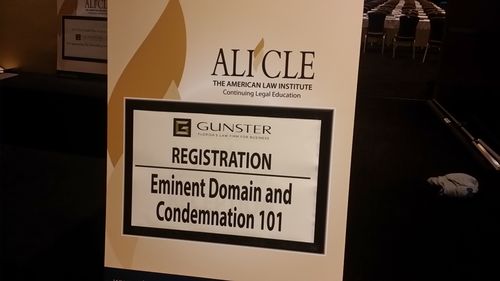
Here are the cases which I spoke about this morning at the 2015 ALI-CLE Eminent Domain and Land Valuation Litigation conference:

Here is our annual “proof of life” photo, the view from the dais. Proof

Continue Reading ALI-CLE 2015 Eminent Domain Conference: Links From Today’s Presentation

Here’s the final program and faculty list for the 2015 Hawaii Land Use Conference, coming up Thursday and Friday, January 15-16, 2015, in downtown Honolulu.

This is the bi-annual gathering of Hawaii’s land use mavens, and this year’s program has two very special presenters. Storied lawprof Richard Epstein (perhaps more than a “mere mortal”) will be presenting the keynote talk on “Stealth Takings: Exactions, Impact Fees and More,” and our ABA colleague Patty Salkin, Dean of the Touro Law School, will get us our Ethics CLE credits with her usual exciting program on ethics topics. (As someone who has attended more than few of her presentations, we can report that it is worth the price of admission alone, and even though “ethics CLE” and “exciting” are words we usually do not associate with each other, Dean Salkin’s presentation is the exception.)

Our panel on “

Continue Reading Still Time To Join Us For The 2015 Hawaii Land Use Conference (Jan. 15-16)

Here’s the Washington Court of Appeals in City of Bellevue v. Pine Forest Properties, Inc., No. 71827-4-1 (Dec. 22, 2014):

Without question, condemnation of the property for construction of the East Link Project and the City’s road improvement project is a public use.

Slip op. at 15. There’s more detailed analysis in the court’s 25 page opinion, of course, but you really didn’t need to read more than the above, did you?

City of Bellevue v. Pine Forest Properties, Inc., No. 71827-4-1 (Wash. App. Dec. 22, 2014)

Continue Reading Wash App: Temporary Taking For Rail Project Construction Staging A Public Use

2015 Hawaii Land Use Law Conference Banner - Credits

Registration is now open for the 2015 Hawaii Land Use Law Conference, to be held in downtown Honolulu on Thursday-Friday, January 15-16, 2015.

This is the bi-annual conference, co-chaired by U. Hawaii lawprof David Callies and land use lawyer Ben Kudo, that brings together the big names in our area of law. In other words, the one conference you don’t want to miss if you are a Hawaii land use or property lawyer, in-house counsel, a planner, an appraiser, a property owner or manager, or a law student interested in these topics. 

Download the full brochure here, or view it below. 

The keynote speaker this year is lawprof Richard Epstein, addressing “Stealth Takings: Exactions, Impact Fees and More.” Immediately following his talk, I will be moderating a panel on “Impact Fees and Exactions After Koontz,” with colleagues Bruce Voss and David Brittin. The rest

Continue Reading Registration Open: 2015 Hawaii Land Use Law Conference, Jan. 15-16, 2015

Lgo

ALI-CLE, the good folks who put on the annual programs on Eminent Domain and Land Valuation, and Condemnation 101: How to Prepare and Present an Eminent Domain Case, have announced the dates and venue for the 2015 conferences:

Thursday – Saturday, February 5-7, 2015 

Hotel Nikko, in San Francisco.

Those of you who have attended or taught at these conferences in the past know they are the premier programs on this topic, and feature exciting presentations and excellent faculty.

I’ve been honored to be asked to serve as the Planning Co-chair of the 32d annual Eminent Domain and Land Valuation Litigation program, stepping into the able shoes of Leslie Fields, who retired last year. Joe Waldo is continuing as Planning Co-Chair. Joe and I are currently putting together the agenda and faculty for the program, and we will have more on that soon. Andrew

Continue Reading Mark Your Calendars: 2015 ALI-CLE Eminent Domain and Land Valuation, and Condemnation 101 – February 5-7, 2015, San Francisco

Here are two recent reports on the progress of the Honolulu rail project that should be read in-tandem:

Both stories are partially behind a paywall, but here’s the relevant bits. The first story reports that HART, the city agency created to build and operate the rail is in “another race against time,” this time to acquire the private property it needs to build the rail’s easternmost stretch through Honolulu’s urban core (the tough part, in other words). According to HART, acquisition of access is “our single highest priority.” Which sounds like a big bite: HART Director “Grabauskas and HART staff say they’re aiming to do some 18 months of work negotiating those properties in only six months’ time. They intend to purchase approximately

Continue Reading Honolulu Rail And The Use Of Eminent Domain

For you rails-to-trails fans, here’s the latest from the Federal Circuit. In Biery v . United States, No. 13-5082 (June 2, 2014), the court held that interests which certain Kansas property owners conveyed to railroads back in the day were grants in fee simple, and some were grants of an easement.  

The issue was dispositive because if the grants were in fee simple, then when the railroad abandoned railroad operations, the land could be converted to public recreational trail use without triggering a taking, but if the grants were easements, then upon abandonment, the owners should have got the land back, and are owed compensation. 

As noted, in 2004, the stretch of rail corridor at issue was converted to a public trail pursuant to the Trails Act. If, prior to the conversion, the BNSF held fee-simple title to the land underlying the corridor, then, for their part, plaintiffs-appellants possess no compensable property interests.

Continue Reading The Latest Takings Decision From The Federal Circuit On Railway “Rights Of Way”

For those of you who are members of the ABA, here’s a tangible member benefit.

On Wednesday, April 9, 2014, tune in for a free webinar, “Rails-to-Trails and the Impact of Brandt Revocable Trust v. United States.” The program is sponsored by the Real Property, Trusts & Estates Legal Education and Uniform Laws Group. 

Here are the details:

ABA-RPTE Professors’ Corner – A FREE monthly webinar featuring a panel of law professors, addressing topics of interest to practitioners of real estate and trusts/estates

This is a One Hour WEBINAR

Wednesday, April 9, 2014
12:30 pm Eastern / 11:30 am Central / 10:30 am Mountain / 9:30 am Pacific

Register online here.  

March’s Program: “Rails-to-Trails and the Impact of Brandt Revocable Trust v. United States

Professors’ Corner is a monthly webinar (on the second Wednesday of each month) featuring a panel of law professors, discussing recent cases or issues of interest to real estate or trust and estate practitioners and scholars.

Speakers:

  • Professor Danaya C. Wright, University of Florida Levin College of Law
  • Professor Michael Allan Wolf, University of Florida Levin College of Law

On March 10, 2014, the U.S. Supreme Court decided Brandt Revocable Trust v. U.S., involving the interpretation of the General Railroad Right-of-Way Act of 1875. The case involved a railroad right of way obtained in 1908, crossing land conveyed by the U.S. to the Brandt family in a 1976 land patent that did not specify what would happen if the railroad later relinquished its right of way (which occurred some years later). In the case, the U.S. sought to quiet title to the abandoned right of way, including the portion that crossed the land conveyed by the Brandt patent. Reversing the Tenth Circuit, which had affirmed a grant of summary judgment for the U.S., the Supreme Court held that the right of way was only an easement and was extinguished when the railroad abandoned it. The decision has already created some substantial consternation regarding its potential impact on the Rails-to-Trails movement and recreational trail development along abandoned rail corridors.

We’re registered, and you should too.
Continue Reading Mark Your Calendars: “Rails-to-Trails and the Impact of Brandt Revocable Trust v. United States” (4/9/2014) – Free To ABA Members

It’s Friday, so we’re slacking a bit on the blogging. But our colleagues at the Nossaman firm have given us a couple of good pieces for our reading enjoyment.

  • First is “9th Circ. Simplifies Enviro Process For Transit Projects,” by Robert D. Thornton. If his name sounds familiar, it’s because he’s the lawyer who represented the City and County of Honolulu in its succcessful defense of a federal lawsuit. The Ninth Circuit and the District Court recently sided with the City on the project (see our summary of the Ninth Circuit and the District Court rulings), and the plaintiffs have stated that they are not going to seek further review. In other words, this is probably the final substantive chapter in the major legal challenges to the Honolulu rail project. Mr. Thornton notes that the decision is one “of national importance for transit and highway projects” because


Continue Reading Worth Reading – The Last Word On Honolulu Rail, And 2013 Eminent Domain Year In Review