IMG_20170126_133958

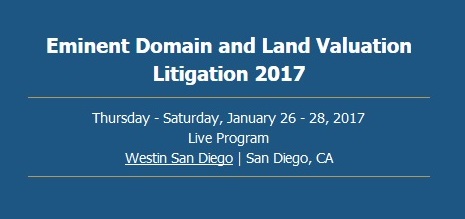
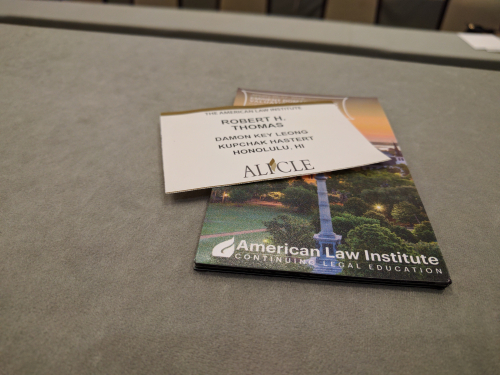
Here are the links and references to the cases we spoke about today at our opening session on the national trends in eminent domain law at the 2017 ALI-CLE Eminent Domain and Land Valuation Litigation Conference in San Diego. 

We again have a record attendance, and a good number of new attendees. If you aren’t here now, we’re sorry you didn’t make it. But fear not: ALI-CLE has already set the date and location for the 2018 Conference: save the date on your calendars now — January 25-27, 2018, Charleston, South Carolina, at the Francis Marion Hotel. 


Continue Reading Day 1, 2017 ALI-CLE Eminent Domain And Land Valuation Litigation Conference, San Diego

There have been a lot of takings and takings-related decisions coming out of the Court of Federal Claims lately, and we’ve held off on posting them individually. So to start off your New Year, here is a pop quiz.

Your task: guess whether the CFC held there was a taking, or no taking (answers below):

Case 1: Sheikh Djibouti 

  • Global Freight was a subcontractor providing services to a Navy base in Djibouti. The Navy ordered it to move its vehicles from the Navy base into Djiboutian territory, after which the Djiboutians seized the vehicles. Taking or no taking? 
  • Taking. Or at least not “no taking.” In Global Freight Systems, Co. v. United States, No. 15-378C (Fed. Cl. Dec. 29, 2016), the CFC denied the government’s motion to dismiss for failure to state a claim (which argued that it was the Djiboutians and not the U.S. which took the


Continue Reading Court Of Federal Claims Pop Quiz: Taking Or No Taking?

Following up on our post earlier this week with our amicus brief, here are the remainder of the briefs filed in the Federal Circuit in a case in which the government is asking the court to bypass panel hearing and go straight to en banc review of a Court of Federal Claims opinion which held that the owners of a railroad easement which was converted to a recreational path are owed $900 in just compensation, plus EAJA fees. 

Why all this sturm und drang (as the Federal Circuit once characterized rails-to-trails cases) over 900 bucks?

As we wrote in our earlier post, this is the government’s attempt to wipe out established regulatory takings doctrine and get the Federal Circuit to effectively overrule its prior decisions holding the government liable for physical takings when it prevents reversion of the railroad easement to private owners when those easements are no longer

Continue Reading More Briefs In En Banc “Hail Mary” Asking Fed Cir To Abandon Decades Of Rails-To-Trails Rulings

You rails-to-trails and takings mavens all know the drill in those cases: rail easement stops being used for rail, bikers and runners want a recreational path, the federal Surface Transportation Board issues a Notice of Interim Trail Use (they say “interim” because of the fiction that they are just “railbanking” and someday when we want the iron horse to rule again, the bike path may be converted back into a rail line), which under the U.S. Supreme Court’s ruling in Preseault v. Interstate Commerce Comm’n, 494 U.S. 1 (1990), triggers the obligation of the federal government to pay just compensation for the taking of the property owner’s “reversionary” interest.

In other words, the owners across whose land the railroad easements are located were supposed to get that land back if those easements stopped being used for railroads. When they get converted instead into public recreational trails, there’s a taking. Now

Continue Reading Fed Cir Amicus Brief: Regulatory v. Physical Takes In Rails-To-Trails – No En Banc Review To Overturn Settled Precedent

Here’s the latest in a case we’ve been following (because we filed an amicus brief in the Federal Circuit in support of the property owners, and will be filing a brief in support of the cert petition). 

This is the case about New York City’s “Highline,” the abandoned elevated rail line which was converted into a public parkway. The problem, however, was that the federal government failed to pay just compensation to the owner of the railway easement, who was supposed to have the easement revert to it when the city stopped using it for a rail line.

The owner brought a rails-to-trails takings case for compensation in the Court of Federal Claims but that court, and the Federal Circuit, concluded that under New York law, the terms of the easement (what the Federal Circuit called a “general easement”) meant that the easement was granted not only for railway

Continue Reading New Cert Petition: When Faced With A Question Of State Property Law, Should A Federal Court Make Its Best Guess?

Here’s the amici brief we’re filing in a case which we told you about earlier, involving the way attorneys’ fees get calculated when a statute allows fee shifting. 

This is the afterglow of a rails-to-trails takings case, in which the property owners are entitled under the Uniform Relocation Act to attorneys’ fees. We like. 

What we didn’t like was the way the trial court arbitrarily cut the property owners’ fee request, without ever explaining why. The court simply made an across-the-board percentage reduction from the “lodestar” (a reasonable hourly rate times a reasonable time per task). And the Federal Circuit affirmed. 

So the property owners sought cert review, and now we’ve filed a brief in support. Our brief focuses on the first Question Presented: “Whether trial courts have discretion to make across-the-board percentage adjustments to the lodestar fee and, if so, what “specific proof” or “explanation” must the

Continue Reading SCOTUS Amicus Brief: Court Can’t Arbitrarily Reduce A Lawyer’s “Stock In Trade”

ALI2017 - Copy
ALI2017

We’ve teased some of the details on the 2017 ALI-CLE Eminent Domain and Land Valuation Litigation and Condemnation 101 Conference, to be held at the Westin San Diego, January 26-28, 2017, but here are the details you’ve been waiting for.

This is the “big one,” our annual 3-day festival of all things eminent domain, property, takings, inverse condemnation, and just compensation. Truly national in scope, this is the 34th annual edition, and the one conference you must attend. Our 2016 conference in Austin was one of the best in years, and we’re on the way to replicating it in 2017, with a great venue in an exciting city. 

Look for the web and printed brochures to show up in your mailboxes, but in the meantime, here are some of the highlights (we’ll post more in the next few days):

  • Relocation, relocation, relocation: we are featuring two sessions on this


Continue Reading Details: ALI-CLE Eminent Domain And Land Valuation Conference – San Diego, January 26-28, 2017

Arlington

Here’s the amici brief we filed today in a fascinating case we told you about recently

The core issue in Brott v. United States, No. 16-1466, which is currently being briefed in the Sixth Circuit, is whether plaintiffs who allege the United States took their property in a rails-to-trails case can only bring their lawsuit for just compensation in the Court of Federal Claims. They filed suit in a U.S. District Court, and the case was dismissed for lack of jurisdiction.  

Our brief, filed on behalf of the National Association of Reversionary Property Owners, the Property Rights Foundation of America, the Pioneer Institute, and Professor Shelley Ross Saxer, supports the property owners’ arguments that they are entitled to file the case in an Article III court. The owners’ brief covers the issues very well, and we didn’t repeat their arguments.

Rather, we covered a somewhat forgotten decision

Continue Reading Amici Brief: “the hallmark of our American system is that we do not have kings lording over us who must first consent before they can be sued in their own courts.”

Here’s the latest in a case we’ve been following, and that could be hugely important. This is a case about federal court jurisdiction and takings claims against the federal government.

We reported on the of Brott v. United States when it commenced: it’s a rails-to-trails takings case, so it would be understandable if you thought this was going to be another one of those dry posts about Court of Federal Claims and Federal Circuit jurisdiction. But it isn’t.

Because, you see, our colleague Thor Hearne and his team brought the case in the United States District Court for the Western District of Michigan, where the property is located. But wait, you say, they can’t do that, because they are seeking more than $10,000 in just compensation, and that means the CFC, an Article I court, has exclusive jurisdiction over the complaint.

Or does it? Not according to this brief,

Continue Reading “Juridical Garlic,” The Takings Clause, And Magna Carta: Sixth Circuit To Consider Jury Right And Article III Courts For Federal Reg Takings Claims