


Some states (mostly in the Midwest, to our knowledge) don’t really recognize inverse condemnation” claims, at least as we in other jurisdictions use that term. Instead of recognizing a direct cause of action for compensation and damages when government has taken property physically or by regulation without first instituting an eminent domain case, these jurisdictions require a property owner to sue in mandamus, to compel the government to formally condemn the property and pay. Minnesota is one of those jurisdictions.

Property owners better follow that mandamus process strictly, at least according to the Eighth Circuit in American Family Ins. v. City of Minneapolis, No. 15-3216 (Sep. 6, 2016). Wait, you say, what’s this — an inverse condemnation/takings case in federal court … how can that be?

The case — a claim by insurance companies on behalf of their insureds after the city’s water main broke and flooded a condo —

Continue Reading Eighth Circuit: Mandamus By Any Other Name … Still Mandamus
In the course of negotiating a successful hostage situation with tear gas, flash-bang grenades, and a bulldozer, the Spartanville, SC police department damaged a convenience store. So badly that the owners “were later asked by the City to tear it down as it did not comply with ordinances regarding vacant commercial buildings.” After the owners said no, the City demolished it. 

In Carolina Conveniece Stores, Inc. v. City of Spartanburg, No. 27663 (Aug. 31, 2016), the South Carolina Supreme Court held that this wasn’t an inverse condemnation. The court didn’t provide any substantial analysis, holding merely that the South Carolina Constitution does not contemplate that damage occasioned to private property by law enforcement in the course of performing their duties constitute a taking.” Slip op, at 4-5. Why? Because “the framers of the Constitution did not intend that law enforcement operate under the fear that their actions could lead to

Continue Reading SC: Damage Caused By SWAT Isn’t A Taking

Entry statutes are in the news lately. As we reported here for example, the California Supreme Court recently saved California’s entry statute from unconstitutionality by implying a requirement for a jury trial (and other eminent domain protections) when the entries which the condemnor seeks to undertake constitute takings.

In that case, the party seeking entry proposed to bore and fill holes on the property. Which meant that the entries were undoubtedly permanent physical appropriations. This triggered the requirement that the entry conform to the eminent domain process, such as having a jury determine just compensation. Thus, the court understood that in the absence of its reformation of the statute (i.e., rewriting it), the entry process as applied would be unconstitutional. We’ll save for another post our commentary on the California Supreme Court’s approach.    

But such details didn’t concern the North Dakota Supreme Court in its opinion applying that

Continue Reading ND: Entry Statutes Are Not Takings, Even If There’s A Physical Invasion

2016 BrighamKanner Property Rights Conference Program_Page_01

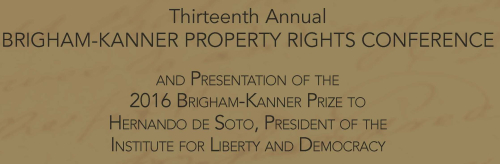
As we mentioned a few weeks ago, the final agenda for the 2016 Brigham-Kanner Property Rights Conference has been released. Here’s the complete conference brochure, which has all the details, including registration information. 

This is the annual program, sponsored by the William and Mary Law School, in which there’s a day-long discussion of all things property rights among members of the academy, the bench, and the practicing bar. The Brigham-Kanner Prize is also presented “to an individual whose work has advanced the cause of property rights and has contributed to the overall awareness of the important role property rights occupy in the broader scheme of individual liberty.” The pantheon of prizewinners is a who’s-who in our area of law: Richard Epstein, James Ely, Michael Berger, Frank Michelman, Carol Rose, and Thomas Merrill, to name a few. Here’s the complete list of prizewinners

This year, the prize is being

Continue Reading Property Rights Take Center Stage At The World Court: 2016 Brigham-Kanner Conference, October 19-21, 2016, The Hague

One for you land users. We’re not going to analyze the Hawaii Intermediate Court of Appeals’ published opinion in Robert D. Ferris Trust v. Planning Comm’n of the County of Kauai, No. CAAP-15-0000581 (Aug. 9, 2016) in too much detail, because our Damon Key colleagues Greg Kugle and Chris Leong represent the prevailing appellant. But here’s a short summary, after which you can read the opinion itself.

The narrow issue in the case involves the definition of the term “applicant” in two different sections in the County’s zoning ordinance. The underlying issue is one that’s hot right now across Hawaii and elsewhere: short-term or transient vacation rentals, defined in the Kauai zoning ordinance as rental for less than 6 months.  

Here, the homeowner had a parcel in an agricultural district, with a single-family residence on the lot. It began renting the home to vacationers in 2003, prior to

Continue Reading HAWICA Rejects Planning Department’s Formalistic Definition Of “Applicant” In Vacation Rental Case

To state a claim for inverse condemnation in Nevada, the property owner must allege that the government was “substantially involved” in activities that caused the taking of the property.

In Fritz v. Washoe County, No. 67660 (Aug. 4, 2016), the Nevada Supreme Court addressed what constitutes substantial involvement. Does it require actual physical “involvement” in the actions which resulted in flooding, or is the government doing governmental things like approving applications enough? In the end, the court set out a test somewhere in between those two poles. 

This is a flood case where the property owners alleged that the County approved plat maps and managed the drainage system which ultimately resulted in their property being inundated. As part of that process, the County accepted dedications, and worked with the Nevada DOT to direct where water coming down a mountain would flow. The County asserted the owners didn’t have standing

Continue Reading Nevada Clarifies Inverse Condemnation And What Is “Substantial Government Involvement”

The issue resolved by the Minnesota Supreme Court in Zweber v. Credit River Township, No. A14-0893 (July 27, 2016) was one that land use lawyers deal with constantly: when an administrative agency is alleged to have violated someone’s constitutional rights, what procedural route must the legal challenge take — is the plaintiff required to go to court via administrative channels, or can she initiate an original jurisdiction (“de novo”) case?

In Zweber, the court came down on the side of original jurisdiction. There, Zweber owned undeveloped land which he wanted to develop, and he submitted a preliminary subdivision plat to divide it up. After a neighbor objected for the usual reasons (traffic), the County approved the plat application. But Zweber didn’t begin development and instead, a couple of years later applied for a new subdivision. “This time, based on the recommendation of the Planning Commission, the County Board denied

Continue Reading Constitutional Property Claims Are For Courts, Not Agencies

Last year, we posted about the Brigham-Kanner Conference, the annual meeting at William and Mary Law School where we talk all things property rights and award the Brigham-Kanner Property Rights Prize. (By the way, this year’s conference will be held in The Hague, The Netherlands in October. But more on that soon, in a separate post.)

What we are posting today is a follow-up about Mike Berger’s presentation at the 2015 conference. His article — then only in draft form — is a critique of the theories of the 2015 Brigham-Kanner prizewinner, Harvard lawprof Joseph Singer. Recall that Berger was presented with the prize in 2014 — the first and thus far only practitioner to receive the award — which makes this article even more important.  

Berger’s article is now finalized, and has been published by the Brigham-Kanner Property Rights Conference Journal: “Property, Democracy, &

Continue Reading Must Read: Michael Berger On “Property, Democracy, & The Constitution”

We’re not going to go into much detail about the Court of Federal Claims’ ruling in Katzin v. United States, No. 12-384L (July 15, 2016): (1) it’s long (44 single-spaced pages), (2) it’s a post-trial ruling and not from an appellate court, and (3) we’re busy today.

But we still recommend you read it, eventually, because it looks like a fascinating case. Here’s the CFC’s ruling, to start:

This post-trial opinion addresses claims by plaintiffs Dr. Richard Lewis Katzin (“Dr. Katzin”), Mary Beth Katzin Simon (“Ms. Katzin”), and Rose Marie Kjeldsen Winters (“Ms. Winters”) that the United States (the “government”) interfered with their ownership rights to a parcel of land (“Parcel 4”) which overlooks the Atlantic Ocean on Culebra Island, Puerto Rico, and that the interference effected a taking in contravention of the Fifth Amendment.

. . . .

This case raises factual questions of property ownership that

Continue Reading Pirate Of The Carribean: Govt Claiming Ownership And Clouding Title Is A Physical Taking

Civil procedure fans, rejoice. Here’s one to take you to the weekend.

We say that because although Laroe Estates, Inc. v. Town of Chester, No. 15-1086 (July 6, 2016), was a regulatory takings case, the issue — whether a third party could intervene — was not really dependent on the underlying Fifth Amendment claim. In that case, the U.S. Court of Appeals for the Second Circuit held that an intervenor need not show standing in order to intervene; it only needs to meet the requirements for as-of-right or permissive intervention under the federal rules of civil procedure. The rules that in order to intervene, an intervenor only have an interest at stake in the litigation, and need not have a vested “property interest” under the Fifth and Fourteenth Amendments.   

Sherman asserted a regulatory takings case against the town in federal court. After a visit to the Second circuit

Continue Reading 2d Cir: Circuit Split? Meh. You Don’t Need Standing (Or A Property Interest) To Intervene In A Takings Case