We were all set to post our thoughts on the Illinois Supreme Court’s recent opinion in Hampton v. Metropolitan Water Reclamation District of Greater Chicago, No. 119861 (July 8, 2016), when we were beaten to the punch by Erin Baker, an associate of our colleague (and fellow U. Hawaii law alum) Julie Tappendorf. They posted “Illinois Supreme Court Addresses Takings Clause in Temporary Flooding Case” on their firm’s Municipal Minute blog.

She has all the details, and we recommend you read the post.

Short story is that land was flooded temporarily, allegedly by the Water District to avoid flooding at O’Hare airport, and the plaintiffs brought a claim for a taking under the Illinois Constitution. Since 1948, Illinois has had a judicially-created rule that temporary flooding cannot be a taking. But as we all know, the U.S. Supreme Court recently held that just because

Continue Reading Illinois Supreme Court: Temporary Flooding Can Be A Taking, But There’s No Bright Lines In Flood Takings Cases

Arlington

Here’s the amici brief we filed today in a fascinating case we told you about recently

The core issue in Brott v. United States, No. 16-1466, which is currently being briefed in the Sixth Circuit, is whether plaintiffs who allege the United States took their property in a rails-to-trails case can only bring their lawsuit for just compensation in the Court of Federal Claims. They filed suit in a U.S. District Court, and the case was dismissed for lack of jurisdiction.  

Our brief, filed on behalf of the National Association of Reversionary Property Owners, the Property Rights Foundation of America, the Pioneer Institute, and Professor Shelley Ross Saxer, supports the property owners’ arguments that they are entitled to file the case in an Article III court. The owners’ brief covers the issues very well, and we didn’t repeat their arguments.

Rather, we covered a somewhat forgotten decision

Continue Reading Amici Brief: “the hallmark of our American system is that we do not have kings lording over us who must first consent before they can be sued in their own courts.”

IMG_4369

Here’s one we’ve been waiting for, but had been hoping for a better result.

In Resource Investments, Inc. v. United States, No. 15-802 (cert. petition filed Dec. 16, 2015), the U.S. Supreme Court was being asked to consider the issue it left open after United States v. Tohono O’odham Nation, 131 S. Ct. 1723 (2011), whether takings claims must be excepted from the rule in Tohono that the Court of Federal Claims is deprived of jurisdiction in any case which is based on the same operative facts “pending in any other court any suit or process.”

Tohono was not a takings case, but rather a non-takings claim for damages. The Supreme Court upheld the dismissal of the claim by the CFC on jurisdictional grounds, because the at the time the Nation filed its CFC complaint against the United States for money damages, the District Court was considering the Nation’s

Continue Reading SCOTUS Denies Cert In Last Hanging Takings Case – Tohono’s Jurisdictional Ambush Remains Lurking

Here’s the latest in a case we’ve been following, and that could be hugely important. This is a case about federal court jurisdiction and takings claims against the federal government.

We reported on the of Brott v. United States when it commenced: it’s a rails-to-trails takings case, so it would be understandable if you thought this was going to be another one of those dry posts about Court of Federal Claims and Federal Circuit jurisdiction. But it isn’t.

Because, you see, our colleague Thor Hearne and his team brought the case in the United States District Court for the Western District of Michigan, where the property is located. But wait, you say, they can’t do that, because they are seeking more than $10,000 in just compensation, and that means the CFC, an Article I court, has exclusive jurisdiction over the complaint.

Or does it? Not according to this brief,

Continue Reading “Juridical Garlic,” The Takings Clause, And Magna Carta: Sixth Circuit To Consider Jury Right And Article III Courts For Federal Reg Takings Claims

20160529_124542

As we noted last week, the expanding costs of the Honolulu Rail project has forced Honolulu’s mayor to ask whether construction should be delayed or stopped entirely, short of its planned terminus at Ala Moana shopping center. “Middle Street” became the new rail watchword, even though stopping it there would omit — temporarily or permanently — the most densely populated, and therefore the most useful, portion of the route. 

Middle Street is somewhat of a nondescript, dare we say it, “blah” street; more of a demarcation between the airport area and the more industrialized Dillingham corridor. A place you generally go by on your way elsewhere, not consider a destination. Frankly, it doesn’t have much of a reputation for anything exciting. In our minds, it is most notable as the border between “town” and “country,” at least psychically. 

  • Civil Beat‘s Chad Blair, however, sees it differently. In a tongue-in-cheek


Continue Reading Rail: Building To The Nowhere Of Middle?

There’s a lot of procedural history to digest in the Michigan Court of Appeals’ opinion in AFT Michigan v. Michigan, No. 303702 (June 7, 2016), because it is merely the latest in a long string of opinions from that court, and the Michigan Supreme Court, interspersed with the Michigan legislature’s attempts to react. The opinion lays it all out, and we won’t repeat it here.

The short story is that the legislature adopted a statute which required public school employees to contribute 3% of their salaries to the retirement and health care system. Adding insult to injury, the withholding was labeled as an employer contribution.

The employees sued, alleging a taking among other claims. The court of appeals agreed it was a taking, but while the case languished in the Michigan Supreme Court awaiting discretionary review, the legislature revised the offending parts of the statute. In a different case

Continue Reading Mich App: Forced Employee Contributions To Retirement Fund – Still A Taking

20160126_163953

It’s a good day. You win your takings case in the Texas Supreme Court. True, it’s a narrow 5-4 victory, and it merely reverses summary judgment against you, which means only that you live to fight another day. But a win is a win, we always say. The decision is based on the Texas Constitution, which also means that your win is insulated from U.S. Supreme Court review. 

So it’s game over, right? 

Not so fast. Under Texas appellate procedure, a win in that court isn’t necessarily the end of the process. You need to get by a motion for rehearing as well. In our (non-Texas) experience, these things are usually exercises in futility for the moving party, at least if the goal is to get the court to change its mind on the critical issue decided. Yes, we’ve seen recon and rehearing motions granted from time to time, but only

Continue Reading Texas Turnabout: Gov’t Development Approvals Without Flood Control Plan Isn’t A Taking

A new(er) law review article, worth reading, from Dean Shelly Saxer, “When Local Government Misbehaves,” 2016 Utah L. Rev. 105 (2016). Here’s the abstract:

In this article, Dean Saxer examines the Supreme Court’s decision in Koontz v. St. Johns River Water Management District. In that land use case, the Court held that proposed local government monetary exactions from property owners to permit land development were subject to the same heightened scrutiny test as imposed physical exactions. The Court left unanswered the question of how broadly this heightened scrutiny should be applied to other monetary obligations imposed by the government. Saxer argues that “in lieu” exactions that are individually assessed as part of the permitting process should be treated differently than the impact fees that are developed through the legislative process and are applied equally to all developers without regarding to a specific project. Accordingly, Koontz’s application should be

Continue Reading New Article On Nollan/Dolan/Koontz: “When Local Government Misbehaves”

This just in: the North Carolina Supreme Court has issued an opinion in an important case we’ve been following for a long time, Kirby v. North Carolina Dep’t of Transportation.

This is the case about the “Map Act,” a statute which designates private property for future highway use, and  “restricted plaintiffs’ fundamental rights to improve, develop, and subdivide their property for an unlimited period of time.” Slip op. at 1.  The court concluded that “[t]hese restraints, coupled with their indefinite nature, constitute a taking of plaintiffs’ elemental property rights by eminent domain.” Id.  

The North Carolina Court of Appeals earlier held the Act was a taking, and this resulted in a lot of shouting and gnashing of teeth that making the DOT actually pay just compensation would crash the system and cost the state a lot of money, so we were not terribly surprised when the DOT sought review

Continue Reading NC: “Map Act,” Which Designates Property For Future Highway Acquisition — And Prohibits Development In The Interim — Is A Taking

20160609_095451

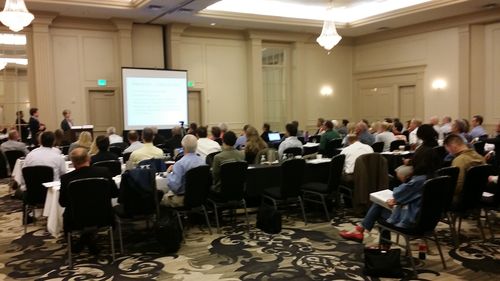
A very good crowd for today’s Oregon Eminent Domain Conference in Portland. 

Here are the links to the cases and other materials that we spoke about today in our session “Inverse Condemnation and Regulatory Takings – Issues and Trends.”  

Our thanks to Planning Chairs Jill Geleneau and Paul Sundermier for putting together a great program, and for inviting us to speak. 


Continue Reading Links From Today’s Oregon Eminent Domain Conference