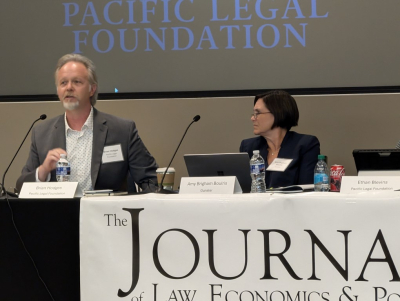
PXL_20241111_181016079.MP

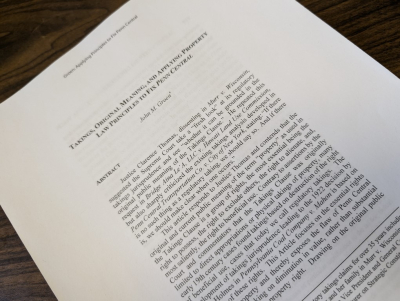
Today’s must-read, a (very) recent article by our Pacific Legal Foundation colleague John Groen, published in the Touro Law Review, “Takings, Original Meaning, and Applying Property Law Principles to Fix Penn Central.”

Get the pdf here.

With a title like that, who could resist? Here’s the Abstract:

Justice Clarence Thomas, dissenting in Murr v. Wisconsin, suggested the Supreme Court take a “fresh look” at its regulatory takings jurisprudence and see “whether it can be grounded in the original public meaning of the Takings Clause.” He repeated this request in Bridge Aina Le’A, LLC v. Hawaii Land Use Commission, but also sharply criticized the existing takings analysis developed in Penn Central Transportation Co. v. City of New York, stating: “If there is no such thing as a regulatory taking, we should say so. And if there is, we should make clear when one occurs.”
Continue Reading New Law Review Article: John Groen, “Takings, Original Meaning, and Applying Property Law Principles to Fix Penn Central,” 39 Touro L. Rev. 973 (2024)

Screenshot 2024-11-08 at 07-19-21 Track Appeals NJ Courts

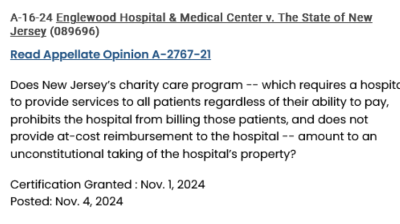
Here’s the latest in a case we’ve been following. The New Jersey Supreme Court has agreed to review the Appellate Division’s decision in Englewood Hospital & Medical Center v. New Jersey

That’s the case where several hospitals challenged a New Jersey statute which requires hospitals to take all patients regardless of their ability to pay, but does not fully reimburse under Medicaid the hospitals for the costs of treating these patients even where it results in the hospitals losing money.

The Appellate Division held this was not a categorical (Cedar Point/Loretto) or an ad hoc (Penn Central) taking.

The hospitals asserted that the statute required them to suffer a physical invasion, because the statute prohibited hospitals from excluding nonpaying patients. The court rejected the argument, in what reminded us of the Yee rent control and PruneYard commercial benefit approach, where the essential reasoning

Continue Reading NJ Supreme Court Grants Review: Is Forcing Hospitals To Operate At A Loss A Taking?

Screenshot 2024-11-04 at 12-34-18 Texas Supreme Court
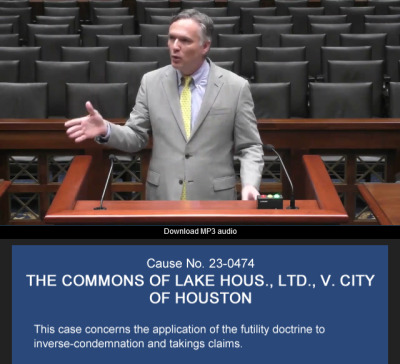
Charles McFarland, arguing.

Here’s the latest in a case we’ve been following closely (and disclosure: our firm filed an amicus brief in the Texas Supreme Court).

In The Commons of Lake Houston, Ltd. v. City of Houston, the Texas Court of Appeals held that the city could not be liable for a taking for an ordinance that limited development and use within the city’s 100-and-500-year floodplains because the ordinance was a valid exercise of police power and otherwise survived the rational basis test.

As we wrote here, that seems like utter nonsense to say that a valid police power reason categorically insulates a government action from a takings challenge. After all, the entire regulatory takings doctrine is built on the notion that an otherwise-valid exercise of government power (here, the police power, delegated from the State to the city) can so impact an owner’s property rights that

Continue Reading Oral Arguments In Texas Takings Case: If The Govt Limits Use For Healthsafetywelfaremorals, Is It Exempt From Takings?

Here’s the latest takings cert petition, in a case involving a California county’s refusal to rezone property back to its former zoning to allow residential development. The only uses permitted on the property presently are “scientific research facilities uses” and hiking trails. Or, at the petition puts it, “only public, park-like uses.” Pet. at 5. 

The District Court and the Ninth Circuit both held no taking.

Here are the Questions Presented:

Does a taking analyzed under Lucas v. S.C. Coastal Council require that the affected property be left with no value even if the regulation in question deprives the property of all economically beneficial uses?

Does Palazzolo v. Rhode Island leave any room for consideration of the landowners’ expectations in a Penn Central takings analysis?

Do the decisions in Loper Bright Enters. v. Raimondo, Cedar Point Nursery v. Hassid, Sheetz v. Cnty. of El Dorado and Lingle

Continue Reading New Cert Petition: Use vs Value, And Applying Penn Central

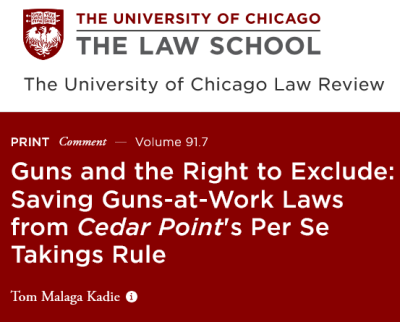
Screenshot 2024-11-04 at 07-50-41 Guns and the Right to Exclude Saving Guns-at-Work Laws from Cedar Point's Per Se Takings Rule The University of Chicago Law Review

The latest issue of the University of Chicago Law Review has this student-authored piece that is worth your time reading. “Guns and the Right to Exclude: Saving Guns-at-Work Laws from Cedar Point‘s Per Se Takings Rule,” 91 U. Chi. L. Rev. 2047 (2024). 

Here’s the Abstract:

The Supreme Court’s decision in Cedar Point Nursery v. Hassid has left considerable uncertainty in the realm of takings law. In Cedar Point, the Court announced a new rule that government-authorized physical occupations of property, even temporary ones, constitute per se takings. But the Cedar Point decision left significant questions unresolved regarding the scope of its per se takings rule and its various exceptions.

To resolve these questions, this Comment looks to the example of guns-at-work laws. Enacted by about half of the states, guns-at-work laws protect the right of a business’s employees, customers, and invitees to store firearms in

Continue Reading New U Chi L Rev Article (Comment): “Guns and the Right to Exclude: Saving Guns-at-Work Laws from Cedar Point‘s Per Se Takings Rule”

Screenshot 2024-10-25 at 13-19-32 Housing and Exactions The Next Frontiers After Sheetz Pacific Legal Foundation

Our outfit (Pacific Legal Foundation) has put out a call for papers. on the topic of land use exactions and housing law. Honorarium included for accepted papers, and there will be a workshop to follow.

Here’s the description:

This workshop seeks to build on the result of Sheetz v. County of El Dorado and chart the course of the next steps in exactions/unconstitutional-conditions law. From Nollan v. California Coastal Commission, through Dolan v. City of Tigard and Koontz v. St. John’s River Water Management District, and now including Sheetz, the Supreme Court has looked to the doctrine of exactions and unconstitutional conditions to ensure property rights are protected. In doing so, it has created a constitutional bulwark protecting the right to build housing on private property, an important stick in the property rights bundle.

The Supreme Court’s unanimous decision in Sheetz held that legislatively-imposed development-fee schedules are

Continue Reading Call For Papers: “Housing and Exactions: The Next Frontiers After Sheetz“

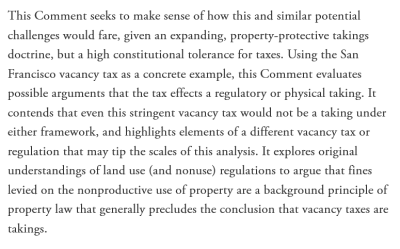
Screenshot 2024-10-24 at 12-28-24 Vacancy Taxes A Possible Taking The University of Chicago Law Review

A new student-authored journal article worth reading, Christine Dong, “Vacancy Taxes: A Possible Taking?,” 91 U. Chi. L. Rev. 1725 (2024).

Here’s the Abstract:

Vacancy taxes are an increasingly popular solution to the paradoxical problem of high housing demand coupled with high vacancy. Cities across the country facing housing shortages have either implemented or are considering adopting vacancy taxes to encourage property owners to rent or sell their property. Soon after San Francisco adopted a vacancy tax with one of the broadest definitions of vacancy, property owners lobbed a constitutional challenge under the Takings Clause, taking advantage of a moment of doctrinal instability.

This Comment seeks to make sense of how this and similar potential challenges would fare, given an expanding, property-protective takings doctrine, but a high constitutional tolerance for taxes. Using the San Francisco vacancy tax as a concrete example, this Comment evaluates possible arguments that the

Continue Reading New Article (Comment): “Vacancy Taxes: A Possible Taking?” (U. Chi. L. Rev.)

Here’s the latest in a case we’ve been following, which asks whether a local ordinance which allowed non-paying tenants to remain in the lessor’s property is a physical taking, or merely the regulation of the lessor/lessee relationship under the Yee theory, which posits that once an owner voluntarily rents property to a tenant, the government then allowing that tenant to remain rent free isn’t facilitating an unauthorized physical occupation, but rather is merely a regulation of the existing lessor/lessee relationship. In short, you let ’em in property owner, so suck it up.

The property owner has now filed this cert petition challenging that rationale.

As we’ve noted previously, some courts’ reliance on Yee in this and similar situations is a misreading of that decision. Besides that, these courts essentially upend the longstanding common law of property governing the owner/tenant relationship, and the contractual nature of that relationship

Continue Reading New Cert Petition: Eviction Moratorium Transferred Possession Easement To Nonpaying Tenants

PXL_20241004_152452877.MP
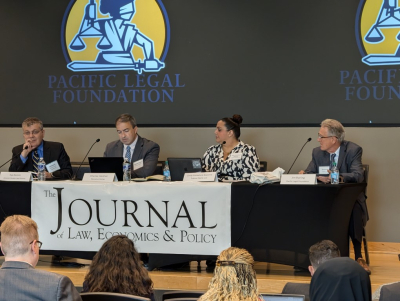
Lawprof Ilya Somin (GMU Law), Mercatus Center’s Charles Gardner,
and lawyer Emily Cruikshank Bayonne (Tubman Realty, LLC)
speaking on “
How Policy Changes Can Address Incursions on
Property Rights Where Courts Have Failed to do So.”
Jim Burling (PLF) moderating.

Recently, we attended a wonderful symposium co-sponsored by George Mason Law School’s Journal of Law, Economics & Policy (congratulations to the student editors who ran the show that day), and our outfit Pacific Legal Foundation. Of course, with the subject being “Imagining the Future of Regulatory Takings,” how could we resist attending?

If you missed it, it was not recorded unfortunately. But stay tuned for the full published symposium issue which shall include all of the articles and other pieces the speakers presented that day.

PXL_20241004_130701595.MP
PLF’s Ethan Blevins kicked off the day by
urging the speakers and the audience to
“make property rights cool again.”

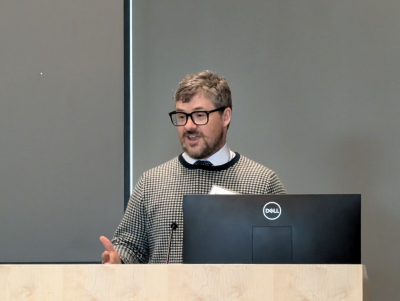
PXL_20241004_182439511.MP
Brian Hodges

Continue Reading Imagining The Future Of Regulatory Takings: “Making Property Rights Cool Again”

This one from the Tenth Circuit didn’t even merit a published opinion, but is still worth reading, just because the situation seems so absurd.

In this Order and Judgment, the court affirmed the dismissal of property owners’ claim that the County wouldn’t issue a septic permit until after the owners actually constructed the septic system. Colorado law, they argued, requires them to get a permit before building a septic system. That’s nice, replied the County: here, we do it different; first you build, and only then do we decide whether you get a permit.

The owners alleged that without a septic permit, they could not obtain a construction permit. Which means that they couldn’t build their home as planned. Next stop, federal lawsuit alleging due process violations (both kinds) and a taking. 

The district court dismissed and the Tenth Circuit summarily affirmed:

  • Procedural due process: yes, the conflict between


Continue Reading CA10: A Municipality Is Forcing Owners To Violate State Law … No Problem!