Screenshot 2024-10-11 at 08-06-50 RPFSS

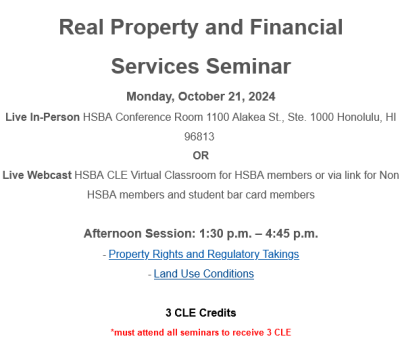
Hawaii lawyers (and those barred in the 808), take note: On October 21, 2024, the Hawaii State Bar Association will hold its annual Convention, and as always there’s a full lineup of CLE programs so you can meet your MCLE requirements.

Thanks to the Real Property & Financial Services Section, there’s a significant dirt law component. First, there’s “Property Rights and Regulatory Takings” the program on which we are presenting along with Dwight Merriam and lawprof Shelley Saxer. Here’s the official description:

This course will provide a survey of property rights and regulatory takings with an emphasis on recent decisions from the United States Supreme Court. Panelists include distinguished faculty and practitioners that will address impact fees, development rights, taking claims, rent controls, and other current issues.

Following us will be a program on “Land Use Conditions” with Cal Chipchase, Brad Saito, and a lawyer
Continue Reading Hawaii Dirt Lawyers: Don’t Miss “Property Rights & Regulatory Takings” CLE At The HSBA Convention (In-Person & Webcast)

CRE prize

Congratulations to our Pacific Legal Foundation colleague Brian Hodges for his article “Build-to-Rent Homes: A Promising Solution to Chronic Housing Shortages” being awarded the 2024 Jared Shales Prize by the Counselors of Real Estate (CRE).

From the Introduction:

When homeownership is increasingly out of reach for many, build-to-rent (BTR) housing offers a desirable alternative to traditional homeownership. First, BTRs provide flexibility that traditional homeownership cannot match. By renting rather than owning, tenants are free to move around the city or the country as their jobs, family situations or lifestyle decisions dictate. They can enjoy the benefits of urban or suburban living without being tied down to a particular location or property. Second, BTRs are often built to higher standards than traditional rental properties, with modern amenities and communal spaces that foster a community and belonging. These properties are often professionally managed, meaning that tenants can enjoy the

Continue Reading “Build-to-Rent Homes: A Promising Solution to Chronic Housing Shortages” – CRE 2024 Jared Shales Prize

If there’s a silver lining in the U.S. Court of Appeals for the Sixth Circuit’s opinion in Slaybaugh v. Rutherford County, No. 23-5765 (Sep. 3, 2024), a case about what we call “SWAT takings” (police destroy someone’s property in order to dislodge a criminal suspect), it’s that the court did not adopt the usual “this was a really, really good exercise of the municipality’s police power so there’s no taking” approach.

But even though it applied a different analysis, the result was the same: no taking. Instead of the “police power” rationale, the court dug into the substance a bit more and determined that the police were “privileged” to physically invade and destroy the Slaybaugh property.

The court first acknowledged that owners generally have the right to exclude:

In arguing their prima facie takings claim, the Slaybaughs contend that police infringed on their property rights by invading

Continue Reading No SWAT Takings In CA6: Police’s Power To Arrest Includes Privilege To Damage Property

BK banner

Here’s the full report from David Morrill about the 21st Brigham-Kanner Property Rights Conference earlier this month. Pictured above: Professor James Stern (responsible for the overall planning of the B-K Conference), this year’s Prizewinner Professor Lee Fennell (U. Chicago Law School), and Andrew Brigham, St. Augustine, Florida – property rights lawyer extraordinaire).

Here are what Prof. Fennell had to say:

Upon accepting the Property Rights Prize, Fennell said that spending time in myriad places through the years piqued her interest in how property can work better for complex systems like large and interconnected cities and ecosystems. In the process, she tried to learn more about what sorts of interconnectedness matter most for humans and other animals, and what forms of adaptability and property forms can best serve needs going forward.

“We can’t make any headway on property as an institutional response to interdependent systems without practicing interdependence ourselves, getting together

Continue Reading 21st Brigham-Kanner Property Rights Conference Report

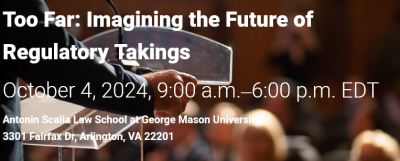
Screenshot 2024-09-26 at 09-41-29 Too Far Imagining the Future of Regulatory Takings

There’s still time to join us next Friday, October 4, 2024, at the Antonin Scalia Law School (George Mason University) for the symposium “Too Far: Imagining the Future of Regulatory Takings.”

Co-produced by our outfit (Pacific Legal Foundation) and the Journal of Law, Economics & Policy, the symposium will feature the most cutting-edge legal academics and courtroom practitioners discussing what is on the horizon in regulatory takings. Here’s the description of the program (full agenda and presenter list below):

A century ago, Supreme Court Justice Oliver Wendell Holmes cautioned government that if property regulations went “too far,” they would be “recognized as a taking.” Flash forward to today, where governments are constantly trying to push the limits while the courts struggle to define what exactly “too far” means.   

Join Pacific Legal Foundation and George Mason University’s Journal of Law, Economics, and Policy for a day-long symposium

Continue Reading Too Far: Imagining the Future of Regulatory Takings (Friday, Oct. 4, 2024)

Sticks bundle
We don’t see any free public education here.

Some old-school property “sticks” analysis from the U.S. Court of Appeals for the Ninth Circuit in Zeven v. Jones, No. 23-35438 (Aug. 23, 2024), worth checking out.

The Idaho Constitution has a “free common schools” clause:

The stability of a republican form of government depending mainly upon the intelligence of the people, it shall be the duty of the legislature of Idaho to establish and maintain a general, uniform and thorough system of public, free common schools.

Idaho Const. art. IX, § 1.

According to some parents, the term “free” means that school districts cannot charge fees for “certain educational and extracurricular opportunities.” In one case, the fees ranged from $4 for locker use, to a $32 optional fee to cover the cost of purchased items for a “health occupations” store. In another, the fees ranged from $15 to $300.

Continue Reading CA9: No Taking For Charging School Fees, Because Idaho’s “Free Common Schools” Clause Does Not Create Private Property Interest

Excerpt

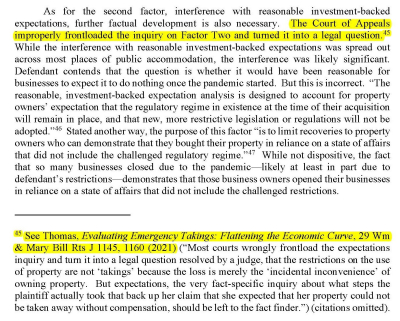
In this Order, the Michigan Supreme Court declined to consider a case which challenges the Michigan governor’s Co-19 shutdown executive orders, which, in the words of the dissenting Justices, reached “nearly every aspect of life in our state.”

There have been a lot of cases asserting that Co-19 shutdowns are takings, with most (but not all) of them crashing and burning, including this one. Here, the plaintiffs — a class of owners whose businesses suffered devastating losses as a result of the shutdown orders — sought just compensation for the regulatory taking. They alleged both types of takings, categorical and ad hoc (Penn Central). They also asserted claims under the Michigan Constitution (a trend we approve!).

We recommend you take a dive into the Statement of the two Justices who dissented. They would have taken up the case because “the majority leaves unresolved

Continue Reading Michigan, Over Dissent, Declines To Hear Co-19 Shutdown Takings Case

As we hinted at a couple of weeks ago, we have some good — nay, great — news: the Eminent Domain Podcast, retired earlier this year by its originator Clint Schumacher, is back with a new host and a slightly new title: “Come and Take It: The Eminent Domain Podcast.”

Bobby Debelak has stepped into the host’s chair. As you might be able to tell from the new title, Bobby is also a Texas lawyer.

Here’s the first episode, where Client figuratively hands the baton to Bobby. If you haven’t already subscribed to the feed, now’s the time so you don’t miss an episode. Available on all pod feeds, so be sure to get subscribed.

Are you as excited about this as we are?Continue Reading The Eminent Domain Podcast Is Back!

Check this out, a recently-filed cert petition asking whether, in order to sue for compensation for a taking, the government must first affirmatively provide a cause of action (an issue recently left unanswered by the U.S. Supreme Court). That’s an issue we’ve been following closely (our outfit recently filed this cert petition also). 

This one is a takings challenge to California’s unclaimed property scheme and the State’s immunity, vel non, to being sued for just compensation.

Here are the Questions Presented:

The State of California, pursuant to its unclaimed property laws, regularly seizes possession of owners’ unclaimed personal property, holds it in custody and trust for the owners, uses it for the state’s purposes to pay its obligations, without paying the owners of that unclaimed property any compensation for its use of the owners’ property pursuant to California Code of Civil Procedure §§1540(c) and 1562. That is an

Continue Reading New Cert Petition: Can An Owner Whose Property Has Been Taken Sue A State Directly Under The Fifth Amendment?

Be sure to read the entirety of Lawprof Ilya Somin’s recent post on Volokh,Federal Appellate Court Rules in Favor of Takings Lawsuit Against the CDC’s Covid-Era Eviction Moratorium.”

There, he analyzes the Federal Circuit’s recent 2-1 opinion in Darby Dev. Co., Inc. v. United States, No. 22-1929 (Aug. 7, 2024) (we wrote up the case here: “Deepening A Lower Court Split, Fed Cir (2-1) Reinstates CDC Co-19 Eviction Moratorium Temporary Takings Claim“).

Professor Somin does a better job that we did offering his thoughts on the “authorized” issue, concluding:

To me, the decisive factor should be that the Takings Clause nowhere says that compensation is only required for legal government actions or for those specifically authorized by statute. Rather, the Clause imposes a general rule that compensation must be paid whenever the government takes private property for “public use.” That, of course, can happen

Continue Reading Lawprof Somin: “Federal Appellate Court Rules in Favor of Takings Lawsuit Against the CDC’s Covid-Era Eviction Moratorium”