In Dimare Fresh, Inc. v. United States, No. 15-5006 (Oct. 28, 2015), the Federal Circuit held that the FDA wasn’t liable for a taking when it issued an incorrect food safety warning that hurt the tomato market, because it was just a warning and didn’t come with coercive action like a quarantine or a recall. In other words, just sayin.

The FDA thought that certain types of tomatoes from certain growing areas might be responsible for a salmonella outbreak. So it “went loud,” which in today’s internet-fueled media environment meant that over the course of the next few days, it issued two press releases, the first which identified the type of tomatoes it believed were involved (“raw red plum, red Roma, or round red” — a pretty wide net), and a second which let certain geographic areas off the hook. The FDA also briefed the media, narrowing the suspected

Continue Reading Just Sayin: No Taking For FDA Salmonella Warning Which Killed Tomato Sales

The Mississippi Highway Commission wanted to build a road. That road was on wetlands, so it needed a permit from the U.S. Army Corps of Engineers. In order to convince the Corps to issue the permit, the Commission offered up 1,300 acres of land as wetlands mitigation. Problem was, these 1,300 acres didn’t belong to the state, but were owned by Ward Gulfport. The Corps issued the permit, conditioned on the Commission acquiring the land from Gulfport.

Understandably, Gulfport wasn’t happy. It had its own plans for what it wanted to do with its land, and those plans — which included its own application for a wetlands permit — went out the window, including (allegedly) some sales that fell through. So Gulfport brought a takings claim in state court, and challenged the permit in federal court. The federal court agreed with Gulfport’s arguments and vacated the permit.

The state court

Continue Reading Intent Matters: DOT Offering Someone Else’s Property To The Corps of Engineers So DOT Can Get A Permit May Be A Taking, Even If Temporary

We all know the old rule that “interest follows principal,” which means that when a deposit on account is private property, so is the interest which that deposit earns. 

Not according to the Florida Court of Appeals, however. In a 2014 decision, that court held that interest earned on quick-take deposits was not the private property of the owner whose land was taken, and thus the government could keep 90% of the money. After the Florida Supreme Court denied review, a cert petition was filed, asking the U.S. Supreme Court for review.  

Tampa needed land, and filed quick-take actions. It deposited the funds which it estimated to be just compensation with the court clerk. That transferred title from the owner to the City. The parties negotiated a settlement, and agreed that the settlement amount was “full compensation” for the taking. Problem was, the owner didn’t know that the

Continue Reading New Cert Petition: Interest Earned On Quick-Take Deposit Is Property, Gov’t Can’t Keep 90%

Here’s the amici brief we filed today in California Building Industry Ass’n v. City of San Jose, No. 15-330 (Oct. 16, 2015).

That’s the case in which the California Supreme Court upheld the city’s “affordable housing” requirement against a challenge which asserted that it was an exaction and thus should have been subject to the heightened scrutiny of the unconstitutional conditions doctrine of Nollan, Dolan, and Koontz. The California court disagreed, holding that because the ordinance did not require a developer to give up land, or money in lieu of land, it was a mere zoning restriction and subject to the “rational basis” test. 

CBIA filed a cert petition, and our brief (filed on behalf of the National Federation of Independent Business Small Business Legal Center and the Owners’ Counsel of America) agrees that the Court should review this case. We argue that even though

Continue Reading Amici Brief In SCOTUS Affordable Housing Case: Prohibiting Homebuilders From Selling At Fair Market Value For 55 Years Is A Taking

bears

If you are an appellant, you know it isn’t going to be a good day when the opinion in your case starts out like this:

“What a long, strange trip it’s been.”1 And, it doesn’t seem to be over due to the continued meanderings of the cause before us and the arguments posed by appellant and his counsel.

———-

1. “Truckin’” by the Grateful Dead.

Slip op. at 1. 

It didn’t get any better than that, and the fact that this was an appeal by a guy who pled guilty of the crime of delivering a controlled substance, after which he was convicted, may have had something to do with the court’s treatment.

A Texas statute allowed the trial court to assess court costs — in this case $2,000 — to a defendant who defers adjudication of guilt and he claimed that this was a taking. According to the court, this issue

Continue Reading The Grateful Court: Making A Criminal Defendant Pay Court Costs Is A Tax, Not A Taking

Here are some upcoming events in which you may be interested, in chronological order:


Continue Reading Upcoming Events And CLE’s – Appellate, RLUIPA, Sharing Economy, And More

ALI-CLE-2016-masthead

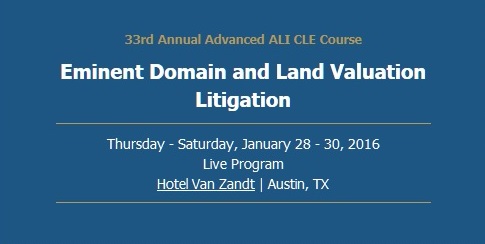
Here’s the full agenda for the 2016 Eminent Domain and Land Valuation Litigation / Condemnation 101 Conference, January 28-30, 2016, in Austin, Texas. 

Together with our friend and colleague Joe Waldo, we think we’re put together a pretty good program that covers a lot of ground. This is the first time the conference has been to Austin, and we’re starting off with a talk by Austin Mayor Steve Adler, who in his former life was an eminent domain lawyer. Other highlights:

  • Professor Ilya Somin will speak about his recently-published book in a segment entitled “The Impact of Kelo and the Limits of Eminent Domain.”
  • Pipelines and Energy Corridors: Valuation Perspectives of Condemnors and Condemnees” with the lawyers on the front lines of one of the hottest topics in eminent domain law nationwide.
  • Retired Minnesota Supreme Court Justice Paul H. Anderson will give us his tips


Continue Reading It’s Here – 2016 ALI-CLE Eminent Domain Conference: Complete Agenda, Faculty, Registration Information

Here’s the Brief in Opposition in the case which asks whether takings claims against the federal government — which we described as subject to a “jurisdictional ambush” due to the old Tucker Act Shuffle — are subject to the rule of 28 U.S.C. § 1500 set out in the Tohono O’odham case. 

If that’s a lot to digest in one sentence, here’s the slightly longer story. The core issue is one we’ve dealt with extensively before, and which the Supreme Court dodged in in United States v. Tohono O’odham Nation, 131 S. Ct. 1723 (2011), namely, whether § 1500’s jurisdictional bar operates in takings claims, which are required to be split between the CFC and the district courts (aka the “Tucker Act Shuffle”). We filed an amicus brief in Tohono O’odham, arguing that the statute cannot be read to deprive takings plaintiffs of their right to secure just compensation, when they

Continue Reading BIO In Tucker Act Jurisdictional Ambush Case: Takings Claims Subject To § 1500’s Rules

Check this out, a story in the September 28, 2015 edition of the New York Times, “Owner of Grand Central Sues Developer and City for $1.1 Billion Over Air Rights.”

Reminds us of this obscure Supreme Court case we heard about…

The Times reports that the current owner of Grand Central Terminal is, with the counsel of uberlawyers, suing New York City in federal court, alleging a taking and related. So what’s this all about (we thought this was “old, unhappy, far-off things, And battles long ago”)?

Apparently, the city granted a Grand Central neighbor permission to build a massive 1500 feet high office tower, and in doing so, took Grand Central’s property (its air rights) without compensation:

On Monday, Mr. Penson filed a $1.1 billion lawsuit in United States District Court in Manhattan that argued that the administration of Mayor Bill de Blasio, a Democrat

Continue Reading Penn Central, Part Deux? A New Complaint Alleges A Taking Of Grand Central Air Rights

20150910_144339

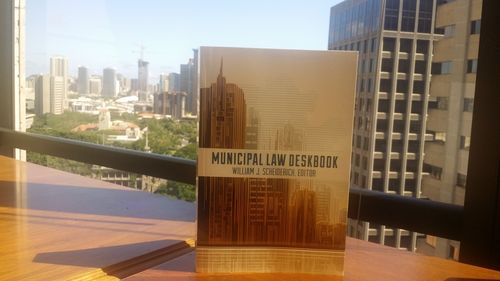
Look what arrived in the mail, a copy of the ABA Section of State and Local Government Law’s recently-published Municipal Law Deskbook, edited by our friend and colleague, Oregon’s Bill Scheiderich

We received a gratis copy because we authored the chapter on Regulatory Takings. The book is designed as a quick reference guide for you muni law types who don’t keep the entire set of McQuillin Municipal Corporations in your library, or for you non-muni law lawyers who want a handy reference guide when these issues come your way:

[The] Municipal Law Deskbook offer[s] legal guidance to municipal attorneys, private practitioners, city administrators, and educators. The book covers a full range of those issues that commonly arise in day-to-day local government administration and the content is intended for attorneys and nonlawyers alike. The chapters cover such topics as when and how federal laws and regulations preempt local legislation

Continue Reading New Book: Municipal Law Deskbook