


We’re continuing our Detroit-themed posts today, with this one about auto bailouts and takings.

We generally don’t post trial court decisions, preferring to wait until we have a published opinion from a court of appeals. But from time to time, we have made exceptions, like here, where the counsel involved are well-known and the issue looks like one that might eventually go up the chain, and indeed has once already.

So it is in Colonial Chevrolet Co., Inc. v. United States, No. 10-647C (Sep. 9, 2015), in which the Court of Federal Claims denied the government’s motion to dismiss a takings claim. The plaintiffs are (former) General Motors and Chrysler dealers whose dealership contracts were sloughed off as part of the $38 billion bailout of the auto manufacturers. As part of the deal, the companies were required to cancel many of their franchise agreements, “forcing the dealerships to close.” According to the plaintiffs, “Chrysler

Continue Reading CFC: Auto Bailout Could Have Resulted In A Taking Of Dealerships’ Contracts
Here’s the cert petition you knew was coming, which asks the U.S. Supreme Court to review the California Supreme Court’s decision upholding the City of San Jose’s “inclusionary housing” requirement by applying rational basis review. The California court held the requirement was not an “exaction,” and was no more than a mere zoning regulation or price control. 

Here’s the Question Presented:

A San Jose, California, ordinance conditions housing development permits upon a requirement that developers sell 15% of their newly-built homes for less than market value to city-designated buyers. Alternatively, developers may pay the city a fee in lieu. The California Supreme Court held that, even where such legislatively-mandated conditions are unrelated to the developments on which they are imposed, they are subject only to rational basis review.

This raises an issue on which the state courts of last resort and federal circuit courts of appeal are split nationwide. The

Continue Reading Cert Petition: Requirement That Developers Set Aside “Affordable” Units Is Subject To More Than Rational Basis Review

Those of you who are members of the ABA Section of State and Local Government Law, tune in tomorrow, Friday, September 11, 2015 for the Land Use Committee’s monthly call.

It will feature two speakers, talking about the California Supreme Court’s recent decision upholding San Jose’s “workforce housing” requirement against a claim that it was an “exaction” and thus should have been subject to the nexus and rough proportionality requirements of Nollan, Dolan, and Koontz.

Law of Affordable/Workforce Housing Exactions and Set-Asides 

FREE Teleconference Sponsored by the Land Use Committee
Friday, September 11, 2015
2:00 p.m. EST
Dial-in 888-3967955
Passcode 797687#
 
Speakers: David L. Callies, FAICP, Kudo Professor of Law at the University of Hawaii

Tim Iglesias, Professor of Law at the University of San Francisco School of Law (Professor Iglesias organized and co-authored an amicus brief in support of the City of San Jose).

Continue Reading Tomorrow: ABA Land Use Committee Talk On The California Workforce Housing “Exaction” Case

Here’s one from the Connecticut Appellate Court which combines two of our favorite geeky topics: takings and muni law.

In Turn of River Fire Dep’t, Inc. v. City of Stamford, No. AC 36468 (Sep. 15, 2015), the court concluded it was not a violation of the Takings Clause for the voters of the city to amend their charter to consolidate the city’s six fire departments (the city-operated Fire and Rescue Department, and five independent volunteer fire departments) into a single city department, commanded by a city-employed official, the fire chief.

After amendment of the charter, one of the volunteer departments sued, alleging among other things a takings claim: “Specifically, they claim that the amendments constitute a per se regulatory taking because they deprive Long Ridge of all economically beneficial use of its property by forcing it to either participate in the Stamford Fire Department or cease operating as a fire department.” Slip op. at 11. The

Continue Reading Merging Volunteer Fire Companies Into An “Official” Municipal Fire Department Isn’t A Taking

From the Ninth Circuit, a published opinion in a case challenging a Napa Valley city’s mobilehome rent control ordinance, Rancho de Calistoga v. City of Calistoga, No. 12-17749 (Sep. 3, 2015). Here’s a complete summary of the issues in the case, along with the Ninth Circuit merits and amici briefs. We’ve been following it because we filed an amicus brief in support of the property owner’s argument that it pleaded enough to get by a motion to dismiss for failure to state a claim. 

The Ninth Circuit didn’t agree, and affirmed the District Court’s dismissal. The panel concluded the case was ripe under Williamson County (an issue that seemed to occupy a lot of the judges’ time at oral arguments), but that the owner’s theory that “even if the taking is for a public purpose, the rent subsidy should be paid by the government if the rent is

Continue Reading Where’s Palazzolo, Ninth Circuit? Owner Bought Property Subject To Regulation (Just Not These Regulations), So Has No Takings Claim

Here’s the latest in a case that we’ve been following, which was in both state and federal court, Bridge Aina Lea v. Land Use Comm’n

The litigation is a series of two lawsuits that originated in state court in the Third Circuit (Big Island), one an original jurisdiction civil rights lawsuit, the other an administrative appeal (that’s a writ of administrative mandate for you Californians). The State removed the civil rights lawsuit to U.S. District Court in Honolulu and promptly moved to dismiss, and this portion of the case nearly caused us to flash back to our Federal Courts class in law school, since it raised a host of procedural questions such as the effect of removal, whether certain defendants are “persons” under 42 U.S.C. § 1983, whether the federal court must abstain from addressing the federal takings claim, whether there is a state damage remedy for

Continue Reading Hawaii Federal Court Gets Rid Of Most Claims Against Land Use Commission, But Allows Takings And Vested Rights Claims To Go Forward

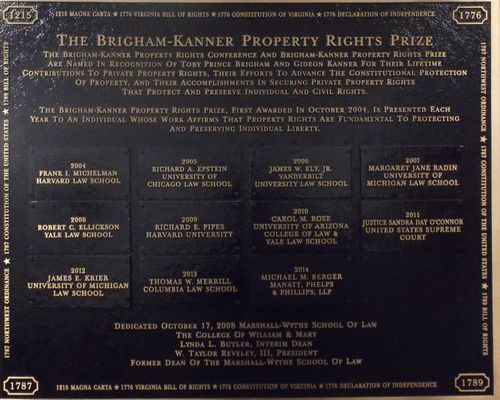
BK-plaque-2015

As we’ve done every year lately, we’re soon headed to the Brigham-Kanner Property Rights Conference at the William and Mary Law School in Williamsburg, Virginia.

This year, the B-K Property Rights Prize will be awarded to Harvard lawprof Joseph Singer, who is, shall we say, an interesting choice, given his theory that a “robust regulatory structure” goes hand-in-hand with property rights, liberty, and the free market. Robust regulation isn’t exactly what you might think of when you think “property rights,” is it? So it should make for an interesting conference.

Professor Singer publishes a blog that is worth following, “Property Law Developments.” It is not one of those blogs that are heavy on the analysis, but its a good place to keep up on recent developments in all things property law. 

The plaque pictured above is a list of prior prize winners.

Here are the conference details:

Continue Reading Join Us: 2015 Brigham-Kanner Conference At William And Mary Law School

We have learned that the North Carolina Supreme Court has granted the State’s request to review Kirby v. North Carolina Dep’t of Transportation, No. COA14-184 (Feb. 17, 2015).

That’s the case in which the Court of Appeals not only held that the property owners’ claims were ripe, but that the Map Act — which gives the DOT the ability to designate property for future highway use and prevent its development in the meantime — effected a taking. The appeals court reversed the trial court’s dismissal and sent the case back down for a calculation of the compensation owed to each property owner.

This is one to watch, for sure. We’ll keep on doing so and let you know as things develop. 

Continue Reading NC Supreme Court To Review “Map Act” Takings Case

After the Supreme Court’s decision in Horne v. Dep’t of Agriculture, 14-275 (U.S. June 22, 2015), we were waiting for this shoe to drop. And now it has.

In “Raisin ruling seen as a lifeline for endangered species,Environment & Energy writes, “[a] Supreme Court ruling that struck down an odd Depression-era raisin program may have revived a critical government defense for endangered species and other wildlife protections, legal experts say.” 

The theory is based on the Horne majority’s rejection of Leonard & Leonard v. Earle, 279 U.S. 392 (1929), the case in which the Court upheld a Maryland state tax which required oyster farmers turn over to the state 10% of the empty oyster shells which they harvested, or pay a monetary equivalent. The Horne majority concluded that Leonard was not applicable because the oysters in Leonard were government property, in contrast to raisins, which —


Continue Reading Nice Try: No, The Supreme Court Didn’t Make Wildlife Public Property In The Raisin Case

A quick one from the Michigan Court of Appeals. Murphy-Dubay v. Dep’t of Licensising and Regulatory Affairs, No. 321380 (Aug. 18, 2015) involved the claims of Mr. Murphy-Dubay, who attended 2 years at a Caribbean medical school, followed by 2 years of clinical rotations in Canada. He returned to Michigan, and passed “Step 3” of the United States Medical Licensing Examination.

But he did not secure a residency, which apparently is a requirement to practice medicine in Michigan. So he sought a “limited license” to practice. When the Department predictably rejected his application because, inter alia, the limited license is for those who are otherwise qualified but who have problems with disciplinary issues (and not for those who do not complete the educational requirements) he sued. His arguments included a takings claim, which asserted that the denial took his property — his “legitimate claim of entitlement” to practice

Continue Reading No, It’s Not A Taking To Prohibit You From Practicing Medicine Because You Think You’re Qualified