So, the President today announced support of “net neutrality,” which Wikipedia describes as “the principle that Internet service providers and governments should treat all data on the Internet equally, not discriminating or charging differentially by user, content, site, platform, application, type of attached equipment, or mode of communication.”

President Obama has come out in support of reclassifying internet service as a utility, a move that would allow the Federal Communications Commission to enforce more robust regulations and protect net neutrality. “To put these protections in place, I’m asking the FCC to reclassifying internet service under Title II of a law known as the Telecommunications Act,” Obama says in a statement this morning. “In plain English, I’m asking [the FCC] to recognize that for most Americans, the internet has become an essential part of everyday communication and everyday life.”

Full story here. Sounds pretty good, right?

Maybe not

Continue Reading The Eminent Domain Angle In “Net Neutrality”
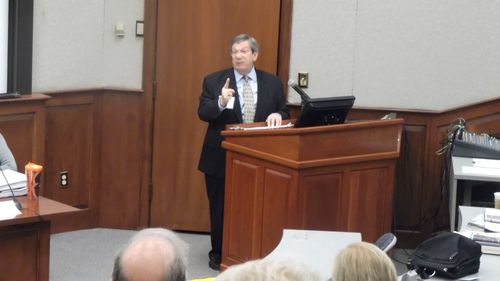
  DSCF2208

You can’t have rights without advocates.”

                              – Michael Berger

We’re at the William and Mary Law School in Williamsburg, Virginia today for the 11th Brigham-Kanner Property Rights Conference. As we’ve noted earlier, Michael Berger is this year’s B-K Prize honoree, for his career contributions to property law and his “scholarly work and accomplishments [which] affirm that property rights are fundamental to protecting individual and civil rights.”

The list of past recipients is an All-Star roster of property scholars and jurists, including lawprofs Frank Michelman, Richard Epstein, James Ely, Carol Rose, Thomas Merrill, and Supreme Court Justice Sandra Day O’Connor (the latter perhaps more for where she ended up in her Supreme Court career than where she started). See the plaque on the Law School’s wall for the complete list of

Continue Reading 2014 Brigham-Kanner Property Rights Conference Report: Honoring Michael Berger

Utah seized a failing bank without notice to the bank, and appointed the FDIC receiver. The bank owners sued for a bunch of things, including a taking under the state constitution. The trial court dismissed for failure to state a claim because the complaint did not contain sufficient factual allegations to support a takings claim.

In America West Bank Members LC v. State of Utah, No. 2012456 (Oct. 24, 2014), the Utah Supreme Court affirmed. Although the court confirmed that under the Utah Constitution, a taking occurs “when there is any substantial interference with private property which destroys or materially lessens its value, or by which the owner‘s rights to its use and enjoyment is in any substantial degree abridged or destroyed,” slip op. at 18, it concluded that the bank’s complaint did not clarify whether it was alleging a regulatory or a physical taking:

According to AWBM‘s complaint,”it

Continue Reading Utah: Complaint Must Allege Either A Physical Or Regulatory Taking To Avoid Dismissal

We’re tied up today and don’t have time to do any analysis, so we post this without comment: Bowman v. California Coastal Comm’n, No. B243015 (Oct. 23, 2014), wherein the court held:

In Kleiniecke v. Montecito Water District (1983) 147 Cal.App.3d 240, we held it would not be inequitable to apply the doctrine of estoppel as a defense to the statute of limitations. Here we conclude it would be inequitable to apply collateral estoppel to require a party to dedicate a coastal easement as a condition of obtaining a coastal development permit.

We reverse a judgment denying a property owner’s petition for a writ of administrative mandate to eliminate a public access condition from a coastal development permit.

Slip op. at 1  

Bowman v. California Coastal Comm’n, No. B243015 (Cal. App. Oct. 23, 2014)

Continue Reading Cal App: “There is no rational nexus, no less rough proportionality”

Banner

If you haven’t already, please mark you calendars: the agendas and faculty lists for the February 5-7, 2015 ALI-CLE eminent domain programs in San Francisco have been finalized. Registration is ongoing, and there’s even a few more days left for the early registration discount. Substantial group discounts are also available. 

We’re talking, of course, about Eminent Domain and Land Valuation Litigation (the “masters” program, now in its 32nd year), and Condemnation 101: How to Prepare and Present an Eminent Domain Case (the boot camp or refesher course on eminent domain fundamentals).  We’re the co-Planning Chair of the Eminent Domain and Land Valuation Litigation program along with Joe Waldo, and we think we’ve assembled an exciting agenda, presented by a faculty comprised of the nation’s best-of-the-best in our field of law.

Some highlights:

  • Eminent Domain National Law Update – Amy Brigham Boulris, Gunster, Yoakley & Stewart, P.A.,


Continue Reading ALI-CLE 2015 Eminent Domain and Land Valuation Litigation & Condemnation 101 Agendas And Faculty Announced

Here’s one for the regulatory takings mavens, because it has just about every conceivable issue: ripeness, res judicata (yes, arugment was that the complaint was filed both too early and too late), RookerFeldman, the Tax Injunction Act, and an analysis of whether the property owner’s complaint stated a claim for relief under the Takings Clause. 

At issue in Coleman v, District of Columbia, No. 13-1456 (D. D.C. Sep. 30, 2014) was the District’s statutory provision which allowed it to place a lien on properties whose owners do not pay their full property tax bill, and then sell the property at auction if the lien is not satisfied. So far so good – this scheme isn’t that much different from similar provisions in virtually every state. The problem with DC’s system is that “the law permits the taking of not only the amount of delinquent taxes, plus any

Continue Reading Federal Court: DC’s Tax Sale Statute May Be A Taking

When the feds need medical care for prisoners, by statute, the Medicare rate is set as the full compensation owed to medical services providers. One of those providers, Baker County Medical Services, sued in U.S. District Court, seeking a declaration that the statute is a taking because, “it is forced to render emergency medical care to federal detainees but its compensation for such treatment is limited to the Medicare rate, an amount less than its actual costs.” 

Short answer, according to the 11th Circuit in Baker County Medical Services, Inc. v. U.S. Att’y General, No. 13-13917 (Aug. 14, 2014): no.

The reason: Baker County Medical chose to treat all emergency patients, including federal prisoners, so can’t complain that the pay is not enough:

Even so, a long line of cases instructs that no taking occurs where a person or entity voluntarily participates in a regulated program or activity. We

Continue Reading 11th Cir: Voluntarily Treating Federal Prisoners Means No Takings Claim For Partial Reimbursement For Medical Costs

You mght read the headline of this post and naturally say to yourself, “well, that’s obvious.” But to the Eleventh Circuit in Kentner v. City of Sanibel, 750 F.3d 1274 (11th Cir. 2014), it wasn’t.

In that case, the court concluded that riparian rights are not “fundamental rights” protected by the Due Process Clause from arbitrary and capricious government action, in this case, a ban on the construction of docks and piers (except, apparently, city-owned docks and piers). The court concluded that riparian rights are not “fundamental” rights because they are merely “state-created” rights.

After we read it, the court’s rationale was so inexplicable we asked aloud, “[i]f you can figure out the court’s logic about why riparian rights are not fundamental, and what is a ‘state-created’ right (in contrast to a state-created right created by legislative act, or why the legislature’s hand triggers greater scrutiny than mere

Continue Reading New Cert Petition: Isn’t Property A Fundamental Right?

We get to post the California Raisins again!

Last term, in Horne v. U.S. Dep’t of Agriculture, No. 12-123 (June 10, 2013), the U.S. Supreme Court unanimously held that a property owner could raise a takings claim as a defense to the government’s attempt to impose a fine pursuant to a complex federal regulatory scheme affecting raisin farmers, which requires those in the industry to set aside a percentage of their yearly crop and “donate” it to the public. The Court held that District Courts have jurisdiction to hear a property owner’s claim that this works a taking, and held that the Court of Federal Claims does not have exclusive jurisdiction over this type of claim.

Having resolved the jurisdictional issue in favor of the property owners, the Court remanded the case to the Ninth Circuit for a determination of the merits of their takings defense. Predictably (given the

Continue Reading New Cert Petition: Raisin Takings Case, Round II

Here’s one to add to the “unusual takings cases” category, at which we looked at last week

In  Young v. Larimer County Sheriff’s Office, No. 13CA1338 (Sep. 11, 2014), the sheriff raided Mr. Young’s (medical) marijuana grow and seized as evidence “forty-two mariijuana plants by cutting them off just above the roots.”

Now, we don’t know much of anything about the botany of the cannabis plant, medical or otherwise. And the court might not have any specialized knowledge either. But it doesn’t take Cheech and Chong to know that “[t]his action killed the plants.” Slip op. at 2. Bummer, man. 

The jury was more kind to Mr. Young than was the sheriff. It bought Young’s claim that his weed was not evidence, but medicine under the Colorado medical marijuana statute. The “jury acquitted him of all charges based on the affirmative defense of medical use of marijuana by

Continue Reading No Taking When Sheriff Took His (Medical) Weed