


On the day we celebrate Constitution Day (or should we say Khaaaaan-stitution Day?) we have to admit that pretty much nothing beats One Named Kirk’s reading of the Preamble

He might be from Iowa, but that guy who plays him is from north of the border, so our kudos to a Canadian for the best dramatic rendition of our founding document.

And in that spirit, we explain the plural parenthetical in this post’s title, which we picked up from a talk last evening by Hawaii Supreme Court Justice Simeon Acoba and U. Hawaii Law School Dean Avi Soifer at the Judiciary History Center, “Who Trumps Whom: Exploring Federalism in Hawaii.” The talk focused on the ways that state constitutional protections can extend beyond what the U.S. Constitution requires (the “floor vs ceiling” theory), and Justice Acoba suggested that today really should be called “Constitutions Day”

Continue Reading Happy Constitution(s) Day

Like love, takings claims can often be found in some very unusual places. And (like love) unfortunately, those claims are not always successful.

When we think of “takings,” things like eminent domain condemning land, inverse condemnation (of land) by flood waters, and cases like that spring to mind first. Even when regulatory takings are involved, the conventional view at least starts with claims about land, and although the Supreme Court hasn’t come out and said it, the argument has been made that the takings and exaction/unconstitutional conditions doctrines are reserved for claims involving land. 

But not always so. 

Here are three recent decisions where property rights and takings came up in situations you might not have expected.

Takings and Labor Law

The first is from the U.S. Court of Appeals for the Seventh Circuit. In Sweeney v. Pence, No. 13-1264 (7th Cir. Sep. 2, 2014), the court held that

Continue Reading Lookin For Takings In All The Wrong(?) Places

A reminder: the 11th annual Brigham-Kanner Property Rights Conference is coming up on October 30-31, 2014, at the William and Mary Law School in Williamsburg, Virginia. As we noted earlier, Michael Berger will receive the Brigham-Kanner Prize, so this one is special – he’s the first practitioner to receive the Prize.

More here, from W&M, including agenda and registration information. Here’s the flyer.

We’re going – hope to see you there. 

11th Annual Brigham-Kanner Property Rights Conference – Oct 30-31, 2014 – Michael Berger

Continue Reading October 30-31, 2014: Brigham-Kanner Property Rights Conference @ William & Mary Law

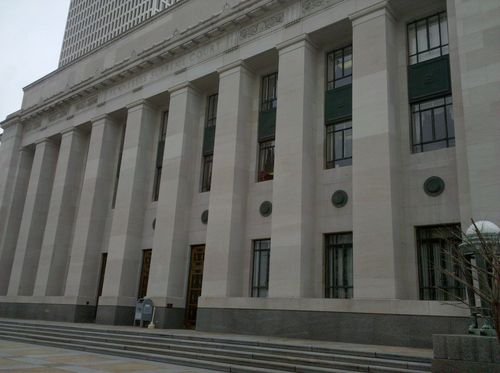
2010-03-24 15.24.40
Tennessee Supreme Court, Nashville

In Phillips v. Montgomery County, No. M2012-00737-SC-R11-CV (Aug. 18, 2014), the Tennessee Supreme Court held that a property owner could recover under the state’s inverse condemnation statute, Tenn. Code Ann. § 29-16-123, for a regulatory taking:

We hold that, like the Takings Clause of the United States Constitution, article I, section 21 of the Tennessee Constitution encompasses regulatory takings and that the Property Owners’ complaint is sufficient to allege a state constitutional regulatory taking claim, for which they may seek compensation under Tennessee’s inverse condemnation statute, Tennessee Code Annotated section 29-16-123.

Slip op. at 12.

That’s all well and good, and we applaud the court for doing so. But wait a minute, you say, that statute and this issue sure sound familiar.

Indeed they do. This is the same statute which the U.S. Supreme Court, in Williamson County Regional Planning Comm’n v. Hamilton Bank

Continue Reading Tennessee Finally Recognizes Regulatory Takings Cause Of Action – A Quarter Century After The US Supreme Court Wrongly Assumed It Did

Ducks

Here’s what we’re reading on this blustery Friday:


Continue Reading Friday Links: Duck Gets Eminent Domain Power, A Small Piece Of New York City … And More

Given the title of this blog and our usual inclinations in takings cases, you would be forgiven for assuming that we’d have a negative review of the Second Circuit’s opinion in 1256 Hurtel Avenue Associates, LLC v. Bulan, No. 12-1603-bk (Aug. 1, 2014), which held that a legislative increase in the size of the homestead exemption — which had the effect of wiping out an existing judgment lien — was not a taking. But before you jump to that conclusion, read on, since we have a couple of nice things to say about the opinion.  

In 2005, the New York legislature increased the homestead exemption — which exempts a certain amount from being used to satisfy money judgments — from $10,000 to $50,000. Five years later, the legislature raised it again to $75,000. Good for homeowners, not so good for those to whom homeowners owe money. But these

Continue Reading 2d Cir: New York’s Wipeout Of Judgment Lien Is “Legislative Tinkering,” Not A Lucas Or Penn Central Taking

A couple of years ago, we posted the complaint (actually, a petition for mandate) alleging a big regulatory takings claim against the County of San Luis Obispo based on the County’s denial of a permit to drill for oil. A very big claim. $6.24 billion big. SeeWow, That’s A Lot of Just Compensation.”

We always wondered what happened to that lawsuit. Now, thanks to our colleagues at the California Eminent Domain Report, we know

In “How Untimely Service Can Be Deadly To Your Takings Claim,” Ben Rubin reports that in an unpublished decision, the California Court of Appeal affirmed the dismissal of the complaint for failure to timely serve it on the County. The plaintiffs filed the complaint on time, they just didn’t serve it. Read Mr. Rubin’s write up for the details, but here are the highlights:

  • The County’s denial of the


Continue Reading Cal App: OK For County To Mislead By Omission In Due Process Notice

When the one side or the other in the public debate complains about “judicial activism,” they’re usually talking about judges legislating from the bench — finding new rights, reading words into statutes that aren’t there, and the like. But that species of judicial activism doesn’t bother us all that much since we rarely see it, and even when we do, we understand that when accomplished incrementally, it is an integral and generally accepted feature of the common law process. Professor Steven Eagle has compared the common law’s gradual evolution to a big ship making a slow turn, and we think that’s an evocative and apt description. Judges in such a system sometimes do things like that, so that kind of judicial activism doesn’t truly get under our skin. 

No, the “judicial activsm” that bothers us is what the Second Circuit did in the the latest chapter in an issue we’ve been following

Continue Reading Circuit Split Alert: Second Circuit Says Williamson County Ripeness Applies To Due Process

To those of you who joined us at the ABA’s Land Use, Planning, and Development Forum, thank you. Here are links to some of the topics I mentioned: 

Those of you who couldn’t make it can get the recording on CD or mp3 here in a couple of weeks, once it is produced.  


Continue Reading Links From Today’s Land Use, Planning, And Development Forum

We finally got around to reading “What Lies Beneath,” an opinion piece from the New York Times that we’ve been saving in our to-read list since the spring, Linda Greenhouse’s musings on the U.S. Supreme Court’s 8-1 decision in Marvin M. Brandt Revocable Trust v. United States.

In that piece, Ms. Greenhouse notes that Brandt was one of those cases she pretty much didn’t care about (“I hadn’t read the briefs or the argument transcript, let alone attended the argument itself.”). In other words, it wasn’t about Citizens United, abortion, or religion, the usual things the reporters who cover the Supreme Court beat consider hot topics. No, this was one that — even after she read the opinion — “I had only a vague sense of what the case was about and none whatsoever of its significance, if any,” that it it concerned what happens when

Continue Reading New York Times SCOTUS Reporter: Wow, Brandt Was About Rails-To-Trails And Property Rights!