Here’s the Brief for the United States in Marvin M. Brandt Revocable Trust v. United States, No. 12-1173 (filed Dec. 17, 2013).

That’s the case, set for argument on January 14, 2014, in which the Court is considering the meaning of the term railroad “right of way” as used in an 1875 federal statute.

As our amici brief argues, if the Court accepts the government’s theory in the case, it could wipe out an entire class of rails-to-trails takings cases.
Brief for the United States, Marvin M. Brandt Revocable Trust v. United States, No. 12-1173 (Dec. 17, 2013)…

Continue Reading Gov’t Merits Brief In Rails To Trails Case

Cover_42_3_ The Urban Lawyer, the law review produced by the ABA Section of State & Local Goverment Law has published my article Recent Developments in Regulatory Takings, 45 Urban Lawyer 769 (2013).

Here’s the Introduction to the article:

THE SUPREME COURT’S 2012 TERM promised to be a banner year in regulatory takings law, with no less than three cases on the Court’s docket. In Arkansas Game and Fish Commission v. United States, a case involving a takings claim against the federal government for compensation resulting from a flood, the Court held that flooding need not be “permanent” in order to result in liability, and reinforced the principle that categorical takings are not favored, and stated that the default analysis is the multi-factored Penn Central test. In Koontz v. St. Johns River Water Management District, the Court held that monetary development exactions fall within the reach of the

Continue Reading New Article: Recent Developments in Regulatory Takings

In Stueve Bros. Farms, LLC v. United States, No. 21013-5012 (Dec. 11, 2013), the Federal Circuit concluded that the government is not liable for a physical invasion taking when a dam enlargement project raised the maximum flood line on the plaintiff’s land by 10 feet, because there has yet to be an actual physical invasion of the property.

The landowner limited its claim to a physical taking, and did not make any claim for a regulatory taking (see slip op. at 5 n.1), and the court rejected each of its arguments that the totality of the circumstances added up to a physical take, because the government has not caused any flooding outside the scope of its previously-acquired flowage easement. The court acknowledged that the Corps of Engineers’ dam improvement project has been ongoing for 20 years, and that the Corps intended at one point to acquire a flowage

Continue Reading Fed Circuit: There Must Be Actual Flooding For A Physical Taking

Last we checked in, the California Supreme Court had agreed to review the Court of Appeal’s decision in California Building Industry Ass’n v. City of San Jose (6th District June 6, 2013), which held that under rational basis review (and not heightend scrutiny) the city of San Jose’s “inclusionary housing” ordinance might survive challenge because it was designed to promote the development of affordable housing, and not to mitigate the impacts of market priced housing.

Yesterday, the CBIA filed its Opening Brief in the appeal, which presents a single Question Presented:

Must inclusionary housing ordinances which exact property interests or in-lieu development fees as a condition of development permit approval be reasonably related to the deleterious impact of the development on which they are imposed, as set forth in San Remo Hotel L.P. v. City & County of San Francisco, 27 Cal. 4th 643, 670 (2002)?

The brief answers

Continue Reading Opening Brief In Cal Supreme Court “Inclusionary Housing” Exactions Case

Here’s the government’s Brief in Opposition in Mehaffy v. United States, No. 12-1416 (cert. petition filed June 3, 2013. 

In that case, the Federal Circuit, in an unpublished opinion, held that Mehaffy failed the Penn Central ad hoc takings test solely because he purchased the property alleged to have been taken after the governmentt adopted the Clean Water Act. As a matter of law, he could not have any “reasonable investment-backed expectations” because his land was subject to regulations that, as applied to his land, are alleged to take property.

That reasoning seems somewhat circular, and would seem to run smack-dab into the Supreme Court’s determination in Palazzolo v. Rhode Island, 533 U.S. 606, 626 (2001), rejecting a per se rule that “postenactment purchasers cannot challenge a regulation under the Takings Clause.”

But for some reason, the lower courts have applied (or, in some cases, have not

Continue Reading Govt’s BIO In Mehaffy: Preexisting Regulations Wipe Out Penn Central’s Reasonable Expectations

A must read from our colleague Professor Steven Eagle (author of the Regulatory Takings treatise) about the Koontz case, Koontz in the Mansion and the Gatehouse, forthcoming in the Urban Lawyer.

Here’s the abstract:

This Article focuses on problems in implementing the U.S. Supreme Court’s expansion of its doctrine of unconstitutional conditions pertaining to land development approvals in Koontz v. St. Johns River Water Management District. As earlier developed in Nollan v. California Coastal Commission and Dolan v. City of Tigard, the doctrine applied only to unrelated or disproportional exactions of interests in real property. The doctrine was expanded in Koontz to include denials of development approval after landowner refusal to accede to unreasonable exaction demands, and also to exactions of money as well as real property interests.

Drawing an analogy to Yale Kamisar’s disparate treatment of criminal defendants in the “mansion” of the judicial system and the “gatehouse”

Continue Reading New Article: “Koontz in the Mansion and the Gatehouse” (Professor Steven Eagle)

Worth reading: a new working paper on exactions and Koontz by a Pacific Legal Foundtion Fellow (PLF represented the prevailing property owner in Koontz).

The article, “Nollan and Dolan and Koontz – Oh My! The Exactions Trilogy Requires Developers to Cover the Full Social Costs of Their Projects, But No More,” by Christina Martin,

argues that, contrary to appalled assertions of some observers, the U.S. Supreme Court’s decision in Koontz v. St. Johns River Water Management District is a straightforward application of Nollan v. California Coastal Commission and Dolan v. City of Tigard. Nollan and Dolan established that when government requires a permit applicant to give up property in exchange for a permit, the demand must be closely related and roughly proportional to the development’s social cost. Anything that exceeds those bounds violates the unconstitutional conditions doctrine by burdening the right to just compensation for a taking. Koontz

Continue Reading New Article On Nollan-Dolan-Koontz

Civil pro wonks, get ready: we all know that under the Full Faith and Credit Clause, states are required to give the judgments of another state the same respect that those judgments would receive in the courts of the other state. That principle remains the same whether the judgment is issued by a state court, or a federal court exercising diversity jurisdiction. The Supremacy Clause also reinforces the notion that a state court must respect and enforce a federal court’s judgment, and can’t simply blow it off.

But what does a litigant do when she claims that a state court isn’t giving full faith and credit to an earlier federal court judgment that she claims settled a dispute? Is her remedy limited to an appeal to a state appeals court and ultimately the U.S Supreme Court by way of certiorari review? Or can she bring an original jurisdiction action

Continue Reading New Cert Petition: How Do You Enforce The Full Faith And Credit Clause (And What Is A Judicial Taking)?

Rent control cases rarely thrill us. They’s often long, the ordinances and rules being challenged are usuallylabyrinthian, and from our point of view, the results are mostly unsatisfying. 

The California Court of Appeal’s recent opinion in Colony Cove Properties, LLC v. City of Carson, No. B227092 (Oct. 21, 2013) doesn’t deviate from that pattern: it’s 50 pages long, the city’s mobilehome rent control system for determining a “fair” return for the park owner will make your head hurt, and in the end, the court held that the property owner was not entitled to make a profit after the payment of debt service. So we’ll leave it to you to read the details in the case itself if those issues interest you.

But what did catch our eye was the final few pages, in which the court reversed the lower court’s determination that the property owner reserving its federal takings

Continue Reading Cal App: Rental Owner Makes “Enough,” But Can Go To Federal Court Later

DSCF1078

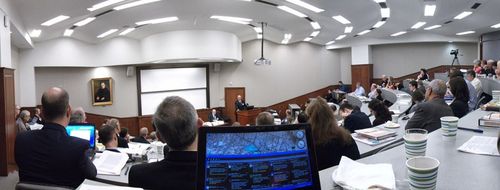
The last couple of days, we’ve returned to Williamsburg, Virginia to attend the annual Brigham-Kanner Property Rights Conference at the William and Mary Law School.

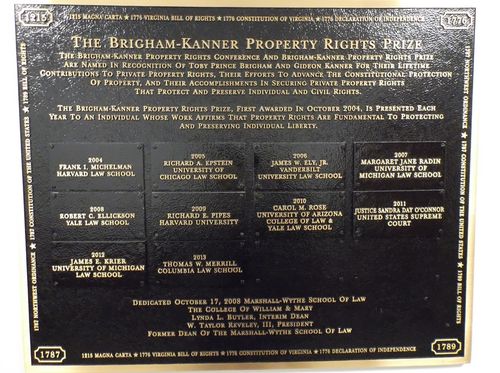
The Conference is the annual gathering of legal scholars and practitioners who focus on property law and property rights to celebrate the award the B-K Prize to “an individual whose scholarly work and accomplishments affirm that property rights are fundamental to protecting individual and civil rights.” The list of past winners is a who’s who of property scholars and includues James Ely, Richard Epstein, Carol Rose, and Frank Michelman.

This year’s prizewinner is Columbia Law’s Thomas Merrill. The Conference panelists have thus far focused on his scholarship, including his landmark article on the right to exclude, titled, not surprisingly, Property and the Right To Exclude, 77 Neb. L. Rev. 730 (1998).

DSCF1087

Our Owners’ Counsel colleage Mark Savin speaking about “Defining the Essence of

Continue Reading 10th Annual Brigham-Kanner Property Rights Conference And Prize – Thomas Merrill