


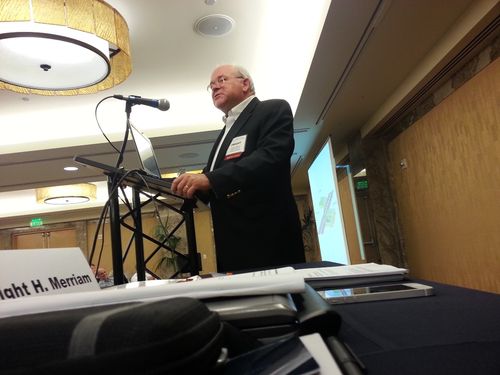
A big thanks to my Owners Counsel of America and ABA State and Local Government Law Section colleague Dwight Merriam for emceeing today’s well-attended double session on land use and takings law at the International Municipal Lawyers Association’s 2013 annual meeting in San Francisco. Dwight and I were joined by land use expert Cecily Barclay, who presented sessions on Harvey Cedars, while I covered Koontz and Dwight did the relevant parcel/Lost Tree sessions. Continue Reading IMLA Conference Session On Koontz, Harvey Cedars, Relevant Parcel

Regulatory takings
Upcoming IMLA Panel On Koontz, Harvey Cedars, And Lost Tree

On Monday, September 30, 2013, we’ll be speaking along with Dwight Merriam and Cecily Barclay at the International Municipal Lawyers Association’s annual meeting in San Francisco, about three important cases/issues: Koontz, Harvey Cedars, and Lost Tree.
That’s a pretty wide range of cases, but we have some time and we’re sure we’ll have a good discussion. If you are attending the IMLA conference, please be sure to join us: 2:15 – 3:15pm, Hilton San Francisco Union Square (Plaza B, Lobby Level). Continue Reading Upcoming IMLA Panel On Koontz, Harvey Cedars, And Lost Tree
Worth Reading On Koontz: “A 20-year legal battle over a water management district’s condition for development is over – sort of.”
A link to a story worth reading about the U.S. Supreme Court’s decision in Koontz v. St. Johns River Water Management District, No. 11-1147 (June 25, 2013).
In Developing Story at Florida Trend (“The Magazine of Florida Business”), our Owners’ Counsel of America colleague Amy Brigham Boulris is quoted along with the property owner/petitioner Coy Koontz, and two lawprofs who don’t care for the decision.
Check it out, it’s a quick read. Continue Reading Worth Reading On Koontz: “A 20-year legal battle over a water management district’s condition for development is over – sort of.”
But … What If Penn Central Terminal Is Flooded?
This past term, the U.S. Supreme Court in Arkansas Game and Fish Comm’n v. United States, 133 S.Ct. 511 (2012), held that government-induced flooding could result in takings liability, even if the flooding was merely temporary. The Court remanded the case to the Federal Circuit to determine whether the flooding resulted in liability.
The Federal Circuit ordered supplemental briefing, and the parties and amici responded. Earlier this month, the court held oral arguments.
The government’s counsel argued that the Supreme Court adopted a new test for temporary flood takings that looks like a hybrid Penn Central test, while the Commission’s counsel argued that the Court expressly did not adopt a new test, and that temporary flooding cases are to be treated just like any other physical invasion under the existing test.
With the arguments submitted, now we wait. Continue Reading But … What If Penn Central Terminal Is Flooded?
CFC: No Amendment Of Complaint To Allege Judicial Taking Because Theory Not Adopted By The Federal Courts
Here’s one we’ve been meaning to post for a while. It’s a Court of Federal Claims opinion in a case involving an indian nation’s takings lawsuit, seeking compensation for its inability to challenge the 1859 conveyance of what is now the town of Southampton, New York without the required tribal consent. Shinnecock Indian Nation v. United States, No. 12-836 L (Aug. 29, 2013).
The judicial taking part of the long opinion (21 single-spaced pages) starts on page 18, where the court rejected the plaintiff’s request to amend its complaint to add a claim for judicial taking. The opinion recounts the judicial takings theory but refused to allow amendment because, “the portion of the Supreme Court’s decision in Stop the Beach that discussed the standard for finding that judicial taking had occured and stated that a judicial taking was a valid cause of action was signed by only four justices.”…
Cal S Ct To Review “Inclusionary Housing” Money Exaction – First Major Post-Koontz Decision On The Way?
As we noted here, where we posted the petition for review, what might be the first major appellate decision following the U.S. Supreme Court’s decision in Koontz may be on the way.
Today, the California Supreme Court agreed to review (order here) the Court of Appeal’s decision in California Building Industry Ass’n v. City of San Jose (6th District June 6, 2013), which held that under rational basis review (and not heightend scrutiny) the city of San Jose’s affordable housing exaction might survive because it was designed to promote the development of affordable housing, and not to mitigate the impacts of market priced housing.
This is not only a chance for the Cal Supreme Court to resolve the lower appellate court split on the issue, but whether, as the Petition‘s Question Presented argued, Koontz “governs the judicial review of in-lieu development fees in California. Koontz clarifies…
Must Read Monday: RLUIPA Ripeness, “The Taking Issue,” Oysters In The Wilderness, Precondemnation Damages
Here’s what we’re reading today:
- As we hoped, our RLUIPA gurus have posted on a recent 11th Circuit case about Williamson County ripeness and RLUIPA – “Eleventh Circuit Clarifies Ripeness Requirements for RLUIPA and Constitutional Land Use Claims.”
- More background from Professor Gideon Kanner on “The Taking Issue,” a publication which we noted is being recognized in an upcoming conference at Touro Law School, “Helping the Bear, Or ‘The Taking Issue’ Was a Failed Propaganda Screed. So Why Is It Being Celebrated?” Take heart, Professor, with speakers like Mike Berger, Dave Breemer, Richard Epstein, and Steve Eagle, among others, the conference will be sure to take a realistic look at The Taking Issue.
- From lawprof Shaun Martin, thoughts about the Ninth Circuit’s 2-1 decision in the Drakes Bay Oyster Company case out of the National Seashore in Marin County, California. In that
SG’s Brief Not-In-Opposition In Railbanking Case: Court Should Resolve Circuit Split
The federal government has filed its brief responding to the cert petition which asks the Supreme Court to review a Tenth Circuit decision and resolve a lower court split about the meaning of the term railroad “right of way” as used in an 1875 federal statute and federal land patents subject to the 1875 Act.
The issue is whether the federal government retained an “implied reversionary interest” when it issued these patents, or whether these grants were subject only to a railroad easement. The difference is that easements may be extinguished, while reversionary interests cannot. In this case, the railway abandoned its use, after which the federal government instituted a quiet title action in federal court asserting it owned the right of way, and that it did not revert to the property owner.
Disclosure: we filed an amicus brief in the case supporting the petition. Our brief argues that the…
A Summary Of Rails-to-Trails Takings Cases
Every now and then, we post an update from the rails-to-trails arena. But we’ve never provided a “big picture” look at the issue. Well, law.com has saved us the effort. In “Rails-to-Trails Program Costly to Taxpayers,” Jenna Greene provides an overview of how a law the Congressional Budget Office said “wouldn’t cost the federal government a thing,” ended up costing the taxpayers $49 million in the last year alone. Worth reading.
For our latest foray into this area, see our amicus brief urging the Supreme Court to review a Tenth Circuit case about the meaning of the term railroad “right of way” in an 1875 federal statute. We argue that the case, if left unreviewed by the Court, is an effort to undercut rails-to-trails takings cases. Continue Reading A Summary Of Rails-to-Trails Takings Cases
New Regulatory Takings Cert Petition: 9th Circuit Made Hash Of Penn Central
Here’s the cert petition filed earlier this week, asking the Supreme Court to review the Ninth Circuit’s decision in MHC Financing Ltd. P’ship v. City of San Rafael,714 P.3d 1118 (9th Cir. 2013).
That’s the case in which the Ninth Circuit overturned the District Court’s ruling (after two trials) that MHC had proven a Penn Central taking and was entitled to just compensation for the City’s mobilehome rent control ordinance. The panel’s rationale was that MHC purchased the mobilehome park with the oppressive regulations already in place, so it had no “investment backed expectations” of operating free of the regulations.
We posted our thoughts on the Ninth Circuit’s ruling here, so we won’t go into the details of the cert petition, except to note two things:
- We didn’t get how the Ninth Circuit just ignored Palazzolo. We still don’t.
- The second Question Presented (below) is particularly fasinating.
…
Continue Reading New Regulatory Takings Cert Petition: 9th Circuit Made Hash Of Penn Central
