


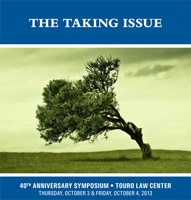
Taking_coverimage_webIf you are anywhere within striking distance of Touro Law School (Central Islip, Long Island), you should make plans to attend a conference that promises two days of fantastic programming on October 3 and 4, 2013.

The Taking Issue – 40th Anniversary Symposium” is dedicated to the memory of the legendary Professor Fred Bosselman, and lead author of The Taking Issue, a 1973 report to the President’s Council on Environmental Quality. While the themes in the book have been overtaken by the Supreme Court’s takings cases, it remains a touchstone work for anyone interested in the subject.

Conference co-Chairs Dean Patricia Salkin and Professor David Callies (a co-author of The Taking Issue) have assembled an excellent faculty and agenda. There will be panels on partial takings, the Nollan/Dolan/Koontz issue, the relevant parcel question, and one on ripeness which we’ll be moderating

Continue Reading Conference Announcement: The Taking Issue – 40th Anniversary Symposium

Here’s a case, set for argument today before the North Carolina Supreme Court, asking whether a series of takings cases can be heard as a class action.

The Court of Appeals, in Beroth Oil Co. v. N.C. Dep’t of Transportation, No. 10 CVS 6926 (N.C. App. May 15, 2012), held that common issues of fact and law would not predominate in takings cases based on NCDOT’s designation of multiple properties for future acquisition for a road corridor (but failure to actually take the properties). The property owners argue that the common legal and factual issues predominate, because even though to prove a taking, each property owner must show how the DOT’s actions impacted their property (and property is, by nature, unique), the singluar focus of each of the cases is the DOT’s action, which is the same in each case.

Here are the briefs in the appeal:


Continue Reading NC Supreme Court Considering Takings Class Action

Just over a month ago, the U.S Court of Appeals for the Fourth Circuit held that a federal takings case could actually proceed in federal court. Well yesterday, the same court issued a similar opinion in a related case, Town of Nags Head v. Toloczko, No. 12-1537 (Aug. 27, 2013).

We won’t go into detail because this post, by J. David Breemer at Pacific Legal Foundation (who also is counsel for the prevailing property owners) sets it all out very well.  But the decision involves abstention (Federal Courts law school flashback), Williamson County, and  beaches and public trust, so it’s well worth a read on its own.

If that doesn’t grab you, then nothing will!

Town of Nags Head v. Toloczko, No. 12-1537 (4th Cir. Aug. 27, 2013)


Continue Reading 4th Cir (Again): Federal Takings Claim Should Be Heard In Federal Court

Word comes that the California Supreme Court has denied review of the Court of Appeal decision in Lockaway Storage v. County of Alameda, No. A30874 (1st Dist. May 9, 2013). The court also rejected a request to “depublish” the First District’s opinion. Congratulations are again in order for colleague Tim Kassouni, who represents the property owners. 

Lockaway is the case in which the First District upheld the trial court’s finding of a Penn Central taking, affirming that the County of Alameda is liable for a temporary regulatory taking, and awarding the property owners nearly three-quarters of a million in attorney fees. This means the only avenue left open is a cert petition to the U.S. Supreme Court. If the County does so, it will probably have as much luck as the private property bar with convincing the Court to take a Penn Central case.

Here’s the (now-denied) Petition

Continue Reading Cal Supremes Deny Review In Property Owner Penn Central Victory

Please join us this upcoming Monday, August 19, 2013 from 1:00 – 2:30 p.m. Pacific Time for a telebriefing, “Regulatory Takings Claims in California – Implications of Recent Decisions and Advice for Practitioners and Government Agencies.”

Brad Kuhn (Nossaman, California Eminent Domain Report) is the program Chair and will serve as moderator, and Timothy Kassourni (Kassouni Law) will give us more details on his recent big win in a case under the Penn Central test. I’ll be talking Koontz and the Ninth Circuit’s latest foray into regulatory takings challenges to rent control.

It promises to be a fast-paced and informative hour, and there’s much here for the non-California practitioner. More information here (from Brad’s blog), and registration information is posted here. Continue Reading Telebriefing: Regulatory Takings Claims In California

Here’s the latest from William W. Wade, Ph.D., a resource economist with the firm Energy and Water Economics (Franklin, Tennessee). Bill is a frequent author and speaker on the regulatory takings issue, and he’s brought much needed clarification to an often confusing issue about how to apply the Penn Central test. He has authored several guest posts for the blog, and we’re glad to have him back with a short piece on regulatory takings.Here, he responds to a recently-published article on the “economic impact” prong of the Penn Central test for a regulatory taking.

++++++++++++++++++++++++++++++++++++

A Note on Economic Impacts andAverage Reciprocity of Advantage

William W.Wade, Ph. D.

Daniel L. Siegel, SupervisingDeputy Attorney General, California Department of Justice, published anarticle, Evaluating Economic Impact in Regulatory Takings Cases in the summer 2013 West NorthwestJournal of Environmental Law & Policy.[1]Perhaps a brief rejoinder by an economist is suitable

Continue Reading Guest Post: A Note on Economic Impacts and Average Reciprocity of Advantage

Whoa, that was fast: in a case argued on August 2, 2013, and decided on August 9, 2013 (that’s one week from orals to opinion, folks), the U.S. Court of Appeals for the Sixth Circuit in Village of Maineville v. Salt Run, LLC, No. 12-4379 (Aug. 9, 2013), held that the property owner/plaintiff forfeited* its argument that a facial takings challenge to municipal impact fees is not subject to Williamson County‘s state procedures requirement because the argument was not raised in the District Court.

You know the drill: Williamson County tells us that a property owner cannot raise a federal takings claim in federal court unless it has first sought and been denied compensation via available state procedures. “And they agree that Salt Run has not invoked this procedure.” Slip op. at 5.

In the normal course, that would be the end of the case. Having failed to

Continue Reading 6th Cir: Takings Plaintiff Forfeited Argument That Facial Challenges Not Subject To Williamson County’s State Procedures Requirement

We’ve ranted extensively about how the takings-only ripeness rules of Williamson County just don’t hold water, but until the Supreme Court revisits and overrules that decision, we’re stuck with it. The federal courts we’re told, just don’t like sitting as “super zoning boards of appeal,” and adjudicating federal constitutional issues are simply beneath Article III judges when something as “local” as land use law is involved. See here at p. 11 for an example.

Well here’s an example of what those federal judges do spend their time on: a decision from the United States Court of Appeals for the First Circuit (complete with a 21-page dissent) about a guy who crapped his pants in a public restroom.

Al Roker, we got our eyes on you.

Turns out it was a restroom in a federal courthouse. Bad for the guy, who gets charged with willfully damaging federal property. We’ll

Continue Reading Federal Courts Can’t Be “Super Zoning Boards,” But They Can Be Hall Monitors

Remember that “audaciouscase filed in the Court of Federal Claims by überlawyer David Boies on behalf of Starr International seeking $35 billion in just compensation for the federal takeover of AIG?

Well, it’s moving along, and apparently is in discovery (every lawyer’s favorite part of the case). Boies sought the deposition testimony of Fed Chair Ben Bernanke about his “personal involvement in the Government’s decision to bail out American International Group, Inc. (‘AIG’) in September 2008, and his knowledge of the specific governmental actions taken to implement the bailout.” Mr. Bernanke didn’t want to testify, claiming that as a “high-level government official,” the plaintiffs had to show that the information sought was not merely relevant under the usual discovery rules, but essential to the case, not not obtainable elsewhere. I’ve got better things to do, so stop bothering me and get this information from someone else, argued

Continue Reading Fed Chair Bernanke Must Testify In AIG Takings Case

Here’s what we’re reading today:

  • Our Owners’ Counsel colleague from New Jersey, Anthony Della Pelle, has posted some thoughts on the New Jersey Supreme Court’s recent decision in Borough of Harvey Cedars v. Karan, No. 070512 (July 8, 2013). That’s the case about valuation issues when there’s a partial taking of littoral property in order to erect protective dunes. Tony’s thoughts are well worth reading. 
  • In that vein, on Wednesday, August 14, 2013, starting at noon ET, we’ll be joining Tony and other experts to speak at the New Jersey Institute for Continuing Legal Education’s teleseminar on “Eminent Domain and Regulatory Takings:


Continue Reading Wednesday Round-Up: Koontz Recording, Jersey Shore Dunes, Plastic Bag Bans