Check out this decision, entered by a Rhode Island Superior Court (a general jurisdiction trial court) denying the State’s motion for summary judgment. The court concluded that a recently-adopted statute shifting the boundary between public and private property on RI’s beaches is a taking.

We won’t be commenting in too much detail because this is one of ours (PLF colleague Dave Breemer represents the plaintiffs). But here’s what you need to know:

  • Until recently, RI law used the high water mark (mean high-tide line) as the boundary between the public beach and private property.
  • In 2023, the RI Assembly adopted a statute that redefined that boundary, and moved it shorewards to where “the land held in trust by the state for the enjoyment of all of its people ends and private property belonging to littoral owners begins.”
  • As a consequence, the public may enter and use “where


Continue Reading Statute Moving The Public/Private Beach Boundary Shoreward Is A Taking

Because the latest takings cert petition is one of ours (our colleagues Dave Breemer and Deb La Fetra are counsel for the petitioner), we won’t be commenting all that much on it.

Except to say that this is the latest in a series of cases where the obligation to provide just compensation for takings butts up against a state government’s claim that it cannot be sued in federal court unless it agrees to be sued. We wrote up the Seventh Circuit’s opinion below here (“Coming And Going: Eleventh Amendment Trumps Fifth Amendment – States Must Consent To Be Sued In Federal Court, Even For Just Compensation“)

Here are the Questions Presented:

1. Whether a state’s constitutional obligation to pay just compensation when taking property waives its sovereign immunity from a claim seeking damages for an unconstitutional taking?

2. Whether a property owner may sue state officials in their

Continue Reading New Cert Petition: Does The Obligation To Provide Just Compensation Waive Sovereign Immunity?

We were all set to write up a scintillating and detailed analysis of the New Jersey Appellate Division’s opinion in Englewood Hospital & Med. Center v. New Jersey, No. A-2767-21 (June 27, 2024), when we thought, ah, why not just ask you to read our New Jersey colleague Joe Grather’s scintillating and detailed analysis.

Short story is right there in the title of this post. As Joe puts it:

In short, the hospitals argued that requiring them to provide charity care and Medicaid care at a loss was an unconstitutional taking of private property without just compensation.  The trial court analyzed the claims as an “as-applied” challenge.  Therefore, it dismissed some of the claims because of a failure to exhaust administrative remedies.  The “slightly different reason” was that the Appellate Court found the claims were a facial challenge to the constitutionality of the statute, and therefore it analyzed the takings claims under the familiar rubric of whether there was a “direct government appropriation or physical invasion of private property,” or an “uncompensated regulatory interference with a property owner’s interest in their property.” Slip op. at 14.

No physical taking, no Penn Central taking. We recommend you read his entire post “As We Approach Our Nation’s Birthday, a New Jersey Appellate Court Rejects Hospitals’ Takings Claims.”

Joe ends it this way: “I bet the hospitals are preparing their petition for certification to the New Jersey Supreme Court now.  Happy 4th of July!”

That means to stay tuned for more.

Englewood Hospital & Med. Center v. New Jersey, No. A-2767-21 (N.J. App. Div. June 27, 2024)

Continue Reading New Jersey: Forcing Hospital To Provide Care At A Loss Isn’t A Taking

Worth reading: a student-authored piece in the latest issue of the Harvard Journal of Law & Public Policy, “Original Understanding of ‘Background Principles’ in Cedar Point Nursery v. Hassid.

From the Introduction:

But in Cedar Point, when considering a regulation that authorized union organizers to enter certain businesses, the Court held that even a temporary physical occupation was a per se taking requiring compensation.

The Court’s shift to a per se rule is significant because it means a landowner can receive “just compensation” without satisfying Penn Central’s high bar required for regulatory takings. For governments, the Cedar Point holding could pose a heavy financial burden if they must compensate landowners for temporary intrusions authorized under existing regulations. Due to this imposing financial burden, some have suggested that Cedar Point threatens existing civil rights regimes, which at first blush resemble the labor rights regulation at

Continue Reading New Article: “Original Understanding of ‘Background Principles’ in Cedar Point Nursery v. Hassid“

Check this out, a local government has filed a cert petition seeking reversal of one of those relatively rare circumstances where the property owner won below on a temporary regulatory takings claim for the County’s denial of a development permit.

We won’t go into details on this, but urge you to read the petition, especially the Questions Presented:

In First English Evangelical Lutheran Church of Glendale v. Los Angeles County, Cal., the Court held that the Fifth Amendment requires “just compensation” for temporary regulatory takings, i.e., “those regulatory takings which are ultimately invalidated by the courts.” 482 U.S. 304, 310 (1987). The appropriate compensation for a temporary regulatory taking is described as “fair value for the use of the property during this period of time.” Id. at 322. All claims for temporary regulatory takings must be analyzed using the ad-hoc, fact-based analysis set out in Penn Central Transp.

Continue Reading New Cert Petition: Gov’t Asks Whether A Penn Central Taking Is Really A Lucas Taking

DSCF3117
If you know, you know.

Sad birthday wishes to our most un-favorite decision ever, Penn Central Transp. Co. v. New York City, 438 U.S. 104 (1978), which turns 45 today.

Time has not treated the opinion well. Practitioners, judges, and legal scholars across the spectrum have called the three-factor Penn Central test for an ad hoc regulatory taking “demanding,” “fuzzy,” a four-part test, “neither defensible as a matter of theory nor mandated as a matter of precedent,” and “problematic” and “mysterious.” Courts mess up the basic meaning of the factors, treat what is supposed to be a fact-centric “ad hoc” test as a legal question decided on the pleadings, and gatekeep most of these cases from juries.

The definitive deconstruction of the case was Professor Gideon Kanner’s “Making Laws and Sausages: A Quarter-Century

Continue Reading Unhappy 45th Birthday, Penn Central

A short one (per curiam is one two-sentence paragraph), with an interesting concurring opinions from the Florida District Court of Appeals (4th District).

In Vazquez v. City of Hallandale Beach, No. 4D2023-0833 (June 12, 2024), the court held that a restrictive covenant that ran with Vazquez’ land (and others in his subdivision, including the city, which had agreed to be bound by the covenant in the settlement of a 1969 lawsuit) is not a compensable real property interest that must be compensated when wiped out by what otherwise would be a regulatory taking.

Vazquez sued the city, asserting that its marina and parking lot violated a buffer zone which had been created by the 1969 settlement. The city was a party to that lawsuit and settlement agreement. The city agreed that yes, the buffer zone indeed had that effect. But we’re the government and even though we agreed to

Continue Reading Fla App: Govt Agreed To Be Bound By Restrictive Covenant, But So What!

DJK was adding a bedroom to an existing residence and needed a wastewater permit from Vermont’s environmental agency. The agency has a “presumptive isolation zone” around potable water supplies and septic systems in which a property owner is presumed to be barred from doing anything sewage related. In this case, the isolation zone for DJK’s property crossed over onto the property of their neighbors, the Crowleys.

The agency granted DJK the permit, which contained a provision that not only no sewage-related construction could take place in the isolation zone, but that “[n]o buildings” could be construction which “might interfere with the operation of a wastewater system or potable water supply[.]” Remember, the isolation zone was located partially on the Crowley property.

The Crowleys were not very appreciative, so appealed (to a Vermont trial court sitting as the Environmental court). They argued that the permit was invalid because it worked a

Continue Reading Vermont: Environmental Court Doesn’t Have Jurisdiction To Determine Property Rights, But We’re Going To Find No Cedar Point Taking Anyway

Screenshot 2024-06-12 at 13-31-02 Property Rights and Regulatory Takings at the Supreme Court ALI CLE

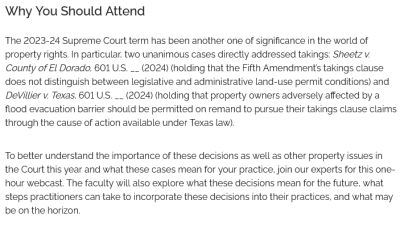
Mark your calendars and register now for the upcoming American Law Institute-CLE webinar “Property Rights and Regulatory Takings at the Supreme Court.” The focus of this program is a summary and analysis (including “what’s next?”) of the two big property and eminent domain cases decided by the U.S. Supreme Court, Sheetz (exactions), and Devillier (just compensation remedy).

We’ve brought together counsel for the property owners in the cases, as well as a legal scholar to provide an academic view of the cases and issues.

The faculty:

Screenshot 2024-06-12 at 13-31-26 Property Rights and Regulatory Takings at the Supreme Court ALI CLEDetails:

  • Date: July 16, 2024
  • Time: 12n – 1pm Eastern Time
  • Format: webinar, with audience questions
  • CLE credits: ALI-CLE programs are approved for CLE credits in most jurisdictions

Come Continue Reading Register Now! ALI-CLE Webinar “Property Rights and Regulatory Takings at the Supreme Court” (With Counsel For Sheetz & Devillier) – July 16, 2024

Here’s the latest in a case we’ve been following.

Check out this cert petition which asks about what actions trigger the statute of limitations on a takings claim. This is an issue that seems to be cropping up more and more these days. For example, see here, here, here, here, and here.

Here are the Questions Presented:

Whether the statute of limitations for a Section 1983 takings claim for the unconstitutional deprivation of private property (specifically real estate) can begin to run before the municipal action that caused the property owner to sacrifice all economically beneficial uses has transpired?

And further, whether the Tenth Circuit Court of Appeals used the proper unit of property to measure if Mr. Bruce was forced to sacrifice all economically beneficial uses of his property?

And finally, whether the 14th Amendment’s due process provisions permit the mayor of a

Continue Reading New Cert Petition: When Does The Statute Of Limitations Start To Run On A Reg Takings Claim?