


We are at the ABA Annual meeting this week, so don’t have a lot of time to keep up a long-distance practice and write up comprehensive blog posts, so we’re going to keep it short.

Here’s the latest takings decision from the Federal Circuit in a case we’ve been following, Estate of Hage v. United States, No. 2011-5001 (Fed. Cir. July 26, 2012). The property owners filed their case in 1991 in the Court of Federal Claims seeking compensation for the federal government’s taking of water rights in Nevada. In 2008, the CFC ruled in favor of the property owners, but the Federal Circuit reversed on Williamson County grounds because the case wasn’t administratively ripe. The federal agency, you see, has not reached a final decision on what the property owners might do with the land, and just might issue a permit (even if other similar permit applications
Continue Reading Federal Circuit: 22-Year Old Takings Case In Which The Landowner Is Already Dead Is Not Ripe

Check out the latest brief filed in the Federal Circuit by our colleague Thor Hearne. Readers know Thor as our semi-regular updater of the latest from the Court of Federal Claims in “rails-to-trails” takings cases, and this appeal is from a CFC case on that subject.

In Ladd v. United States, the CFC dismissed the property owners’ Fifth Amendment takings claim stemming from a rail conversion in Arizona. The court held that the claim was filed past the six-year Tucker Act statute of limitations. A Trails Act case begins when the Surface Transportation Board issues an order (a NITU) that converts an otherwise abandoned railroad easement into a new federal rail-trail easement. The new easement can be used by the public for recreation and the STB retains jurisdiction to “railbank” the corridor, potentially allowing some railroad in the future to build a new railway line across the land. 

Continue Reading Can The Statute Of Limitations In Tucker Act Start Running Before The Govt Provides Actual Notice Of The Taking?

Mark your calendars for next Tuesday, July 17, 2012, at 1:00 p.m. Eastern (noon CT, 11:00 a.m. MT, 10:00 a.m. PT, 7:00 a.m. Hawaii Time) for “Recent Developments in Eminent Domain,” a live audio program sponsored by Lorman Education.

It’s a 1.5 hour teleconference discussing some of the more important recent court decisions about our favorite topics, eminent domain, inverse condemnation, and regulatory takings.

I’m the sole faculty member, so you get to hear me chatter for about an hour and fifteen minutes, and we’ll save 15 minutes or so for questions. I’ll be covering the latest in public use, just compensation, and related topics. Here is the registration and CLE credit information. Hope you can join us. Continue Reading Upcoming Teleconference: Recent Developments In Eminent Domain

Today, on behalf of Owners’ Counsel of America, we filed this amicus brief in Arkansas Game & Fish Comm’n v. United States, No. 11-597 (cert. granted Apr. 2, 2012), the case in which the Federal Circuit held that flooding caused by the Corps of Engineers was only temporary, and did not result in a compensable taking merely because it eventually stopped, and “at most created tort liablity.” The dissenting judge concluded that temporary flooding was no different in kind than more permanent flooding that occurs in other inverse condemnation cases, and regularly results in awards of compensation. We posted the Federal Circuit’s opinion here.

Our brief argues:

This case presents the court with an opportunity to bring a measure of long-absent clarity to one part of takings law. A physical invasion of property – even that which is deemed “temporary” – is a taking and triggers the

Continue Reading Amicus Brief: Any Physical Invasion That “Directly And Substantially” Interferes With Use Is A Taking

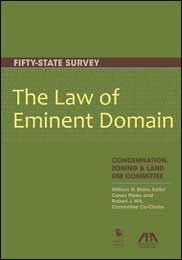
5310412_bigJust published: the ABA Section of Litigation (Condemnation, Zoning, and Land Use Committee) has released The Law of Eminent Domain — A Fifty State Survey (First Chair Press 2012). This book is a “single resource for eminent domain practitioners … a reference for questions about eminent domain and condemnation procedure in every state and the District of Columbia.” It’s a handy desk reference for how common issues in eminent domain are handled in each jurisdiction. Each state chapter covers the same topics:

  • Who is Eligible to Condemn?
  • What can be Condemned?
  • The Condemnation Proceedings
  • Procedure to Challenge Condemnation
  • Inverse Condemnation
  • Just Compensation Issues
  • How are Various Ownership Interests Treated?
  • Abandonment
  • Attorney’s Fees and Costs

We authored the Hawaii chapter. Our Owners’ Counsel of America colleague Bill Blake served as the editor, and many of our friends and colleagues from across the nation authored their state’s chapter. It’s a great reference

Continue Reading New Book: The Law of Eminent Domain (A Fifty State Survey)

Here’s the petitioner’s merits brief in Arkansas Game & Fish Comm’n v. United States, No. 11-597 (cert. granted Apr. 2, 2012), a case from the Federal Circuit that we’ve been watching.

In a 2-1 decision, the Federal Circuit held that flooding caused by the Corps of Engineers was only temporary, and did not result in a compensable taking merely because it was temporary and eventually stopped, and “at most created tort liablity.” The dissenting judge concluded that temporary flooding was no different in kind than more permanent flooding that occurs in other inverse condemnation cases, and regularly results in awards of compensation. We posted the Federal Circuit’s opinion here.

The Question Presented is straightforward:

Whether government actions that impose recurring flood invasions must continue permanently to take property within the meaning of the Takings Clause.

The Supreme Court’s docket report is here.

Petitioner’s Brief on

Continue Reading Petitioner’s Merits Brief In SCOTUS Takings Case: Even Temporary Flooding Requires Compensation

Here’s a key amicus brief in support of the cert petition in CCA Associates v. United States, No. 11-1353 (cert. petition filed May 8, 2012). In that case, the Court of Federal Claims concluded that it was a taking for Congress to prohibit a property owner from prepaying a government-issued mortgage, which required it to continue to allow use of its property as low-income housing. But the Federal Circuit reversed, and then denied en banc review.

The amicus brief of the National Federation of Independent Business Small Business Legal Center, the Cato Institute, and the Center for Constitutional Jurisprudence addresses three Questions Presented:

1. In conforming to the “parcel as a whole rule” propounded in Penn Central Transportation Co. v. New York City, 438 U.S. 104 (1978), does Tahoe-Sierra Preservation Council, Inc., v. Tahoe Regional Planning Agency, 535 U.S. 302 (2002) require conflation

Continue Reading Amicus Brief: A Temporary Regulation Can Work A Penn Central Taking

This just in: in Leone v. County of Maui, No. 29696 (June 22, 2012), the Hawaii Intermediate Court of Appeals held that a plaintiff alleging a regulatory taking is not required to seek an amendment to a Community Plan in order to ripen her claim. A CP amendment is a legislative act, and plaintiffs are not required to try to change the law before they seeks just compensation. 

The trial court determined the plaintiffs’ regulatory takings claims were not ripe because they should have tried to change offending land use regulations which allegedly deprive their property of all economically beneficial uses. The trial court’s decision is available here.

Disclosure: we filed an amicus brief in the case in support of the property owner, arguing that Williamson County Regional Planning Comm’n v. Hamilton Bank of Johnson City, 473 U.S. 172 (1985) does not require a takings plaintiff to

Continue Reading HAWICA: Plaintiff Need Not Change The Law To Ripen Takings Claim Under Williamson County

Here’s the cert petition asking the Supreme Court to review the Federal Circuit’s decision in CCA Associates v. United States, a case we’ve been following since it was being argued in the Court of Federal Claims. The CFC found a taking, but the Federal Circuit reversed, and then denied en banc review.

Here are the Questions Presented:

Pursuant to a regulatory agreement with the Department of Housing and Urban Development (“HUD”), Petitioner agreed to maintain and operate an apartment complex as low-income housing for as long as a government-insured, 40-year mortgage on the property remained outstanding. The transaction documents entered into among Petitioner, HUD, and the lender provided Petitioner with the express right to prepay this government-insured mortgage after 20 years and thereby regain complete control of the property. In response to concerns that owners would prepay their government-insured mortgages and cease providing low-income housing, Congress outlawed

Continue Reading Cert Petition: Federal Circuit In Conflict With Kaiser Aetna

Every now and then, there’s a cert petition which those who generally support the petitioner’s side of the equation secretly hope is not granted, and breathe a sigh of relief when the Court denies review. Today, we’re sure that those on the regulatory side of the table are doing just that, because the Court declined to review the Third Circuit’s decision in R&J Holding Co. v. Redevelopment Authority of Montgomery County, 670 F.3d 420 (3d Cir. Dec. 9, 2011), a case we detailed here.

In that case, the Third Circuit held that a property owner did not litigate its federal takings claims in an earlier state court case, and thus actually allowed a property owner to raise its federal constitutional claims in federal court. In its cert petition, the redevelopment agency claimed that the Third Circuit’s application of Pennsylvania preclusion law created an “unfair procedural trap” for

Continue Reading Cert Denied In Williamson County Case