We’ve been thinking a lot about exactions lately.

First, it was the petition for certiorari in West Linn Corporate Park LLC v City of West Linn, No. 11-299 (petition for cert. filed Sep. 6, 2011), which asks whether the nexus and “rough proportionality” tests for a regulatory taking in Nollan and Dolan are limited to government demands for land. Then, late last week the Florida Supreme Court disagreed with the California and Texas Supreme Courts, and held in St. Johns River Water Management Dist v. Koontz, No. SC09-713 (Nov. 3, 2011) that Nollan and Dolan analysis is limited to real estate exactions, and do not apply to demands for offsite mitigation.

Now we’re back to the West Linn case, since the parties have filed their final briefs, and the Court is scheduled to decide whether to take the case at its upcoming November 10, 2011 conference. So

Continue Reading Final Cert Briefs In West Linn Case: Are Nollan And Dolan Limited To Exactions Of Land?

This just in: on November 10, 2011, the U.S. Supreme Court will consider whether it has found the vehicle to resolve an issue the lower courts have vehemently disagreed upon, whether the Nollan/Dolan nexus/rough proportionality analysis is limited to exactions of real property. See West Linn Corporate Park, LLC v. City of West Linn, No. 11-299.

The Ninth Circuit concluded it does not, disagreeing with the California and Texas Supreme Courts, which have held that Nollan/Dolan is applicable to all exactions, not just demands for land. Yesterday, the Florida Supreme Court weighed in, holding in St. Johns River Water Management Dist v. Koontz, No. SC09-713 (Nov. 3, 2011):

Accordingly, we hold that under the takings clauses of the United States and Florida Constitutions, the Nollan/Dolan rule with regard to “essential nexus” and “rough proportionality” is applicable only where the condition/exaction sought by

Continue Reading Fla S Ct: Nollan/Dolan Applies Only To Exactions Of Land

ZPLR_11_2011Here’s an article I recently published in the Zoning and Planning Law Report, Recent Developments in Regulatory Takings Law: What Counts as “Property?”, 34 Zoning & Planning Law Report (Thomson | West 2011).

If you subscribe to ZPLR, look for it in the mail (and if you don’t, you should).

If you are not a subscriber (and again, you really should subscribe, ZPLR is one of the better ways, along with Gideon Kanner’s Just Compensation, to keep up with the latest goings-on), the good people at West provide this freebie, as authors are allowed to post their own articles on their web site. So here you go.

Thomas, Recent Developments in Regulatory Takings Law: What Counts as “Property?” 34 Zoning & Planning Law …

Continue Reading New Article: What Counts As “Property” In Regulatory Takings Law?

This has been a pretty good week for my St. Louis colleague Thor Hearne.

First, he obtained summary judgment in the Court of Federal Claims for the property owners in a rails-to-trails case, Dana R. Hodges Trust v. United States, No. 09-289 L (Oct. 25, 2011). Next, his Cardinals come back from the edge to take the World Series. And now comes Rogers v. United States, No. 07-273L (Oct. 31, 2011), another good decision for property owners from the CFC. 

Rogers involves the appraisal standard applied in a partial takings case. As Thor writes:

The case involves a partial taking of an easement. Under the National Trails Act the federal government converted an abandoned railroad easement into a public recreational trail. Under Florida law the owner of the fee estate had the right to exclusive and unencumbered use and possession of their land. But, the federal law

Continue Reading Another Good Decision From The Court Of Federal Claims

Here’s a worth-reading decision from the U.S. Court of Federal Claims (the court that has exclusive jurisdiction to hear major regulatory takings claims agains the federal government), litigated and won by colleague Mark (Thor) Hearne, II.

In Dana R. Hodges Trust v. United States, No. 09-289 L (Oct. 25, 2011), the CFC concluded the federal government granted the property owners’ summary judgment on their takings claim. Rail-to-trails cases are detailed (see Preasault v. United States, 100 F.3d 1525 (Fed. Cir. 1996) and pages 2-3 of the CFC’s opinion for the legal framework), but the short story is that the railroad easment the property owners gave the federal government many years ago does not extend to its use as a recreational trail:

The court finds that the railroad’s easements in these Plaintiffs’ properties in the northern segment were for railroad purposes and that, for the same reasons

Continue Reading Rail To Trail Fail: CFC Finds A Taking In A Railway Conversion

IMG_6999

“Yosemite,” according to California Place Names, Erwin Gudde’s seminal work on the origins of (surprise) California place names, means “they are killers.” It was “[e]vidently a name given to the Indians of the valley by those outside it.”

I raise this historical tidbit because I must admit to feeling a little like “those outside it” when I was invited to speak about regulatory takings at the California State Bar’s Environmental Law Conference at Yosemite. I figured as a conference devoted to environmental law, it was a going to be a decidedly skeptical audience, given my advocacy for property owners and property rights. I accepted the invitation nonetheless, heartened that this conference wasn’t going to be an echo chamber and that they were at least open to hearing competing ideas.

It turns out that my prediction about “they are killers” was not accurate — the audience, while not exactly

Continue Reading Yosemite Seminar Summary – Regulatory Takings: Looking Back And Looking Forward

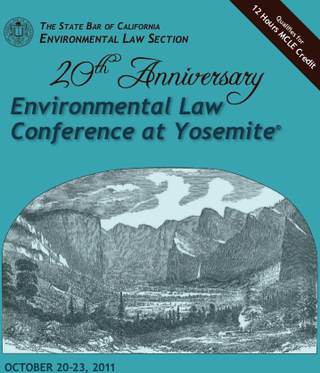
Yosemite_conference Here are the links to the cases and other items discussed today at the session Regulatory Takings – Looking Back and Looking Forward at the Cal State Bar’s Environmental Law Section’s Environmental Law Conference at Yosemite.

These cases are also in your written materials.


Continue Reading Links From “Regulatory Takings: Looking Back And Looking Forward” (Cal. State Bar Yosemite Conference)

The Supreme court has declined review of Colony Cove Properties, LLC v. City of Carson, 640 F.3d 948 (9th Cir. 2011), the case in which the Ninth Circuit affirmed the dismissal of a property owner’s claim that the city’s mobilehome rent control ordinance is a taking. The district court dismissed the facial takings claim because it was filed outside the statute of limitations, and the as-applied takings challenge as unripe.

The cert petition asked the Court to overrule Williamson County Regional Planning Commission v. Hamilton Bank of Johnson City, 473 U.S. 172 (1985), the source of the Court’s oft-maligned ripeness doctrine in regulatory takings. This was another in a recent in a series of petitions (see here and here for two others) asking the Court to revisit Williamson County, and we’ve criticized the case and its ripeness rules as illogical, unfair, and not the result of a

Continue Reading Williamson County Still Lives: Cert Denied In Colony Cove

We break from our Brigham-Kanner Conference programming to bring you this development. The U.S. Court of Appeals for the Federal Circuit has issued its first post-Tohono O’Odham Nation v. United States opinion, Trusted Integration, Inc. v. United States, No. 2010-5142 (Oct. 14, 2011), involving the Court of Federal Claims’ subject matter jurisdiction under 28 U.S.C. § 1500.

Haven’t had a chance to read it yet to see if there’s anything there of interest to takings lawyers, but thought we’d post it up just in case. Continue Reading Federal Circuit: First Post-Tohono O’odham CFC Jurisdiction Opinion

Here is the Petitioner’s Reply Brief in Colony Cove Properties, LLC v. City of Carson, No. 11-189 (cert. petition filed Aug. 11, 2011). We posted the cert petition and the amici and BIO here

The cert petition is asking the Supreme Court to revist and discard the ripeness rules of Williamson County Regional Planning Comm’n v. Hamilton Bank of Johnson City, 473 U.S. 172 (1985). It poses two Questions Presented:

1. Should Williamson County be overruled, to the extent that it arbitrarily denies a federal forum to regulatory takings claimants seeking just compensation for the violation of their rights under the Fifth Amendment, contrary to the intention of Congress in enacting Section 1983?

2. Should this Court recognize an exception to Williamson County’s “state procedures” requirement for takings claimants like Petitioner, whose Fifth Amendment claims will otherwise be relegated to a California state court system that

Continue Reading Final Cert Brief In Williamson County Challenge