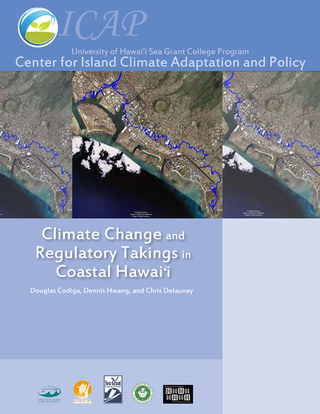
Climatechangemongraphpage

“There is strong consensus in the international scientific community that climate change is occurring and that greenhouse gas emissions from human activities contribute to climate change.”

So begins Climate Change and Regulatory Takings in Coastal Hawaii, a monograph by Douglas Codiga, Dennis Hwang, and Chris Delaunay, published by the University of Hawaii Sea Grant College Program’s Center for Island Climate Adaptation and Policy

We’re not entering into the debate about whether global warming/climate change is or isn’t happening. But the one certain thing is that every regulatory entity from the U.N. on down to your local neighborhood board believes it is real, and seems to want to do something about it. Thus, the question is how property owners may be affected by those actions, and what they can do in response. This report doesn’t really resolve anything, but it does establish the framework and makes some recommenations. From

Continue Reading Climate Change And Regulatory Takings In Coastal Hawaii
Wade-front-page-small Thanks to the folks at the Environmental Law Institute, who have allowed us to reprint an article from a recent Environmental Law Reporter by William W. Wade, Ph.D., a resource economist with the firm Energy and Water Economics (Columbia, Tennessee). Bill is a frequent author and speaker on the Penn Central issue, and he’s brought much needed clarification to an often confusing issue.

In Sources of Regulatory Takings Economic Confusion Subsequent to Penn Central, Mr. Wade writes:

The Federal Circuit Cienega X decision imposes insufficient financial analysis of Penn Central’s two economic prongs to satisfy either economic practice or the Penn Central test. The decision’s imposed change in value measurement evaluates only one prong of the Penn Central test. Change in value satisfies the economic impact prong but does not establish severity of the economic impact vis-à-vis frustration of distinct investment-backed expectations (DIBE). Mere diminution is well-known

Continue Reading Article: Sources of Regulatory Takings Economic Confusion Subsequent to Penn Central

Here are the latest briefs in a case we’ve been following. In Colony Cove Properties, LLC v. City of Carson, 640 F.3d 948 (9th Cir. 2011), the Ninth Circuit affirmed the dismissal of a property owner’s claim that the city’s mobilehome rent control ordinance is a taking. The district court dismissed the facial takings claim because it was filed outside the statute of limitations, and the as-applied takings challenge as unripe.

The cert petition is asking the Suprme Court to revist and discard the ripeness rules of Williamson County Regional Planning Comm’n v. Hamilton Bank of Johnson City, 473 U.S. 172 (1985). It poses two Questions Presented:

1. Should Williamson County be overruled, to the extent that it arbitrarily denies a federal forum to regulatory takings claimants seeking just compensation for the violation of their rights under the Fifth Amendment, contrary to the intention of Congress in

Continue Reading More Cert Briefs In Williamson County Challenge (Colony Cove)

There’s been yet another cert petition asking the Suprme Court to revist and discard the ripeness rules of Williamson County Regional Planning Comm’n v. Hamilton Bank of Johnson City, 473 U.S. 172 (1985).

In Colony Cove Properties, LLC v. City of Carson, 640 F.3d 948 (9th Cir. 2011), the Ninth Circuit affirmed the dismissal of a property owner’s claim that the city’s mobilehome rent control ordinance is a taking. The district court dismissed the facial takings claim because it was filed outside the statute of limitations, and the as-applied takings challenge as unripe.

The property owners’ petition poses these Questions Presented:

This case involves a regulatory takings claim brought under the Fifth Amendment and 42 U.S.C. § 1983. The Ninth Circuit Court of Appeals upheld the district court’s dismissal of the claim, holding that Petitioner is required to seek a remedy for the taking through the California state

Continue Reading The Latest Cert Petition Seeking To Overrule Williamson County

You have to like any sport that the New York Times describes as “like driving full speed through an endless loop of red lights. Luck often expires in a cloudburst of steam and scattered auto parts.” That’s how the Times described “figure 8 car racing.”

But not everyone likes figure 8 racing or related activities, it seems. After a property owner stored several of his race cars on his land and annoyed some residents of Indianola, Iowa, the city adopted an ordinance requiring land on which figure 8 cars (and others) are stored to be enclosed by a fence if two or more cars are present. The property owner sued the city in state court alleging a regulatory taking and the city removed the case to federal court. After a bench trial, the district court held that the ordinance was not a taking.

In Iowa Assuarnce Corp.

Continue Reading Eighth Circuit: No Physical Take For Fence Requirement

cert petition has been filed by the property owners in a case we’ve been following about what the takings ripeness doctrine of Williamson County Regional Planning Comm’n v. Hamilton Bank of Johnson City, 473 U.S. 172 (1985) requires.

In Downing/Salt Pond Partners v. Rhode Island, 643 F.3d 16 (1st Cir. 2011), the U.S. Court of Appeals for the First Circuit concluded that because Rhode Island state law might allow an inverse condemnation remedy andthe burden is on the property owner to show that the remedy is unavailable, and thus the case was not ripe for review in federal court.

The petition poses these Questions Presented:

Does the ripeness doctrine of Williamson County Reg’l Planning Comm’n v. Hamilton Bank of Johnson City, 473 U.S. 172, 194 (1985), require a property owner to litigate in state court to show a taking of property is “without just compensation,” and

Continue Reading New Cert Petition: Why Can’t A Federal Court Determine The State Has Not Provided Compensation?

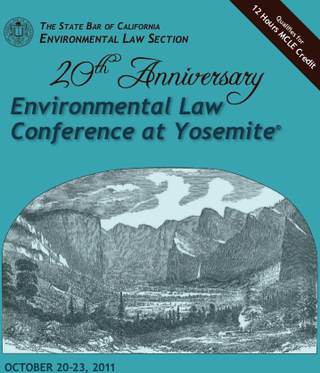
Yosemite_conference

Mark your calendars for October 20 – 23, 2011. That’s when the State Bar of California will present its 20th Anniversary Environmental Law Conference at Yosemite® (yes, it is trademarked), at the Tenaya Lodge in Fish Camp, California.

Along with U.C. Berkeley law professor Joseph Sax and Deputy California Attorney General Daniel L. Siegel, I will be speaking about “Regulatory Takings: Looking Back and Looking Forward.”

We will be discussing the seminal regulatory takings cases from the past 20 years. “The panelists, who have been involved in several of the most significant takings cases since even before the founding of the annual Yosemite Environmental Law Conference twenty years ago, will highlight key decisions, offer their views on the evolution of takings law, and discuss cutting-edge issues raised by more recent court decisions.”  E. Clement Shute will moderate the panel discussion.

The Yosemite program, sponsored by the CSB’s

Continue Reading “Regulatory Takings: Looking Back and Looking Forward” At The Cal Bar’s Yosemite Conference

Here’s what we’re reading this fine summer Monday:

  • Land Use Institute – Although we won’t be able to attend the upcoming annual ALI-ABA program in Boston due to a scheduling conflict, we have attended several times in the recent past, and can highly recommend it. The faculty, as usual, is stellar, and includes colleagues Michael Berger,  Amy Brigham Boulris, Bob Foster, Patricia Salkin, Julie Tappendorf, and Gideon Kanner. 
  • 2011 Takings Conference – Another law conference (November 19, 2011), this one devoted (mostly) to how to defeat regulatory


Continue Reading Monday Round-Up: Vested Rights, Land Use Institute, And More

Another drive-by blog post today because we’re still at the ABA Annual Meeting in Toronto, and between meetings of the State and Local Goverment Law Section and scooping up as many CLE credits as possible, haven’t had much down time to detail the latest cases. But here’s one that’s worth reviewing on your own, if only because it was authored by Judge Jay Bybee, who is becoming quite the takings maven on the Ninth Circuit.

The Takings Clause, as the Supreme Court has reminded, is “self-executing,” which means that the obligation to pay compensation for a taking is not completeley dependent on an enabling statute, nor is it subject to every claim of sovereign immunity.

That thought played central role in Jachetta v. United States, No. 10-35175 (Aug. 1, 2011), in which a three-judge panel of the Ninth Circuit held that a property owner’s inverse condemnation claim

Continue Reading Ninth Circuit: Takings Claims Must Have A Forum … Somewhere